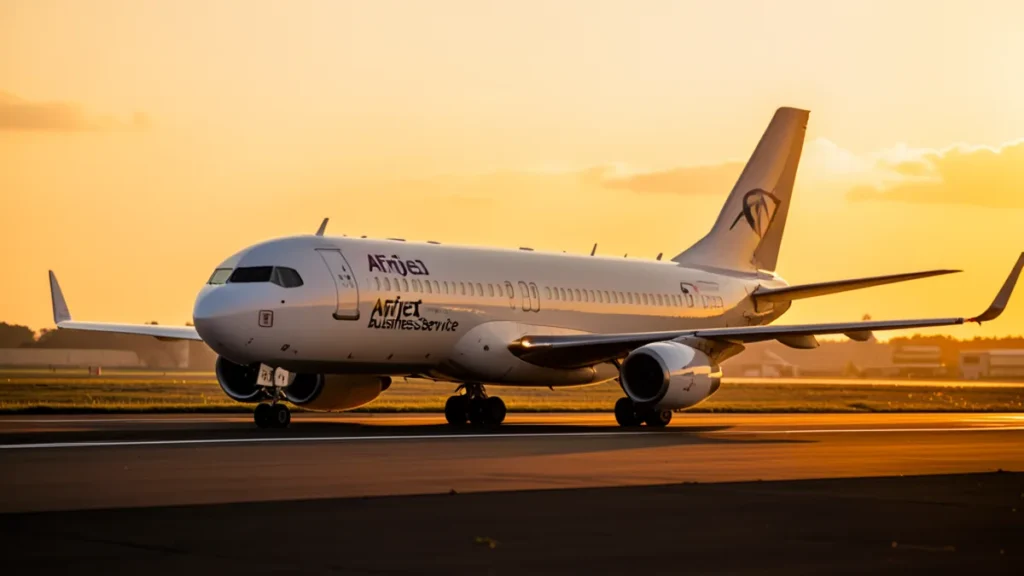
Afrijet Business Service
Afrijet Business Service
About
Afrijet Business Service is Gabon’s principal privately operated scheduled carrier, occupying a distinctive niche in Central African aviation as both a regional connector and a business-oriented airline serving a resource-rich, oil-dependent economy. Operating under IATA code J7 and ICAO designator ABS, and headquartered at Libreville’s Léon-Mba International Airport (LBV), Afrijet has positioned itself as the most commercially consistent Gabonese airline of the post-Air Gabon era — a modest but strategically significant player in a sub-region where reliable scheduled service remains scarce.
Afrijet Business Service was founded in the early 2000s, emerging in the vacuum left by the prolonged decline of the state carrier Air Gabon, which ceased meaningful operations in the mid-2000s. The airline was established with a focus on serving Gabon’s domestic trunk routes and regional West and Central African destinations, catering heavily to the business travel and oil-sector workforce that drives much of the country’s aviation demand. Its founding reflected a broader pattern across francophone Africa in which private operators stepped in as governments retreated from direct airline ownership.
Ownership of Afrijet has historically involved a combination of Gabonese private capital and, at various points, strategic partnerships with French aviation interests — a structure common among Central African carriers with close historical ties to France. The airline has operated with a relatively lean corporate structure, enabling it to remain agile in a market where demand can shift sharply with commodity prices. In recent years, the airline has navigated the turbulence of Gabon’s broader political and economic environment, including the August 2023 military transition, while maintaining scheduled operations.
Bases and Hubs
Libreville – Léon-Mba International Airport (LBV): Afrijet’s primary hub and operational base, handling the majority of the airline’s departures and all long-haul and regional connections.
Port-Gentil Airport (POG): Gabon’s second city and the heart of its offshore oil industry; a critical domestic focus city for Afrijet, reflecting the airline’s strong relationship with the energy sector workforce.
Franceville – Mvengue Airport (MVB): A secondary domestic point in southeastern Gabon, serving government and mining-related traffic in the interior of the country.
Fleet
Afrijet has historically operated a fleet centred on Embraer regional jets, with the Embraer ERJ-145 family forming the backbone of its network for much of its operational history. The ERJ-145, a 50-seat regional jet well suited to the thinner route densities typical of Central African markets, allowed the airline to maintain frequency on domestic sectors without the overcapacity risk of larger narrowbody aircraft. According to publicly disclosed fleet data and industry tracking sources, the airline has also operated or wet-leased Embraer 170 and Embraer 190 family aircraft at various points, reflecting an ambition to scale capacity on higher-demand regional routes. Any fleet renewal or expansion activity in the 2024–2026 period should be verified against current ACMI and registry records, as the airline’s fleet composition has been subject to change in response to market conditions and lessor arrangements.
Destinations
Afrijet’s network is primarily intra-Gabonese and regional West and Central African in character, with no intercontinental scheduled service operated under its own metal. Domestically, the airline links Libreville with Port-Gentil, Franceville, and other secondary Gabonese points, providing a lifeline service in a country where road infrastructure is limited and river transport is slow. Regionally, Afrijet has served destinations including Douala (DLA) in Cameroon, Cotonou (COO) in Benin, Malabo (SSG) in Equatorial Guinea, São Tomé (TMS), and Pointe-Noire (PNR) in the Republic of Congo — routes that reflect both commercial demand and the geographic logic of the Gulf of Guinea basin. The airline’s network is shaped heavily by business and government travel rather than leisure tourism, meaning load factors are sensitive to oil prices and public-sector activity rather than holiday seasons.
Codeshare and Alliance
Afrijet Business Service is not a member of any of the three major global airline alliances — Star Alliance, SkyTeam, or oneworld — and industry observers consider full alliance membership unlikely in the near term given the airline’s scale and network scope. The airline has maintained commercial arrangements with larger carriers operating into Libreville, most notably Air France, which serves LBV as part of its extensive francophone African network. Such interline or codeshare arrangements, where confirmed and active, allow Afrijet passengers to connect onto long-haul services without the airline needing to operate widebody equipment itself. Travellers and travel managers should verify current interline ticketing agreements directly with the airline or through GDS systems, as these arrangements can change.
Notable Incidents
Afrijet Business Service does not appear on the public record as having been involved in a major fatal accident or hull-loss event in recent years. No specific incident meeting the threshold of a significant safety occurrence has been identified in authoritative sources — including the Bureau d’Enquêtes et d’Analyses (BEA), the ICAO Accident/Incident Data Reporting system, or credible aviation safety databases — that this profile can responsibly characterise in detail. Readers requiring a comprehensive safety history should consult the Aviation Safety Network database and Gabon’s Direction Générale de l’Aviation Civile (DGAC) directly.
Financial and Operational Situation
Afrijet operates in one of Central Africa’s more commercially viable aviation markets by virtue of Gabon’s relatively high per-capita income and its large expatriate and oil-sector workforce — a demographic that generates consistent demand for reliable, business-class-oriented air travel. Industry estimates suggest the airline has maintained a degree of operational continuity that has eluded many of its regional peers, though precise profitability figures are not publicly disclosed. The airline is privately held and does not publish audited financial statements in the public domain. Its financial resilience is understood to be closely correlated with the health of Gabon’s hydrocarbon sector; periods of sustained low oil prices have historically compressed corporate travel budgets and, by extension, load factors on key routes. The political transition following the August 2023 coup introduced a degree of regulatory and macroeconomic uncertainty, though the transitional authorities have broadly signalled continuity in civil aviation policy.
Recent Developments
In the 2024–2026 period, Afrijet has continued to consolidate its position as Gabon’s most operationally active domestic and regional carrier following the broader restructuring of the country’s aviation sector. The airline has been attentive to opportunities created by the ongoing difficulties of larger regional competitors, some of whom have reduced frequencies into Libreville. Discussions around fleet modernisation — potentially including newer-generation Embraer E2 family aircraft, which offer improved fuel efficiency on thin regional routes — have been reported in regional aviation trade media, though no firm order has been publicly confirmed as of the time of writing. The airline has also been navigating the implications of Gabon’s transitional government for bilateral air service agreements, particularly those governing routes to neighbouring CEMAC member states. Investors and route planners should monitor announcements from Gabon’s DGAC and the airline’s own communications channels for confirmed developments.