Ceiba Intercontinental
Ceiba Intercontinental
About
Ceiba Intercontinental is Equatorial Guinea’s national carrier and one of the smaller but strategically significant scheduled airlines operating in Central Africa. Holding IATA designator C2 and ICAO code CEL, the airline connects a hydrocarbon-rich, Spanish-speaking nation to regional and intercontinental destinations at a time when West and Central African aviation is drawing renewed attention from investors, development financiers, and global carriers seeking foothold partnerships on the continent.
The airline was founded in the early 2000s and is closely associated with the Equatoguinean state, reflecting a pattern common across Central Africa in which national governments retain a guiding interest in flag carriers as instruments of connectivity and economic sovereignty. Ownership has historically involved a combination of state-linked entities and private capital, though the precise structure of shareholding has not always been disclosed in full to public markets.
Over the years, Ceiba has undergone several operational resets, adjusting its network and fleet in response to the sharp volatility in oil revenues that has defined Equatorial Guinea’s economic cycle since the mid-2010s. Industry observers note that the airline has shown resilience in maintaining scheduled services despite the fiscal pressures that have affected the broader public sector in Malabo.
More recently, the airline has signalled an intent to reposition itself as a more commercially oriented carrier, with reported interest in fleet modernisation and network expansion that would better serve both the business travel market — dominated by the oil and gas sector — and the growing diaspora corridor between Equatorial Guinea and Spain.
Bases and Hubs
Malabo International Airport (SSG) — Located on Bioko Island, SSG serves as Ceiba Intercontinental’s principal hub and primary base of operations; it is the gateway through which the vast majority of the airline’s international traffic flows.
Ciudad de la Paz International Airport (BSG) — The newer international airport serving Oyala (also known as Ciudad de la Paz) on the mainland enclave of Río Muni functions as a secondary focus city, reflecting the Equatoguinean government’s long-term ambition to develop the mainland interior as an administrative and economic centre.
Bata Airport (BSG) — Bata, the largest city on the mainland, represents an important domestic and sub-regional node for the airline, serving commercial and government traffic between the island capital and the continental portion of the country.
Fleet
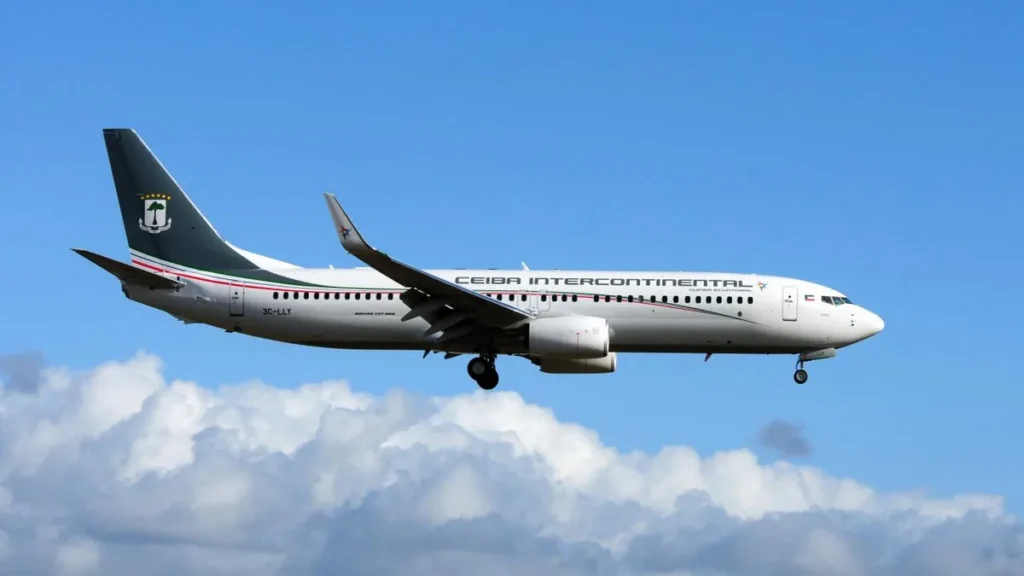
According to publicly disclosed fleet data and industry tracking sources, Ceiba Intercontinental has operated a mixed narrowbody fleet suited to the relatively thin route densities of its network. Aircraft types associated with the airline have included Boeing 737 series variants, which provide the range and capacity needed for both domestic hops and medium-haul regional routes into West and Central Africa. The airline has also been linked to turboprop operations for shorter domestic sectors where jet economics are less favourable.
Fleet renewal has been a recurring topic in the airline’s strategic discussions. Industry estimates suggest the operational fleet remains modest in size, as would be expected for a carrier serving a national market of Equatorial Guinea’s scale. Any confirmed orders or lease agreements for next-generation narrowbody types — such as the Boeing 737 MAX family or Airbus A220 — had not been formally announced in detail as of the time of writing, though such options have been discussed in the context of the airline’s modernisation ambitions.
Destinations
Ceiba Intercontinental’s network is shaped primarily by three gravitational forces: domestic connectivity between Bioko Island and the mainland, regional African routes serving neighbouring Central and West African capitals, and a critical intercontinental corridor to Europe.
Within Africa, the airline has served destinations including Douala and Yaoundé in Cameroon, Libreville in Gabon, and Cotonou in Benin — routes that reflect both geographic proximity and the commercial ties of the Gulf of Guinea oil economy. Connections to Lagos have also featured in the network, given Nigeria’s role as the dominant aviation market in the sub-region.
The Madrid route stands out as the airline’s most commercially significant long-haul service, linking Malabo with Spain in a corridor that carries diplomatic traffic, oil sector professionals, and a substantial Equatoguinean diaspora community. This Spain connection gives Ceiba a rare intercontinental dimension that few carriers of comparable size in Central Africa can claim.
Codeshare and Alliance
Ceiba Intercontinental is not a member of any of the three major global airline alliances — Star Alliance, SkyTeam, or oneworld. The airline operates as an independent carrier, which is typical for flag carriers of smaller African states that have not yet reached the scale or network density required for full alliance participation.
Codeshare arrangements have been limited, though the airline has at various points explored interline and commercial cooperation agreements with carriers serving the same Central African corridors. Formal, publicly announced codeshare partnerships with major European or African network carriers had not been confirmed in detail as of early 2026. Travellers connecting beyond Malabo typically do so through self-connecting itineraries or via partner hubs in Douala or Libreville.
Notable Incidents
Ceiba Intercontinental does not appear on its public safety record to have been involved in any major hull-loss or fatal accident events in recent years. The airline is not listed among carriers subject to the European Union Air Safety List ban as of the most recently published update, which permits it to operate its Madrid service into EU airspace — a meaningful regulatory endorsement for a Central African carrier. Travellers and researchers are advised to consult the latest ICAO Safety Audit (USOAP) disclosures and the EU Air Safety List for the most current assessments.
Financial and Operational Situation
Ceiba Intercontinental’s financial position reflects the broader economic context of Equatorial Guinea, a country whose public finances have been significantly shaped by fluctuating oil revenues. Industry estimates suggest the airline operates on a relatively lean commercial basis, with revenue heavily dependent on the business travel segment tied to the hydrocarbons sector and on the Madrid diaspora corridor.
State support — whether through direct subsidy, preferential airport arrangements, or government-mandated traffic — is widely understood to play a role in sustaining the airline’s operations, as is common among flag carriers in comparable markets across the continent. Detailed audited financial statements have not been made available through public channels, making independent profitability assessment difficult. What can be said qualitatively is that the airline has maintained scheduled operations continuously, which in the context of Central African aviation represents a form of operational credibility in itself.
Recent Developments
In the 24 months leading into 2026, Ceiba Intercontinental has been navigating a post-pandemic recovery environment that has seen African aviation demand rebound unevenly. The airline has focused on consolidating its core routes — particularly the Malabo–Madrid corridor and its Central African regional network — rather than aggressive expansion.
Discussions around fleet renewal have continued to feature in the airline’s public communications, with the question of whether to pursue a leased narrowbody upgrade or a longer-term purchase arrangement remaining unresolved in publicly available reporting. Regulatory engagement with the Equatoguinean civil aviation authority and with ICAO’s African regional office has been part of the airline’s ongoing compliance agenda as the continent moves toward fuller implementation of the Single African Air Transport Market (SAATM) framework.
The broader liberalisation push under SAATM, if it gains further traction, could present both opportunity and competitive pressure for Ceiba — opening new route possibilities while also exposing the Malabo market to larger regional carriers that have historically been kept at bay by bilateral restrictions.
Related Research
- Equatorial Guinea Expert Briefing — full country profile for investors and analysts
- African Airlines — the africa-research.org airline sector pillar
- African Airports — infrastructure data and airport profiles across the continent
- Country Comparison Tool — benchmark Equatorial Guinea against peer markets