Transair
Transair
About
Transair is a Senegalese regional carrier operating under IATA code 2H and ICAO code TSC, occupying a modest but strategically significant position in West African aviation. Based at Dakar’s Léopold Sédar Senghor International Airport (DSS), the airline serves as one of the few locally registered operators connecting Senegal to its immediate regional neighbours at a time when intra-African connectivity remains one of the continent’s most persistent infrastructure challenges.
Transair has operated in various forms since the early 2000s, positioning itself primarily as a regional and charter carrier rather than a full-service network airline. Its ownership structure has historically reflected the mixed public-private arrangements common across Francophone West Africa, though the airline has functioned with a degree of commercial independence. Precise ownership disclosures have been limited in publicly available filings, a characteristic shared by many smaller African carriers operating outside of major stock exchange listings.
In recent years, the airline has navigated a difficult operating environment shaped by post-pandemic demand recovery, fuel price volatility, and the broader restructuring of West African air transport following the collapse of regional carriers such as ASKY’s reduced schedules and Air Sénégal’s own competitive expansion. Transair has responded by focusing on routes and market segments where larger operators have limited appetite, including thinner regional sectors and ad hoc charter operations serving mining, humanitarian, and government clients.
Bases and Hubs
Dakar – Léopold Sédar Senghor International Airport (DSS): Transair’s principal hub and primary maintenance base, giving the airline access to Dakar’s role as one of West Africa’s busiest aviation gateways and a natural connecting point between Europe, the Americas, and sub-Saharan Africa.
Ziguinchor (ZIG): A focus city in Senegal’s Casamance region, historically underserved by surface transport and therefore dependent on air links to the capital — a route Transair has served as part of its domestic network.
Cap Skirring (CSK): A seasonal and leisure-oriented focus point serving Senegal’s southern coastal tourism corridor, where charter and scheduled operations have supported the hotel and resort economy.
Fleet
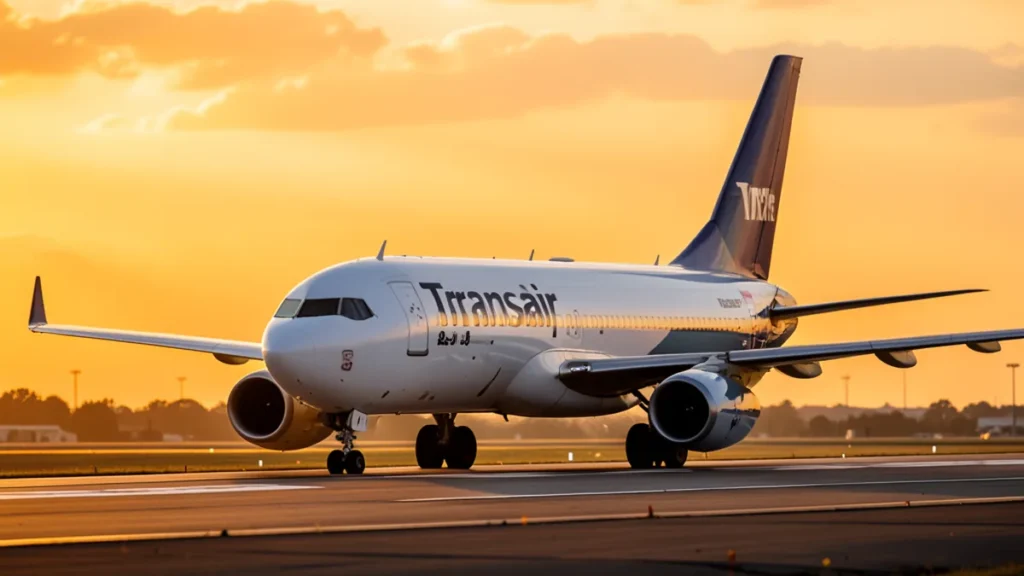
According to publicly disclosed fleet data and industry tracking sources, Transair has operated a mixed fleet centred on turboprop and narrowbody jet equipment suited to short-haul and thin-route operations. The airline has historically operated ATR 72 turboprops, which are well-matched to the shorter runways and lower passenger volumes of secondary Senegalese and West African airports. Boeing 737 Classic series aircraft have also featured in the fleet at various points, used on higher-density domestic and regional sectors. Industry estimates suggest the operational fleet has remained relatively small, consistent with the airline’s regional and charter positioning rather than a full network carrier model. Fleet renewal discussions have been reported in regional aviation trade media, though no firm publicly confirmed orders had been announced as of early 2026.
Destinations
Transair’s network is shaped primarily around domestic Senegalese connectivity and short-haul West African regional flying. Domestically, the Dakar–Ziguinchor corridor is among the most operationally significant, providing an air bridge to a region where road travel remains lengthy and unreliable. Regionally, the airline has served destinations across the Economic Community of West African States (ECOWAS) zone, with routes to cities including Banjul in The Gambia, Bissau in Guinea-Bissau, and Conakry in Guinea reflecting the dense web of cross-border movement in the sub-region. The airline does not operate intercontinental services and has not publicly positioned itself as a long-haul competitor, leaving that space to Air Sénégal and foreign carriers serving DSS. Charter operations extend the effective destination footprint beyond the scheduled network, particularly for leisure, mining sector, and government contract flying.
Codeshare and Alliance
Transair is not a member of any of the three major global airline alliances — Star Alliance, SkyTeam, or oneworld. As a regional and charter-oriented carrier, the airline has not pursued the scale of interline infrastructure that alliance membership typically requires. No major codeshare agreements with international network carriers have been publicly confirmed in recent industry disclosures. The airline’s commercial relationships have tended toward ground handling partnerships and slot-sharing arrangements at shared West African ports rather than formal codeshare structures. This remains an area where future commercial development could materially change the airline’s connectivity proposition, particularly if a larger African carrier sought a feeder arrangement into Dakar.
Notable Incidents
A Boeing 737 operated by Transair was involved in a runway excursion incident at Dakar in 2022, an event that received coverage in regional and international aviation safety reporting and was subject to investigation by Senegalese civil aviation authorities. The aircraft sustained damage and there were reported injuries among those on board; readers seeking precise details are directed to official investigation reports from the Bureau d’Enquêtes et d’Analyses (BEA) and Senegalese ANAC filings. Beyond this documented event, the airline does not appear on major international safety watchlists as of early 2026, and no further major incidents have been confirmed in publicly available safety databases covering the subsequent period.
Financial and Operational Situation
Transair’s financial profile is characteristic of small regional African carriers: operationally lean, exposed to fuel cost swings, and reliant on a combination of scheduled revenue and charter contract income to maintain viability. The airline does not publish audited financial statements in a form accessible to the general public, making precise profitability assessment difficult from the outside. Industry observers have noted that the post-2022 period brought both recovery in passenger demand and continued pressure from rising operational costs, a combination that has tested carriers of Transair’s size across the continent. The airline’s ability to sustain operations through the 2022 incident and its aftermath suggests a degree of operational resilience, though the longer-term capital position and any state support arrangements have not been publicly detailed. Investors and analysts should treat any third-party financial estimates for this carrier with appropriate caution.
Recent Developments
The most consequential recent development in Transair’s public profile was the 2022 runway excursion and the regulatory and reputational management that followed. In the period since, the airline has worked to restore normal operations and, according to regional aviation trade reporting, has continued to serve its core domestic and West African routes. The competitive landscape in Senegal has intensified with Air Sénégal’s continued network expansion and the entry of new regional operators, placing additional commercial pressure on Transair’s scheduled flying. Fleet modernisation and the potential introduction of newer turboprop or regional jet equipment have been discussed in industry circles as a medium-term priority. Senegal’s broader aviation infrastructure investment, including the development of Blaise Diagne International Airport (DSS relocated operations) as the country’s primary gateway, continues to reshape the operating environment for all carriers based in the country. Transair’s positioning within that evolving ecosystem will be a key variable for observers tracking West African regional aviation through 2026 and beyond.
Related Research
- Senegal Expert Briefing — full country profile for aviation, infrastructure and investment context
- African Airlines — the complete pillar covering carriers across the continent
- African Airports — hub profiles, runway data and connectivity analysis
- Country Comparison Tool — benchmark Senegal against peer markets in West Africa