Safarilink Aviation
Safarilink Aviation
About
Safarilink Aviation occupies a distinctive and well-defined niche in East African aviation: a Kenyan regional carrier built almost entirely around the safari and conservation tourism economy, connecting Nairobi’s Wilson Airport with the bush airstrips, coastal strips, and secondary towns that larger jets cannot reach. In a continent where regional connectivity remains one of the most persistent infrastructure gaps, Safarilink has carved out a commercially coherent identity by serving routes that are commercially unattractive to full-service carriers yet operationally critical to Kenya’s tourism sector.
The airline was founded in 2010 and is registered in Kenya under IATA code F2 and ICAO designator SLA. It operates as a privately held entity; the carrier has historically been associated with the Governors’ Aviation group, a Kenyan aviation and hospitality business with deep roots in the safari camp industry. That ownership structure has shaped the airline’s strategic logic from the outset: Safarilink is not merely a transport provider but an integrated component of a broader luxury and eco-tourism supply chain.
In recent years the airline has pursued measured expansion, adding capacity on high-demand leisure corridors and investing in fleet modernisation. While it remains a relatively small operator by global standards, it is regarded within the East African aviation community as a professionally run, safety-conscious carrier that has managed the post-pandemic recovery in Kenyan tourism with notable resilience.
Bases and Hubs
Nairobi-Wilson Airport (WIL) — The airline’s principal hub and operational headquarters; Wilson is Kenya’s primary general aviation and regional turboprop hub, located within Nairobi city limits and serving as the gateway to Kenya’s interior and coast.
Mombasa-Moi International Airport (MBA) — A secondary focus city serving the Indian Ocean coast, enabling connections between the coast and upcountry safari destinations without routing through Nairobi.
Ukunda Airstrip (UKA) / Diani — A key coastal node serving the Diani Beach resort corridor south of Mombasa, reflecting the airline’s strong orientation toward leisure and resort traffic.
Fleet
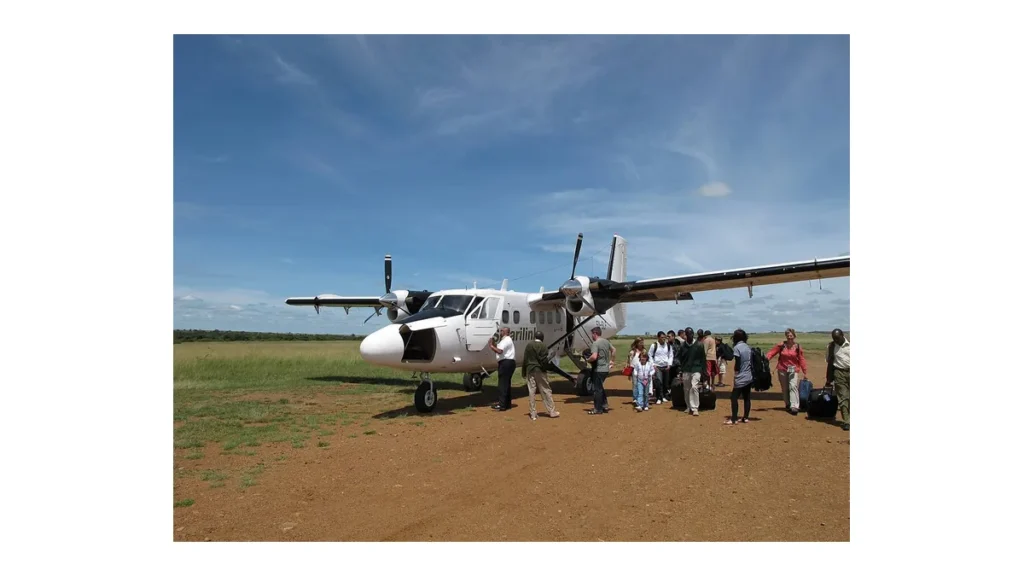
Safarilink operates a fleet composed primarily of Cessna Caravan turboprops — the 208B Grand Caravan variant in particular — which are well suited to short, unpaved, or semi-prepared airstrips characteristic of Kenya’s national parks and conservancies. According to publicly disclosed fleet data, the airline has also operated de Havilland Canada Dash 8 (DHC-8) series turboprops on higher-capacity or longer-range regional sectors, providing a meaningful step up in passenger volume over the single-engine Caravan. The Dash 8 platform allows the carrier to serve routes where demand justifies a larger cabin without requiring jet infrastructure.
Industry observers note that Safarilink has been attentive to fleet condition and maintenance standards, consistent with the expectations of the premium tourism clients it serves. Any fleet renewal or additions in the 2025–2026 period should be verified against the airline’s current published fleet disclosures, as the composition of small regional fleets can shift materially within a single operating season.
Destinations
Safarilink’s network is domestic and intra-regional in character, with no intercontinental operations. The route map is shaped almost entirely by Kenya’s tourism geography. Key destination categories include: Maasai Mara ecosystem airstrips (including Keekorok, Ol Kiombo, and Mara North, among others); Amboseli and Tsavo corridor strips; Laikipia Plateau destinations such as Nanyuki (NYK); the Kenyan coast including Malindi (MYD) and Lamu (LAU); and the Rift Valley lake circuit. The Nairobi Wilson–Maasai Mara corridor is widely regarded as the airline’s highest-frequency and most commercially significant route category. Cross-coastal services linking Mombasa and Lamu are also operationally important. The network does not currently extend to scheduled international routes into Tanzania, Uganda, or other neighbouring states in a significant way, though positioning and charter operations do cross borders in support of broader safari itineraries.
Codeshare and Alliance
Safarilink is not a member of any of the three major global airline alliances — Star Alliance, SkyTeam, or oneworld. As a specialist regional carrier, its commercial relationships are structured differently: the airline has maintained interline and cooperative ticketing arrangements with Kenya Airways (KQ), the national carrier, which allows passengers arriving at Jomo Kenyatta International Airport (NBO) on long-haul services to connect onward to Safarilink departures from Wilson. This functional feeder relationship with Kenya Airways is commercially significant even where no formal codeshare agreement is publicly documented. The airline also works closely with tour operators, safari camp groups, and ground handlers as distribution partners, reflecting the tourism-centric nature of its passenger base.
Notable Incidents
Safarilink does not appear on publicly available records of major fatal accidents or hull losses that can be attributed to the carrier with confidence. The airline operates in an environment — short bush strips, variable weather, high-density wildlife zones — that demands rigorous airmanship and maintenance discipline, and industry observers generally regard its safety culture as consistent with the standards expected of a carrier serving premium international clients. Researchers and journalists seeking a definitive safety record should consult the Kenya Civil Aviation Authority (KCAA), the Aviation Safety Network database, and the ICAO Universal Safety Oversight Audit Programme disclosures for Kenya.
Financial and Operational Situation
As a privately held company, Safarilink does not publish audited financial results in the public domain, and no verified revenue or profit figures are available for citation. Qualitatively, the airline’s financial trajectory appears to have tracked Kenya’s tourism recovery closely: the collapse of international arrivals during 2020–2021 was severely damaging to a carrier whose revenue is almost entirely dependent on leisure and safari travellers, and industry estimates suggest the broader Kenyan bush aviation sector contracted sharply during that period. The recovery from 2022 onward, as international tourism to Kenya rebounded strongly, is understood to have restored load factors on core Mara and coastal routes to commercially viable levels. The airline’s private ownership structure insulates it from some of the political pressures facing state-linked carriers, but also means it must fund any fleet investment or network expansion from retained earnings or private capital rather than government support.
Recent Developments
In the 2024–2026 period, Safarilink has continued to consolidate its position as the leading scheduled bush aviation operator in Kenya. Key developments of note to researchers and investors include: sustained high demand on Nairobi Wilson–Maasai Mara services during the Great Migration season (July–October), which has driven frequency increases on that corridor; ongoing dialogue within the Kenyan aviation sector about airstrip infrastructure investment in national parks, which directly affects the airline’s network viability; and broader regulatory engagement with the KCAA as Kenya works toward compliance with ICAO standards under its ongoing safety oversight programme. The airline has also benefited from Kenya’s growing profile as a meetings, incentives, conferences, and exhibitions (MICE) destination, which generates demand for charter and group movements to bush properties. Any specific fleet orders, route launches, or partnership announcements made after early 2025 should be verified against the airline’s official communications and KCAA records.
Related Research
- Kenya Expert Briefing — full country profile for investors and journalists covering the Kenyan market
- African Airlines — the africa-research.org pillar covering carriers across the continent
- African Airports — infrastructure profiles including Wilson Airport (WIL) and Jomo Kenyatta International (NBO)
- Country Comparison Tool — benchmark Kenya’s aviation and tourism metrics against peer markets