Moçambique Expresso
Moçambique Expresso
About
Moçambique Expresso — operating under the IATA code MXE and ICAO designator MEX — is one of Mozambique’s most active regional carriers, connecting the country’s dispersed provincial centres to its commercial capital and serving as a practical lifeline for business travellers, aid workers, and domestic passengers navigating a nation whose road infrastructure remains challenging across vast distances. In a southern African aviation market dominated by South African carriers and the recovering flag carrier LAM Mozambique Airlines, Moçambique Expresso has carved out a distinct identity as a nimble, domestically focused operator with ambitions that extend into the broader regional market.
The airline was established to address a persistent gap in Mozambique’s domestic connectivity, particularly for routes linking Maputo with the country’s northern and central provinces. Its founding reflected a broader pattern seen across sub-Saharan Africa in the 2000s and 2010s, where private or semi-private regional carriers emerged to supplement — and in some cases compete with — struggling state-owned flag carriers. The precise founding date and original ownership structure have evolved over time, and the airline has undergone corporate reorganisation as investor appetite for Mozambican aviation has shifted alongside the country’s broader economic fortunes, including the impact of the natural gas sector’s development in Cabo Delgado province.
Ownership of Moçambique Expresso has included a mix of private Mozambican capital and, at various points, strategic investors with regional aviation interests. The airline operates under a Mozambican air operator’s certificate and is subject to oversight by the Instituto de Aviação Civil de Moçambique (IACM). In recent years, the carrier has focused on consolidating its operational base and positioning itself to benefit from infrastructure investment linked to the liquefied natural gas projects in the country’s north, which have generated significant demand for charter and scheduled air services.
Bases and Hubs
Maputo International Airport (MPM) — The airline’s principal hub and operational headquarters, located in the capital and serving as the primary gateway for both domestic connections and regional international services.
Beira Airport (BEW) — A key focus city in central Mozambique, Beira functions as an important secondary base given its role as the country’s second-largest city and a regional logistics hub for landlocked neighbours including Zimbabwe and Zambia.
Nampula Airport (APL) — Serving the largest city in northern Mozambique, Nampula is a strategically significant point given its proximity to the Cabo Delgado gas corridor and its function as a gateway for the country’s north.
Pemba Airport (POL) — A focus city of growing commercial importance, Pemba has seen increased aviation demand driven by energy sector activity and humanitarian operations in Cabo Delgado province.
Fleet
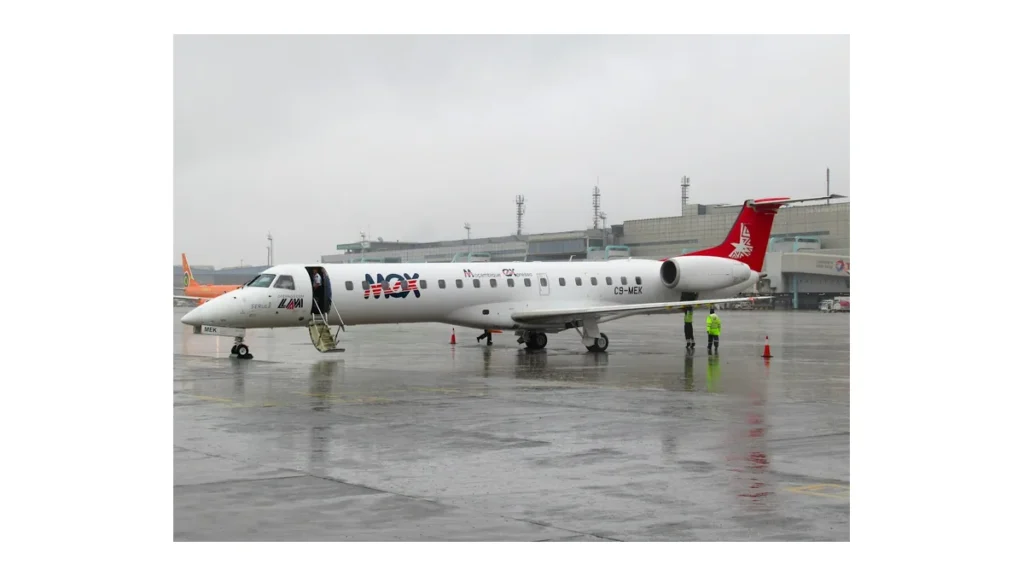
Moçambique Expresso operates a fleet oriented toward the demands of regional and domestic African routes — relatively short sectors, thinner passenger loads, and airports with limited infrastructure. According to publicly disclosed fleet data and industry tracking sources, the carrier has operated turboprop and regional jet equipment suited to these conditions. Aircraft from the ATR family — specifically variants such as the ATR 72 — have been associated with the airline’s operations, reflecting a common choice among African regional carriers for their fuel efficiency and ability to operate from shorter or less-developed runways. Industry estimates suggest the operational fleet has remained modest in size, consistent with the airline’s regional positioning. Any fleet renewal or expansion discussions have been closely tied to the airline’s route development plans and the capital availability of its ownership group, and no major publicly confirmed new-type orders had been announced as of early 2026.
Destinations
The network of Moçambique Expresso is shaped primarily by the geography and economics of Mozambique itself — a long, narrow country stretching more than 2,500 kilometres from north to south, where air travel is often the only practical option for time-sensitive journeys. The core of the network is domestic, linking Maputo with provincial capitals and commercially significant towns. Key route categories include the Maputo–Beira trunk route, the Maputo–Nampula corridor, and services into the northern tier of the country including Pemba and Lichinga. The airline has also operated or explored intra-regional services to neighbouring southern African destinations, reflecting the natural travel flows between Mozambique and markets such as Tanzania, Malawi, and Zimbabwe. Intercontinental flying has not been a feature of the MXE network, which remains firmly anchored in the regional and domestic segment where the carrier holds its competitive advantage.
Codeshare and Alliance
Moçambique Expresso is not a member of any of the three major global airline alliances — Star Alliance, SkyTeam, or oneworld. As a regional carrier operating in a market with limited interline traffic volumes, formal alliance membership has not been a near-term strategic priority. The airline has, at various points, maintained working relationships with larger carriers operating into Maputo, including potential feed arrangements with carriers serving the MPM hub from Johannesburg and other regional gateways. Any formal codeshare agreements in place as of 2026 have not been prominently disclosed in public filings, and researchers should verify current interline arrangements directly with the airline or through IATA data sources.
Notable Incidents
No major safety incidents involving Moçambique Expresso appear on the airline’s publicly available safety record in recent years. Researchers and journalists requiring a comprehensive safety audit should consult the Aviation Safety Network database, the IACM’s published records, and the ASN’s Africa-specific incident logs, which provide the most authoritative and up-to-date documentation of any occurrences involving Mozambican-registered operators.
Financial and Operational Situation
Like the majority of sub-Saharan African regional carriers, Moçambique Expresso operates in a financially demanding environment characterised by high fuel costs relative to yield, thin load factors on some provincial routes, and currency exposure given that aviation costs are predominantly denominated in US dollars while ticket revenues are partly collected in Mozambican meticais. The airline’s financial position has not been subject to detailed public disclosure, and no audited accounts are available through open sources as of early 2026. Industry observers note that the carrier’s viability is closely linked to the health of Mozambique’s broader economy and, increasingly, to the pace of energy sector development in the north, which has generated both charter revenue and scheduled passenger demand. State support, if any, has not been formally confirmed in publicly available documentation, and the airline appears to operate on a predominantly commercial basis.
Recent Developments
In the 24 months leading into 2026, Moçambique Expresso’s most significant operational context has been the continued evolution of demand patterns in northern Mozambique, where the partial resumption of LNG project activity following security improvements in Cabo Delgado has sustained interest in reliable air access to Pemba and surrounding areas. The airline has been attentive to opportunities arising from the partial retrenchment of other operators on domestic Mozambican routes, a dynamic that has periodically opened schedule gaps for a nimble regional carrier to fill. Regulatory engagement with the IACM has continued as part of routine licence maintenance and any route authority applications. Investors and journalists tracking the airline should monitor announcements from the Mozambican civil aviation authority and the airline’s own commercial communications for confirmed route launches, fleet additions, or partnership agreements, as the carrier’s public communications profile has historically been limited.