LAM Mozambique Airlines
LAM Mozambique Airlines
LAM Mozambique Airlines (TM / LAM)
LAM Mozambique Airlines is the flag carrier of the Republic of Mozambique, operating scheduled passenger and cargo services from its principal hub at Maputo International Airport (MPM). As one of southern Africa’s longest-established national carriers, LAM occupies a strategically important position in a region where aviation infrastructure remains a critical enabler of economic development, tourism, and humanitarian access. For investors, journalists, and travellers seeking to understand the dynamics of African aviation, LAM offers a revealing case study in the challenges and opportunities facing state-linked carriers on the continent.
About
LAM Mozambique Airlines traces its origins to the post-independence era of Mozambique, having been established in 1936 under Portuguese colonial administration as Divisão de Exploração dos Transportes Aéreos (DETA), before being reconstituted as LAM following Mozambican independence in 1975. The airline has operated continuously since then, making it one of the older surviving carriers in sub-Saharan Africa. Its IATA designator is TM and its ICAO code is LAM, the latter also serving as the informal shorthand by which the airline is widely known across the region.
Ownership of LAM remains principally in the hands of the Mozambican state, with the government holding a controlling stake through the Instituto de Gestão das Participações do Estado (IGEPE), the country’s state asset management body. This structure is broadly consistent with the ownership model of many African flag carriers, where governments retain strategic control for reasons of national connectivity and prestige. Over the years, LAM has explored various partnership and privatisation discussions, though as of 2026 the airline remains substantially state-owned.
In recent years, LAM has undergone a series of internal restructuring efforts aimed at improving operational efficiency and financial sustainability. The airline has faced the twin pressures common to many African carriers: thin margins on regional routes and the high fixed costs associated with maintaining a mixed fleet. Corporate governance reforms and closer engagement with international aviation bodies have been part of a broader effort to reposition LAM as a more commercially competitive operator within the southern African market.
Bases and Hubs
Maputo International Airport (MPM) — LAM’s principal hub and primary operational base, serving as the gateway to Mozambique’s capital and commercial centre, and the airline’s main maintenance and administrative facility.
Beira Airport (BEW) — A key secondary focus city in central Mozambique, serving the country’s second-largest urban area and an important hub for humanitarian and reconstruction logistics, particularly following cyclone-related disruption in the Sofala province.
Nampula Airport (APL) — LAM’s northern focus city, providing connectivity to Mozambique’s third-largest city and a growing commercial centre in the country’s resource-rich north.
Pemba Airport (POL) — A strategically significant focus city in Cabo Delgado province, serving the offshore gas development zone and supporting energy-sector travel demand.
Fleet
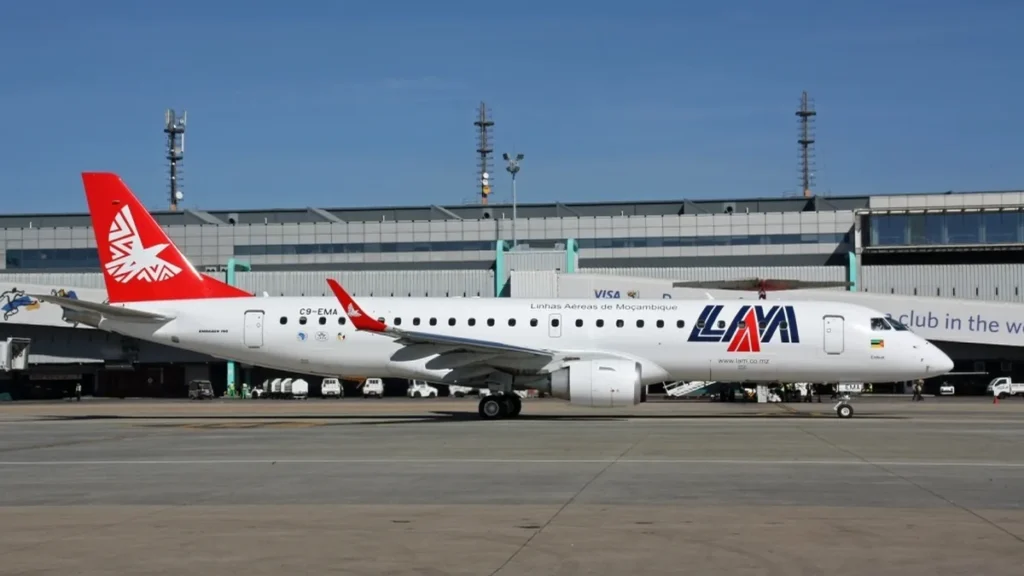
According to publicly disclosed fleet data and industry tracking sources, LAM operates a modest mixed fleet suited to its combination of short-haul domestic routes and medium-haul regional services. The airline has historically operated aircraft from the Boeing 737 family for its regional and international routes, alongside smaller turboprop types for thinner domestic sectors. Industry observers have noted that LAM has in recent years evaluated options within the Embraer E-Jet family — including the E190 and E170 variants — as part of a fleet rationalisation strategy aimed at better matching capacity to demand on lower-density routes. Any fleet renewal programme of significance would require either state financing or external credit support, and the pace of such renewal has historically been constrained by Mozambique’s broader fiscal environment. Travellers and analysts should consult LAM’s official communications for the most current confirmed fleet composition.
Destinations
LAM’s network is shaped primarily around domestic connectivity within Mozambique, reflecting the country’s elongated geography and the limited road and rail infrastructure linking its major population centres. Key domestic routes include Maputo to Beira, Maputo to Nampula, and Maputo to Pemba, with additional services to smaller provincial towns depending on seasonal demand and aircraft availability.
At the regional level, LAM operates intra-African services connecting Maputo to key southern and eastern African cities. Johannesburg (JNB) in South Africa is among the most commercially significant international routes, given the volume of business and diaspora travel between the two countries. Additional regional services have historically included connections to Dar es Salaam (DAR) in Tanzania, Nairobi (NBO) in Kenya, Harare (HRE) in Zimbabwe, and Lusaka (LUN) in Zambia, though the precise schedule of these routes is subject to seasonal and operational variation.
LAM does not currently operate long-haul intercontinental services under its own metal, meaning passengers travelling beyond the African continent typically connect through partner or interline carriers at regional hubs. This positions LAM firmly as a regional and domestic operator rather than a long-haul carrier, a strategic reality that shapes both its commercial model and its infrastructure requirements.
Codeshare and Alliance
LAM Mozambique Airlines is not a member of any of the three major global airline alliances — Star Alliance, SkyTeam, or oneworld — as of 2026. The airline has historically maintained interline and codeshare arrangements with a number of regional and international partners to extend its effective network reach. South African Airways (SAA) has been among the most notable codeshare partners given the geographic and commercial ties between Mozambique and South Africa. LAM has also engaged in interline agreements with carriers operating into the southern African region, enabling through-ticketing for passengers connecting beyond Maputo. Industry analysts have noted that deeper alliance or partnership integration would likely require LAM to meet more stringent operational and financial benchmarks, which remains an ongoing strategic consideration for the airline’s management.
Notable Incidents
LAM’s safety record includes one significant incident that has been extensively documented in aviation safety databases and international reporting: the loss of a Embraer ERJ 190 operating as Flight TM470 in November 2013, which crashed in Namibia with the loss of all on board. Investigators concluded that the aircraft’s flight path was deliberately altered, and the incident was classified accordingly by the relevant accident investigation authorities. This event had a profound impact on the airline’s reputation and operations in the years that followed. Beyond this documented case, LAM does not appear prominently in major accident records for the period since, and the airline has continued to operate under the oversight of Mozambique’s civil aviation authority. Travellers and researchers seeking detailed safety data should consult the Aviation Safety Network and ICAO’s published records.
Financial and Operational Situation
LAM’s financial position reflects the structural challenges facing many state-owned African carriers: a relatively small revenue base, exposure to fuel cost volatility, a thin domestic market, and the ongoing requirement for state support to sustain operations. Industry estimates suggest that the airline has operated with recurring financial pressures, and like many of its regional peers it has at times required government intervention to meet operational obligations. Mozambique’s own fiscal situation — shaped by the aftermath of the hidden debt crisis of the mid-2010s and the economic disruption caused by cyclones Idai and Kenneth in 2019 — has constrained the government’s capacity to recapitalise the airline at scale. Nonetheless, LAM continues to operate as a going concern, and its domestic network remains essential to national connectivity in a country where alternative transport options are limited. Investors and analysts should treat any specific financial projections with caution and seek current disclosures directly from the airline or Mozambican government sources.
Recent Developments
In the 24 months leading into 2026, LAM has been navigating a period of cautious operational consolidation. The airline has focused on stabilising its domestic network following disruptions linked to both the security situation in Cabo Delgado province — where insurgency-related instability has affected travel patterns in the north — and broader post-pandemic demand recovery across the southern African region. Pemba, as the gateway to the offshore gas development zone, has attracted renewed attention as energy-sector activity gradually resumes following earlier security setbacks, and LAM’s connectivity to that market remains commercially significant. On the fleet front, industry observers have noted ongoing discussions around the potential introduction of more fuel-efficient narrowbody or regional jet types, though no major confirmed order had been publicly announced at the time of writing. LAM has also continued to engage with regional aviation bodies on safety oversight and operational standards, reflecting a broader push by African carriers to align with ICAO and IATA benchmarks. Travellers should monitor LAM’s official channels for the latest schedule and route updates, as the network remains subject to adjustment.
Related Research
- Mozambique Expert Briefing — full country profile for Mozambique, covering economy, politics, infrastructure, and investment climate
- African Airlines — the africa-research.org pillar covering carriers across the continent
- African Airports — infrastructure profiles for key hubs and secondary airports across Africa
- Country Comparison Tool — benchmark Mozambique against peer markets across key aviation and economic indicators