Air Algérie
Air Algérie
About
Air Algérie is Algeria’s flag carrier and one of the largest airlines operating across the African continent, connecting North Africa to Europe, the Middle East, and sub-Saharan Africa from its principal hub at Houari Boumediene International Airport in Algiers (ALG). As one of the few African carriers with a genuinely intercontinental network, it occupies a strategically important position in regional aviation — serving a country of more than 45 million people that has historically been underserved relative to its economic weight.
The airline traces its origins to 1947, when it was established under French colonial administration as Compagnie Générale de Transports Aériens. Following Algerian independence in 1962, the carrier was restructured and rebranded as Air Algérie, becoming a wholly state-owned enterprise under the authority of the Algerian government. That ownership structure remains in place today, with the airline operating as a public enterprise under the Ministry of Transport.
Over the decades, Air Algérie has undergone several rounds of internal restructuring aimed at improving operational efficiency and commercial performance, though the pace of reform has at times lagged behind regional peers. In recent years, the Algerian government has signalled renewed interest in modernising the carrier’s commercial model, including fleet renewal and network expansion, as part of broader efforts to position Algeria as a transit and trade hub for the western Mediterranean and Sahel regions.
Bases and Hubs
Algiers – Houari Boumediene International Airport (ALG): The airline’s primary hub and operational centre, handling the vast majority of Air Algérie’s international and domestic traffic and serving as the connecting point for the carrier’s intercontinental routes.
Oran – Ahmed Ben Bella Airport (ORN): A secondary focus city serving Algeria’s second-largest urban agglomeration, with connections to several European destinations particularly relevant to the Algerian diaspora in France and Spain.
Constantine – Mohamed Boudiaf International Airport (CZL): A further domestic and regional focus point in eastern Algeria, supporting routes to France and other European cities with significant Algerian communities.
Fleet
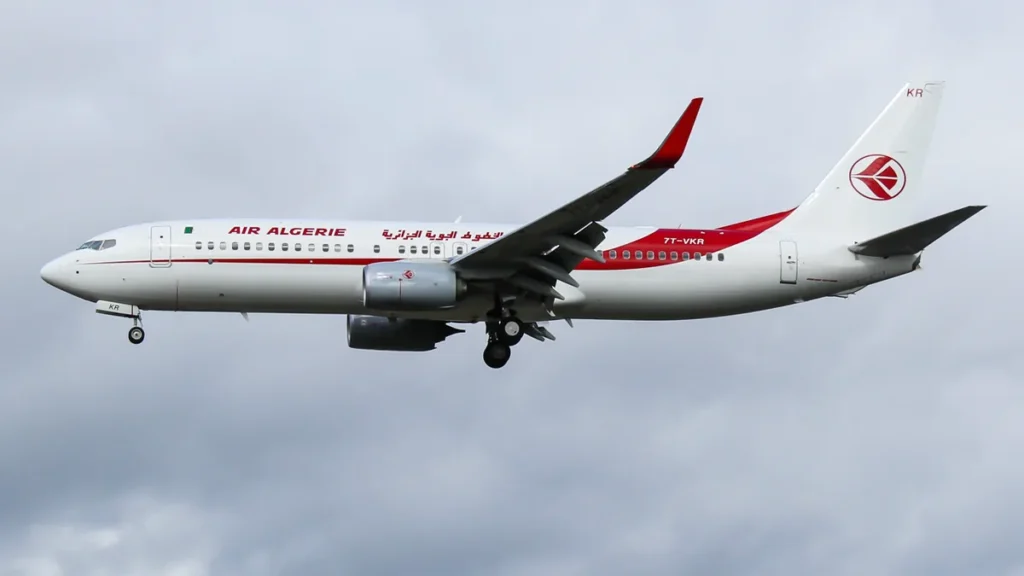
Air Algérie operates a mixed fleet drawing from both Airbus and Boeing families. According to publicly disclosed fleet data, the carrier’s widebody intercontinental operations are served by Boeing 737 and Boeing 767 variants, while narrowbody and medium-haul routes are operated using Airbus A330 aircraft alongside older narrowbody types. The airline has also operated ATR turboprop aircraft on thinner domestic routes connecting regional Algerian cities where jet operations would be commercially unviable.
Industry observers have noted that portions of the fleet carry above-average age profiles by international standards, and fleet renewal has been a recurring topic in the airline’s strategic planning discussions. Reports in the aviation trade press have indicated ongoing evaluation of next-generation narrowbody options, including the Airbus A320neo family and Boeing 737 MAX series, though no firm order had been publicly confirmed at the time of writing. Any confirmed order would represent a significant capital commitment and a meaningful signal of the Algerian government’s long-term intentions for the carrier.
Destinations
Air Algérie’s network is shaped by three distinct demand pillars: diaspora traffic to Western Europe, particularly France; intra-African and regional connectivity across North and West Africa; and intercontinental routes to the Middle East. The European network is the airline’s commercial backbone, with high-frequency services to Paris Charles de Gaulle (CDG), Paris Orly (ORY), Lyon (LYS), Marseille (MRS), and several other French provincial cities reflecting the large Algerian community resident in France. Services also operate to London Heathrow (LHR), Madrid (MAD), Brussels (BRU), and Frankfurt (FRA), among others.
Within Africa, Air Algérie maintains connections to a range of sub-Saharan destinations including Dakar (DKR), Bamako (BKO), Niamey (NIM), Nouakchott (NKC), and Abidjan (ABJ), reflecting Algeria’s historical and diplomatic ties across the Sahel. Middle Eastern services include routes to Dubai (DXB) and Jeddah (JED), the latter serving significant Hajj and Umrah traffic. Domestic operations link Algiers to more than a dozen Algerian cities, fulfilling a public service obligation role across a large and geographically dispersed country.
Codeshare and Alliance
Air Algérie is not a member of any of the three major global airline alliances — Star Alliance, SkyTeam, or oneworld. The carrier has historically maintained a limited codeshare portfolio, with agreements reported with carriers including Air France and a small number of regional partners. The absence of a major alliance affiliation constrains the airline’s ability to offer seamless interline connectivity and frequent flyer reciprocity at a global scale, a gap that industry analysts have identified as a competitive disadvantage as Algerian aviation opens to greater international competition.
Notable Incidents
Air Algérie’s safety record includes one significant and well-documented tragedy: the loss of Flight AH5017 in July 2014, a McDonnell Douglas MD-83 operated on behalf of the carrier by Spanish charter airline Swiftair, which crashed in Mali shortly after departure from Ouagadougou, Burkina Faso, with no survivors among the 116 people on board. The accident, attributed to crew failure to activate the de-icing system in adverse weather conditions, was thoroughly investigated by French and Malian authorities and resulted in findings that informed broader industry guidance on crew training and adverse-weather procedures. In the years since, no major incidents involving Air Algérie-operated aircraft have been recorded on the public safety record.
Financial and Operational Situation
As a state-owned enterprise, Air Algérie does not publish audited financial results in a form accessible to external analysts, making precise assessment of its financial health difficult. Industry estimates suggest the airline has faced persistent structural challenges common to many African flag carriers, including high operating costs relative to yield, exposure to fuel price volatility, and a revenue base heavily concentrated on a single diaspora corridor. The Algerian dinar’s limited convertibility has historically complicated the repatriation of foreign-currency ticket revenues, adding a further layer of financial complexity.
The post-pandemic recovery period brought improved load factors on European routes as diaspora travel rebounded strongly, providing some relief to the carrier’s top line. However, qualitative assessments from regional aviation consultancies indicate that sustained profitability remains contingent on fleet modernisation — which would reduce fuel burn and maintenance costs — and on broader liberalisation of Algeria’s aviation market, which has traditionally been protective of the national carrier’s position.
Recent Developments
In the 24 months leading to mid-2026, Air Algérie has been active on several fronts. The airline resumed and expanded a number of African routes that had been suspended or reduced during the COVID-19 period, reinforcing its Sahel network in line with Algeria’s diplomatic re-engagement across the region. New or reinstated services to select West African capitals were announced, reflecting both commercial ambition and government foreign-policy priorities.
Fleet renewal discussions have intensified, with Algerian government officials publicly acknowledging the need to replace ageing aircraft and improve the carrier’s environmental and operational performance. Separately, Algeria’s broader aviation sector has seen renewed regulatory attention, with the government exploring frameworks that could allow limited private participation in domestic aviation while preserving Air Algérie’s primacy on international routes. Observers will be watching closely whether any concrete fleet order or strategic partnership announcement materialises in the near term, as either would mark a significant inflection point for the carrier’s trajectory.