Air Côte d’Ivoire
Air Côte d’Ivoire
About
Air Côte d’Ivoire occupies a strategically significant position in West African aviation: it is the flag carrier of one of the continent’s most dynamic economies, operating out of Abidjan’s Félix Houphouët-Boigny International Airport (ABJ) — a hub that has long served as a commercial and logistical gateway for the broader West and Central African region. Carrying the IATA designator HF and ICAO code VRE, the airline competes in a market where regional connectivity remains chronically undersupplied relative to demand, giving it both a structural opportunity and a persistent operational challenge.
The airline was established in 2012, rising from the ashes of Air Ivoire, which had ceased operations. It was founded as a public-private partnership, with the Ivorian state holding a significant equity stake alongside Air France, which brought operational expertise, commercial systems, and codeshare reach to the venture from an early stage. That founding structure reflected a broader trend across Francophone Africa in which legacy European carriers took minority positions in reconstituted national airlines, providing credibility to lenders and regulators while governments retained strategic control.
In subsequent years, the ownership composition has evolved. The Ivorian state has remained the dominant shareholder, and the airline has pursued a degree of commercial independence as it has matured. Corporate governance has been a recurring focus, with the carrier working to align itself with IATA Operational Safety Audit (IOSA) standards and to meet the expectations of international partners and financiers. As of 2026, Air Côte d’Ivoire continues to position itself as the premium scheduled carrier of record for Côte d’Ivoire, distinct from the low-cost and charter operators that have entered the West African market in recent years.
Bases and Hubs
Abidjan – Félix Houphouët-Boigny International Airport (ABJ): The airline’s principal hub and operational base, ABJ handles the overwhelming majority of Air Côte d’Ivoire’s departures and serves as its maintenance and crew base; the airport’s ongoing infrastructure investment has supported the airline’s network growth.
Bouaké (BYK): A secondary domestic focus city in the centre of the country, reflecting the airline’s role in binding together Côte d’Ivoire’s interior with its commercial capital.
San Pédro (SPY): A focus point for domestic services in the southwest, important for connecting the country’s cocoa and port economy to the national network.
Fleet
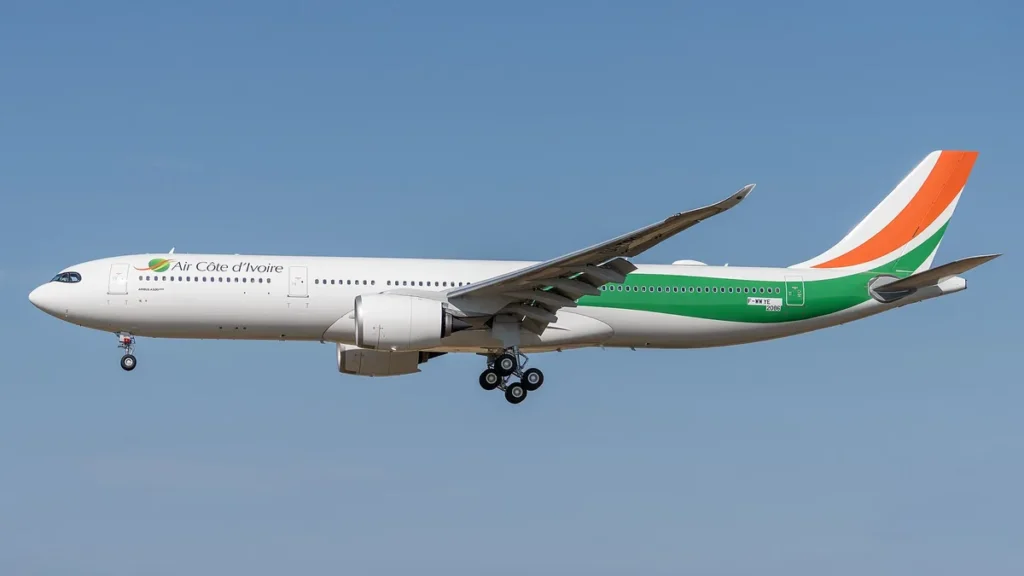
Air Côte d’Ivoire operates a mixed narrowbody fleet centred on Airbus A319 and A320 family aircraft, which form the backbone of its regional and medium-haul operations. According to publicly disclosed fleet data, the carrier has also operated ATR 72 turboprop aircraft on thinner domestic and short-haul regional routes where jet economics are less favourable. The ATR 72 is well-suited to the secondary airfields of West Africa, many of which have runway and infrastructure constraints that preclude jet operations.
Industry observers have noted that fleet renewal and right-sizing remain ongoing priorities for the airline. Securing financing for new aircraft in the West African market carries particular challenges, including currency risk, limited local capital markets depth, and the cost of political-risk insurance. Any fleet expansion or order activity in the 2024–2026 period should be verified against the airline’s official communications and IATA registry updates, as figures in circulation vary between sources.
Destinations
The airline’s network is primarily intra-African in character, with Abidjan serving as the pivot point for routes across West and Central Africa. Key regional connections include services to Dakar (DSS) in Senegal, Accra (ACC) in Ghana, Lagos (LOS) in Nigeria, Bamako (BKO) in Mali, Ouagadougou (OUA) in Burkina Faso, Conakry (CKY) in Guinea, and Douala (DLA) in Cameroon — routes that reflect both historical Francophone economic ties and the practical demand of business travellers moving between regional commercial centres.
On the intercontinental side, Air Côte d’Ivoire has operated or codeshared on services to Paris (CDG), the dominant long-haul market for Ivorian travellers given the country’s Francophone heritage and diaspora links. The airline’s own long-haul capability has been limited by fleet composition, making codeshare arrangements with Air France particularly important for connecting passengers beyond the continent. Domestically, the network links Abidjan to Bouaké, San Pédro, and other interior points, fulfilling the carrier’s public service obligations as the national flag carrier.
Codeshare and Alliance
Air Côte d’Ivoire is not a member of any of the three major global airline alliances — Star Alliance, SkyTeam, or oneworld — as of 2026. Its most significant codeshare relationship has historically been with Air France, a relationship rooted in the airline’s founding ownership structure and one that provides Ivorian travellers with onward connectivity to the Air France/KLM network beyond Africa. The airline has also pursued bilateral interline and codeshare arrangements with other African carriers as part of broader efforts to deepen intra-African connectivity, consistent with the ambitions of the Single African Air Transport Market (SAATM) framework championed by the African Union.
Notable Incidents
Air Côte d’Ivoire does not have major accidents or hull-loss incidents on its public safety record. The airline has maintained IOSA registration, which requires adherence to IATA’s standardised operational safety audit framework. Researchers and journalists seeking a comprehensive safety history should consult the Aviation Safety Network database and the French Bureau d’Enquêtes et d’Analyses (BEA) records, which cover incidents involving aircraft registered in Francophone jurisdictions.
Financial and Operational Situation
Like many African flag carriers, Air Côte d’Ivoire operates in a financially demanding environment characterised by high fuel costs (typically priced in US dollars against local CFA franc revenues), airport charges, and the structural thinness of many regional routes. The airline has benefited from Côte d’Ivoire’s relatively robust economic growth trajectory — the country has been among West Africa’s stronger performers by GDP growth metrics — which supports both business and leisure travel demand out of Abidjan.
State ownership provides a degree of financial backstop, but also brings expectations of route network obligations that may not always align with commercial optimisation. Industry estimates suggest the airline, like most of its regional peers, has faced recurring pressure on operating margins, particularly in the post-pandemic period when fuel prices spiked and demand recovery was uneven across African markets. Investors and analysts tracking the carrier should seek the most current financial disclosures from the Ivorian Ministry of Transport and the airline’s own published accounts, as precise figures are not consistently available in the public domain.
Recent Developments
In the 2024–2026 period, Air Côte d’Ivoire has continued to focus on network consolidation and the deepening of its regional footprint, with Abidjan’s growing status as a West African business hub supporting incremental passenger growth. The airline has engaged with discussions around the SAATM framework, which — if fully implemented — would liberalise air transport across African Union member states and potentially open new route opportunities for carriers based in economically significant hubs like Abidjan.
Fleet modernisation conversations have continued, with the airline evaluating options for more fuel-efficient narrowbody aircraft that would reduce per-seat operating costs on its core regional routes. Partnership development with other African carriers has also been a stated strategic priority, reflecting a recognition that intra-African connectivity gaps represent both a market failure and a commercial opportunity. Travellers and investors should monitor the airline’s official communications and the Ivorian civil aviation authority (ANAC-CI) for the most current regulatory and operational updates.