FlySafair
FlySafair
About
FlySafair has established itself as one of South Africa’s most operationally consistent low-cost carriers, occupying a distinctive position in a regional aviation landscape that has seen the collapse of several larger rivals. Operating under IATA code FA and ICAO code SFR, the airline competes on price and punctuality within the domestic South African market, offering a no-frills proposition that has resonated strongly with cost-conscious leisure and business travellers alike.
The airline traces its origins to Safair, a long-established South African cargo and charter operator with decades of aviation experience. FlySafair launched scheduled passenger services in 2014, leveraging Safair’s existing Air Operator Certificate infrastructure, maintenance capabilities, and technical expertise — an advantage that gave it a more stable operational foundation than many start-up low-cost carriers on the continent. Its parent, Safair Operations (Pty) Ltd, is privately held, which has shielded it from the political pressures and liquidity crises that have periodically destabilised state-linked carriers in the region.
In the years since launch, FlySafair has grown steadily rather than aggressively, a strategy that has helped it maintain operational discipline. The airline has benefited significantly from the 2019 collapse of South African Airways’ domestic dominance and the subsequent withdrawal or reduction of competitors including Mango and Comair’s kulula.com brand, which created meaningful capacity gaps that FlySafair was well-positioned to absorb.
Bases and Hubs
Johannesburg O.R. Tambo International Airport (JNB) — FlySafair’s principal hub and largest base of operations, serving as the origin or connection point for the majority of its scheduled network.
Cape Town International Airport (CPT) — A high-frequency focus city and the airline’s busiest point-to-point destination, reflecting the strength of the Johannesburg–Cape Town corridor, one of the highest-traffic domestic routes on the African continent.
Durban King Shaka International Airport (DUR) — A key secondary base serving KwaZulu-Natal, with meaningful demand from both leisure and business travellers connecting to the country’s eastern seaboard.
Port Elizabeth / Gqeberha (PLZ) and George (GRJ) — Smaller focus cities that round out the airline’s domestic footprint, serving regional demand in the Eastern and Western Cape respectively.
Fleet
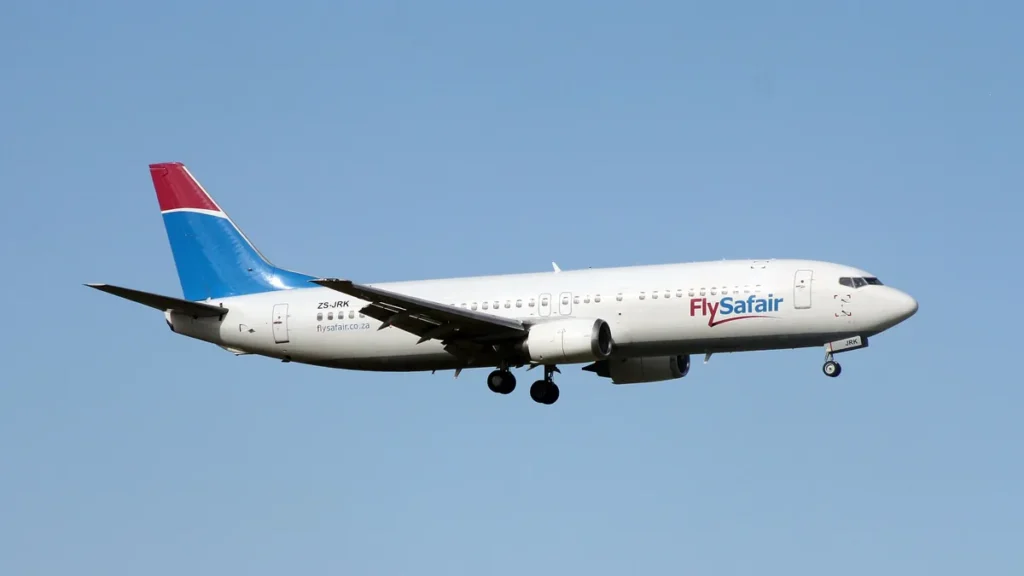
FlySafair operates an all-Boeing 737 fleet, a deliberate choice that simplifies maintenance, crew training, and spare-parts logistics — a meaningful operational and cost advantage for any carrier operating in southern Africa’s infrastructure environment. According to publicly disclosed fleet data, the airline has operated variants within the Boeing 737-800 family as its primary workhorse, a narrowbody well-suited to the short-to-medium stage lengths that characterise its domestic network. Industry observers have noted the airline’s interest in fleet renewal consistent with broader 737 MAX adoption trends across the low-cost sector, though the precise composition and timing of any transition should be verified against the airline’s current official disclosures.
Destinations
FlySafair’s network is intentionally domestic in focus, concentrating on South Africa’s highest-yield point-to-point corridors rather than pursuing an expansive regional or intercontinental footprint. The Johannesburg–Cape Town route sits at the heart of the network and is among the most competitive air routes in Africa by frequency. Other headline routes include Johannesburg–Durban, Johannesburg–Port Elizabeth, Cape Town–Durban, and services to leisure-oriented destinations such as George. As of 2026, the airline has explored selective expansion beyond South Africa’s borders, with routes into neighbouring southern African markets representing a logical next step, though its core identity remains rooted in the domestic market where it has built its reputation.
Codeshare and Alliance
FlySafair is not a member of any of the three major global airline alliances — Star Alliance, SkyTeam, or oneworld. Consistent with its low-cost model, the airline has historically prioritised direct distribution and operational simplicity over interline complexity. However, the airline has engaged in selective commercial partnerships; industry reporting has noted discussions and arrangements with carriers seeking domestic feed within South Africa, and its growing market share makes it an increasingly attractive codeshare candidate for international carriers operating into JNB. Travellers and investors should consult the airline’s current commercial disclosures for the most up-to-date partnership status.
Notable Incidents
FlySafair does not have any major accidents or serious safety incidents on its publicly documented record. The airline has maintained a strong operational safety profile since commencing scheduled services in 2014, a record consistent with its inheritance of Safair’s established maintenance culture and its operation of a standardised, well-supported aircraft type. Journalists researching specific operational events should consult the South African Civil Aviation Authority (SACAA) and the Aviation Safety Network’s verified incident database for primary-source confirmation.
Financial and Operational Situation
FlySafair is privately held and does not publish detailed financial statements in the public domain, making precise revenue or profitability figures difficult to verify independently. Industry estimates suggest the airline has been among the more financially resilient South African carriers in the post-pandemic period, benefiting from reduced domestic competition, disciplined cost management, and strong load factors on its core routes. Its private ownership structure insulates it from the governance and funding pressures that have historically troubled state-linked South African aviation entities. Fuel costs, rand volatility, and airport infrastructure charges at ACSA-managed airports remain the principal cost headwinds for the business, as they do for all South African carriers.
Recent Developments
The period from 2024 to 2026 has been consequential for FlySafair’s competitive positioning. The continued restructuring of South African Airways under its new private-public ownership model has reshaped the domestic competitive landscape, and FlySafair has been an active participant in absorbing displaced demand. The airline has expanded frequencies on its highest-performing routes and, according to industry reporting, has evaluated network extensions into sub-Saharan African markets as part of a measured growth strategy. Regulatory engagement with the SACAA and the South African Department of Transport around bilateral air services agreements has been a relevant backdrop for any cross-border ambitions. Fleet modernisation discussions, consistent with the wider industry’s gradual transition toward more fuel-efficient narrowbody variants, have also featured in trade press coverage of the airline’s medium-term planning.
Related Research
- South Africa Expert Briefing — full country profile for aviation context, regulatory environment, and economic indicators
- African Airlines — the africa-research.org pillar covering carriers across the continent
- African Airports — infrastructure profiles including JNB, CPT, and DUR
- Country Comparison Tool — benchmark South Africa’s aviation market against regional peers