Air Sénégal
Air Sénégal
About
Air Sénégal (IATA: HC / ICAO: SNG) is Senegal’s flag carrier and one of West Africa’s most closely watched aviation stories of the past decade — a state-backed attempt to restore a credible national airline to a country that lost its previous flag carrier, Air Sénégal International, in 2009. Operating out of Léopold Sédar Senghor International Airport (DSS) in Dakar and, increasingly, from the newer Blaise Diagne International Airport (AIBD/DSS), the airline sits at the intersection of Senegal’s broader economic ambitions and the continent’s fast-growing demand for intra-African connectivity.
The current airline was formally established in 2016 and began commercial operations in 2018, backed principally by the Senegalese state. Its creation was framed as a cornerstone of the government’s Plan Sénégal Émergent, the long-term development blueprint that positioned aviation infrastructure — including the construction of Blaise Diagne International Airport — as a strategic priority. The Royal Air Maroc group held a technical partnership role in the airline’s early years, providing operational and management expertise that helped accelerate the carrier’s launch timeline.
Ownership has remained predominantly public, with the Senegalese state holding a controlling stake. The airline has undergone several rounds of internal restructuring as it has sought to balance rapid network expansion against the financial pressures common to young carriers operating in a capital-intensive industry. Leadership changes in the early 2020s signalled a sharper focus on operational discipline and route profitability, themes that continue to define the airline’s corporate direction heading into the second half of the decade.
Bases and Hubs
Dakar – Blaise Diagne International Airport (DSS/AIBD): The airline’s principal hub and primary base of operations, positioned to serve both West African regional traffic and intercontinental routes to Europe and beyond.
Ziguinchor (ZIG): A key domestic focus city in the Casamance region, where Air Sénégal plays an important public-service role connecting a geographically isolated part of the country to the capital.
Saint-Louis (XLS): A secondary domestic point serving Senegal’s historic northern city, reinforcing the airline’s mandate to maintain internal connectivity across the national territory.
Fleet
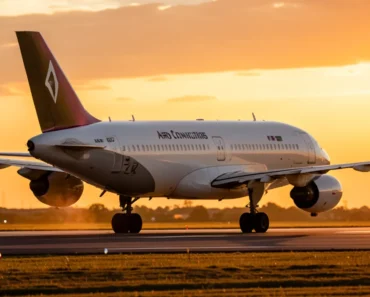
Air Sénégal has built its fleet around a combination of Airbus narrowbody and widebody aircraft. The Airbus A319 and A320 family have formed the backbone of short- and medium-haul operations, offering the range and capacity suited to West African regional routes and thinner intercontinental sectors. For longer intercontinental flying, the airline has operated the Airbus A330, a widebody type that provides the range to serve European destinations from Dakar non-stop. According to publicly disclosed fleet data, the airline has also utilised ATR turboprop aircraft for domestic and sub-regional routes where jet economics are less favourable.
Fleet renewal has been a stated priority for the airline’s management. Industry observers have noted interest in more fuel-efficient narrowbody variants as the carrier seeks to reduce unit costs and align with broader sustainability commitments being made across African aviation. Any confirmed new orders or lease agreements should be verified against the airline’s most recent official communications.
Destinations
Air Sénégal operates a network that spans three broad categories: domestic Senegalese routes, intra-African regional services, and intercontinental routes primarily to Europe. Domestically, the airline connects Dakar with Ziguinchor, Saint-Louis, and Cap Skirring, fulfilling a public-service obligation on routes where surface alternatives are limited or slow. Regionally, the airline has developed a meaningful West and Central African network, with services to cities including Abidjan (ABJ), Bamako (BKO), Banjul (BJL), Conakry (CKY), Freetown (FNA), Lagos (LOS), and Libreville (LBV), among others. These routes position Dakar as a genuine sub-regional hub rather than simply a point-to-point capital city airport.
On the intercontinental side, Paris (CDG) represents the airline’s highest-profile long-haul route, reflecting the deep historical, commercial, and diaspora ties between Senegal and France. Services to other European points have been operated or explored as the network has matured. The airline has also expressed strategic interest in developing transatlantic connectivity, in line with Senegal’s ambitions to attract investment and tourism from North America.
Codeshare and Alliance
Air Sénégal is not a member of any of the three major global airline alliances — Star Alliance, SkyTeam, or oneworld. The airline has, however, pursued bilateral codeshare and interline arrangements with select partners as a means of extending its commercial reach without the capital commitments that formal alliance membership entails. Its early operational relationship with Royal Air Maroc provided a degree of commercial connectivity to that carrier’s network. Travellers and travel buyers should verify current interline and codeshare arrangements directly with the airline or through GDS systems, as partnership agreements in this segment of African aviation evolve frequently.
Notable Incidents
Air Sénégal does not have a major accident or serious incident on its public safety record in the years since it commenced operations in 2018. The airline operates under the oversight of the Agence Nationale de l’Aviation Civile et de la Météorologie (ANACIM) of Senegal. Journalists and researchers requiring a comprehensive safety audit should consult the Aviation Safety Network database and ICAO’s safety oversight assessment records for the most current and authoritative information.
Financial and Operational Situation
As a young, state-owned carrier operating in a competitive and capital-intensive environment, Air Sénégal’s financial position reflects the structural challenges common to African flag carriers in their growth phase. Industry estimates suggest the airline has faced the losses typical of network build-out — high fixed costs, thin yields on some regional routes, and the burden of establishing brand recognition against more established competitors. The Senegalese government has periodically provided financial support to sustain operations and enable fleet and network investment, a pattern consistent with the treatment of flag carriers across the continent.
The airline’s operational performance — on-time rates, load factors, and unit cost trajectory — has not been comprehensively disclosed in public reporting, and investors or analysts seeking detailed financial metrics should engage directly with the airline or the Senegalese Ministry of Transport. The broader context of Senegal’s oil and gas revenues beginning to materialise in the mid-2020s may improve the government’s capacity to support and eventually partially privatise the carrier, though no confirmed transaction has been publicly announced as of the time of writing.
Recent Developments
The past 24 months have seen Air Sénégal navigate a period of consolidation and selective expansion. The airline has continued to refine its West African regional network, adding frequencies on commercially viable routes while rationalising services where load factors have not justified the capacity deployed. Fleet discussions — including the potential addition of more fuel-efficient aircraft types — have featured in the airline’s public communications, reflecting an industry-wide response to sustained fuel price volatility and pressure on operating margins.
Senegal’s emergence as a significant hydrocarbon producer following the development of the Sangomar oil field and the Greater Tortue Ahmeyim LNG project has raised the profile of Dakar as a business aviation destination, creating incremental demand that Air Sénégal is positioned to capture on its intercontinental routes. The airline has also been attentive to the growing diaspora travel market between West Africa and Europe, a segment that rewards competitive pricing and reliable schedules. Regulatory developments at the ECOWAS level, including ongoing discussions around the Yamoussoukro Decision’s implementation, remain a structural factor that could reshape competitive dynamics across the region in the years ahead.