Tarco Aviation
Tarco Aviation
About
Tarco Aviation is one of Sudan’s most prominent privately operated scheduled carriers, holding IATA code 3T and ICAO designator TRQ. Operating out of Khartoum International Airport (KRT), the airline occupies a strategically significant position in a corner of African aviation that remains chronically underserved and, in recent years, acutely disrupted by political and security instability. For journalists tracking the resilience of African carriers, investors assessing frontier-market aviation assets, and travellers navigating connectivity options across the Horn of Africa and the wider Arab world, Tarco represents both the promise and the fragility of commercial aviation in conflict-affected states.
Tarco Aviation was established in the early 2000s and grew steadily through the following decade as Sudan’s liberalised aviation environment allowed private carriers to compete alongside the state-owned Sudan Airways. The airline is privately held, with ownership concentrated among Sudanese business interests, though the precise corporate structure has not been subject to extensive public disclosure. Unlike many African carriers that have sought foreign strategic investors or government bailouts, Tarco has historically operated as an independent commercial entity.
The airline’s corporate trajectory has been shaped as much by external shocks as by internal strategy. The political upheaval that followed the 2019 removal of President Omar al-Bashir, the subsequent transitional governance period, and most critically the outbreak of armed conflict between the Sudanese Armed Forces and the Rapid Support Forces in April 2023 have each imposed severe operational constraints. By 2025 and into 2026, Tarco — like all carriers based in Sudan — was navigating an environment in which its principal hub had been rendered largely non-functional for extended periods, forcing significant operational adaptation.
Bases and Hubs
Khartoum International Airport (KRT) — Tarco’s registered principal hub and historic centre of operations, though the airport’s operational status has been severely compromised by the conflict that began in 2023, with damage to infrastructure limiting or suspending regular commercial services for extended periods.
Port Sudan Airport (PZU) — Port Sudan has emerged as a critical alternative operational base for Sudanese carriers during the Khartoum crisis, with the Red Sea city serving as a de facto administrative and aviation hub for the government and, by extension, for airlines seeking to maintain some level of scheduled service.
Regional focus cities — Prior to the 2023 conflict, Tarco served several domestic Sudanese points as focus cities, connecting regional populations to the capital in a country where road infrastructure makes air travel a practical necessity for many journeys.
Fleet
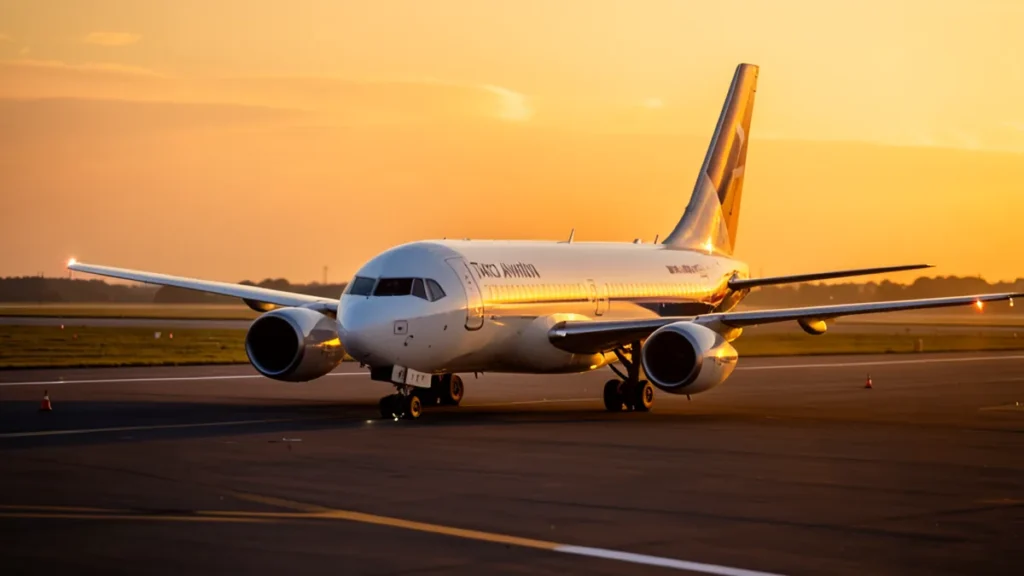
According to publicly disclosed fleet data and industry tracking sources, Tarco Aviation has operated narrowbody jet equipment consistent with the demands of its regional and medium-haul network. The airline has been associated with Boeing 737 family aircraft, which form the backbone of many comparable African carriers given the type’s suitability for the route lengths and runway conditions typical of the region. Industry observers have also noted the presence of Airbus A320 family equipment in the carrier’s operational history, reflecting a pragmatic, mixed-fleet approach not uncommon among mid-sized African independents. Exact current fleet size is difficult to confirm given the operational disruptions of recent years; industry estimates suggest the active fleet has contracted from pre-conflict levels as aircraft have been repositioned, stored, or had their utilisation significantly reduced. No major publicly announced fleet renewal order has been confirmed as of early 2026, though the airline’s longer-term recovery planning would logically necessitate fleet rationalisation once stable hub operations resume.
Destinations
Tarco’s network has historically combined domestic Sudanese routes with a regional international footprint spanning the Arab world and East Africa. Key route categories have included services to Gulf Cooperation Council destinations — most notably Dubai (DXB) and Jeddah (JED), the latter carrying significant traffic linked to the Umrah pilgrimage — alongside connections to Cairo (CAI), which serves as a critical transit and diaspora link. Intra-African connectivity has included routes to Addis Ababa (ADD) and other East African capitals, positioning the airline as a modest but meaningful contributor to the continent’s internal air connectivity. Domestic routes linking Khartoum to cities such as Port Sudan, El Obeid, and Kassala have historically formed an important part of the revenue base, serving populations with limited surface transport alternatives. The conflict beginning in 2023 severely disrupted this network, and as of 2026 the operational route map reflects a much-reduced schedule shaped by the realities of hub inaccessibility and reduced passenger demand.
Codeshare and Alliance
Tarco Aviation is not a member of any of the three major global airline alliances — Star Alliance, SkyTeam, or oneworld. The airline has not publicly disclosed significant codeshare agreements with major international partners, which is consistent with its profile as a regionally focused independent carrier. Some interline arrangements with other carriers serving the Khartoum market have been reported in industry sources, though the current status of such agreements is subject to the broader disruption affecting Sudanese aviation. As the airline works toward operational recovery, formalising codeshare or interline partnerships — particularly with Gulf carriers that dominate connectivity to and from Sudan — would represent a logical commercial priority.
Notable Incidents
A thorough review of publicly available aviation safety databases and incident records does not surface any major hull-loss accidents or fatal incidents directly attributed to Tarco Aviation’s operations that can be reported with confidence and full attribution. The airline does not appear prominently in major accident investigation reports from bodies such as the Aviation Accidents Investigation Board or international equivalents. As with any carrier, this profile will be updated should verified, well-documented safety events enter the public record. Readers requiring the most current safety status information are directed to consult the Aviation Safety Network and ICAO’s safety audit disclosures directly.
Financial and Operational Situation
Tarco Aviation’s financial position is not subject to public reporting obligations, and no audited accounts have been made available through channels accessible to this research. Qualitatively, the airline’s situation must be understood against the backdrop of one of the most severe operational environments facing any carrier in Africa today. The destruction and closure of Khartoum International Airport as a functioning commercial hub from 2023 onward would, by any reasonable industry assessment, have imposed acute financial stress on a carrier whose entire network architecture was built around that gateway. Revenue streams from both domestic and international routes have been severely curtailed. Whether Tarco has accessed emergency financing, restructured liabilities, or received any form of state support during this period has not been publicly confirmed. Industry estimates suggest the airline, like Sudan Airways and other Sudanese operators, is in a period of managed survival rather than growth, with operational continuity dependent on the pace of conflict resolution and infrastructure restoration.
Recent Developments
The dominant story for Tarco Aviation across 2024 and into 2026 has been adaptation to the consequences of Sudan’s ongoing civil conflict. With Khartoum International Airport rendered largely inoperable, the airline has been among the Sudanese carriers attempting to maintain some level of service through Port Sudan and, where bilateral arrangements permit, through regional hubs in neighbouring countries. The broader Sudanese aviation sector has attracted attention from the African Union and ICAO in the context of post-conflict reconstruction planning, and any framework for restoring KRT to full commercial operation would directly affect Tarco’s recovery trajectory. On the regulatory side, the airline’s continued compliance with ICAO standards and its standing with the Sudanese Civil Aviation Authority (SCAA) are factors that investors and partners will scrutinise closely as the situation evolves. No major new route launches, fleet orders, or alliance announcements have been confirmed in the period under review, reflecting the necessarily defensive posture of the airline’s management during an extraordinarily challenging operational phase.
Related Research
- Sudan Expert Briefing — full country analysis including political risk, infrastructure, and economic context
- African Airlines — the africa-research.org carrier directory and sector overview
- African Airports — hub profiles, infrastructure assessments, and connectivity data
- Country Comparison Tool — benchmark Sudan’s aviation market against peer frontier and emerging markets