King Shaka International Airport
King Shaka International Airport
About
King Shaka International Airport (IATA: DUR / ICAO: FALE) serves Durban, South Africa’s third-largest city and the busiest port on the African continent. Opened in May 2010 to coincide with South Africa’s hosting of the FIFA World Cup, the airport replaced the aging Durban International Airport and was designed from the outset to function as a modern, scalable gateway capable of supporting both domestic trunk routes and long-haul international services. Named after the celebrated Zulu king who unified the Zulu nation in the early nineteenth century, the airport carries considerable symbolic weight as well as practical importance — anchoring the aviation infrastructure of KwaZulu-Natal province and positioning Durban as a competitive node within the broader Southern African air-travel network.
The airport is owned by the South African government and operated by Airports Company South Africa (ACSA), the state-owned entity that manages nine principal commercial airports across the country, including OR Tambo International in Johannesburg and Cape Town International. King Shaka was constructed at La Mercy, approximately 35 kilometres north of Durban’s city centre, on a site chosen partly for its proximity to the Dube TradePort Special Economic Zone — an integrated logistics and industrial precinct that gives the airport a cargo and trade dimension beyond simple passenger throughput.
Since opening, the airport has undergone incremental capacity improvements managed by ACSA, with attention paid to airside efficiency, retail concessions, and cargo handling infrastructure. The broader Dube TradePort development continues to evolve around the airport, reinforcing its role as a multimodal logistics hub. Industry observers have noted that King Shaka’s single-terminal, single-runway configuration — while efficient for current traffic volumes — will require deliberate investment to accommodate projected long-term growth in both passenger and freight demand across the region.
Country
South Africa is a constitutional republic located at the southern tip of the African continent, with a population estimated at over 60 million people. It maintains three capital cities — Pretoria (executive), Cape Town (legislative), and Bloemfontein (judicial) — and is widely regarded as one of Africa’s most industrialised and economically complex nations. South Africa is a member of the African Union, the G20, and BRICS, and its transport infrastructure, including its airport network, plays a structurally important role in regional connectivity across Southern Africa. The country’s diverse economy, significant tourism sector, and substantial diaspora communities make it one of the continent’s most active aviation markets.
→ Read the South Africa expert briefing
Airlines based here
King Shaka International is not a primary hub for any single carrier in the way that OR Tambo serves as the operational base for South African Airways, but it functions as an important focus city for several airlines. FlySafair, the low-cost South African carrier that has grown rapidly on domestic routes, operates scheduled services through King Shaka and treats Durban as a key point on its network connecting major South African cities. Airlink, the regional carrier operating under a franchise and codeshare model, uses King Shaka as a significant node for its Southern and East African regional network. Kulula.com, the low-cost brand historically associated with Comair, has also served the airport, though the broader Comair group faced significant restructuring in the early 2020s. International carriers including Qatar Airways, Emirates, and Ethiopian Airlines operate services to or through Durban, treating King Shaka as a visiting-carrier destination rather than a hub. British Airways (operated by Comair on domestic routes prior to restructuring) and international British Airways metal have also featured in the airport’s route history.
Flights and destinations
The airport’s network is anchored by high-frequency domestic services connecting Durban to Johannesburg (OR Tambo and Lanseria), Cape Town, and other South African centres. Regionally, King Shaka supports connections into East Africa, with Nairobi among the destinations served by carriers such as Ethiopian Airlines via Addis Ababa. Intercontinental services link Durban to the Middle East — Doha via Qatar Airways and Dubai via Emirates are among the long-haul routes that have featured in the airport’s schedule — providing onward connectivity to Europe, Asia, and beyond. Representative destinations served from King Shaka include Johannesburg, Cape Town, Port Elizabeth (Gqeberha), Addis Ababa, Nairobi, Dubai, Doha, Maputo, and Harare. The airport’s intercontinental offering remains more limited than that of OR Tambo, reflecting Durban’s position as a secondary international gateway, but the Dube TradePort context and the city’s tourism and trade profile continue to attract airline interest in direct long-haul services.
Facilities and capacity
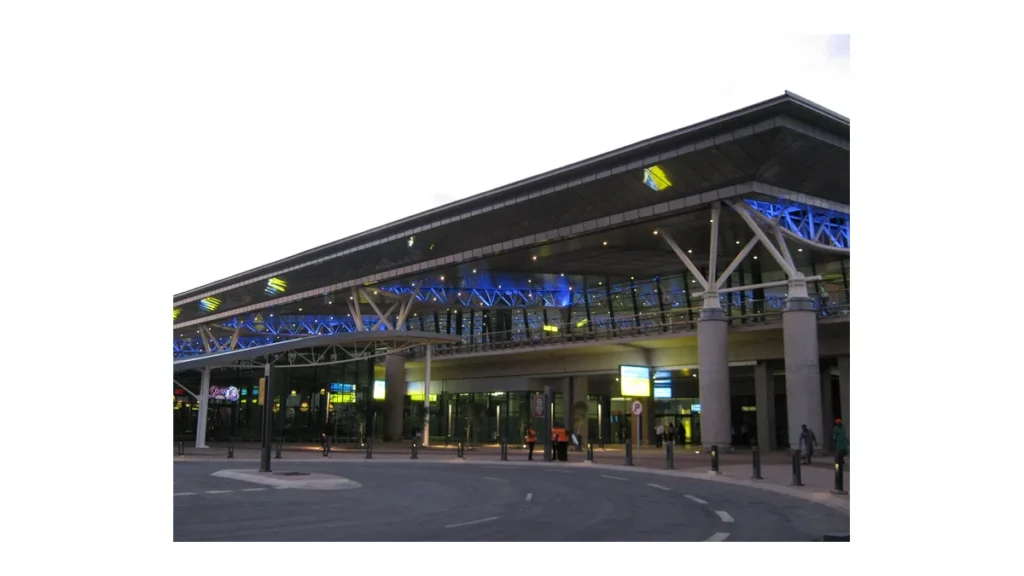
King Shaka International operates a single integrated passenger terminal designed to handle both domestic and international traffic under one roof, with separate processing zones for arriving and departing international passengers. The terminal was purpose-built to contemporary standards and includes retail, food and beverage concessions, airline lounges, and landside hotel connectivity. The airport has a single runway — designated 06/24 — which, according to publicly available aeronautical information, measures approximately 3,900 metres in length, making it capable of handling wide-body, long-haul aircraft including the Boeing 747 and Airbus A380 family. Cargo facilities are integrated with the Dube TradePort logistics zone, which provides temperature-controlled storage, perishables handling, and bonded warehousing relevant to KwaZulu-Natal’s agricultural and manufacturing export sectors. By regional classification, King Shaka is considered a medium-sized international hub — significantly smaller in throughput than OR Tambo or Cape Town International, but larger and better-equipped than most secondary African airports. ACSA has indicated ongoing interest in capacity planning for the airport, though specific expansion timelines and budgets are subject to regulatory and fiscal processes that were still under review as of 2026.
Visa regulations
Travellers arriving at King Shaka International Airport are subject to South Africa’s national visa regime, administered by the Department of Home Affairs. Citizens of the United States, the United Kingdom, and most European Union member states are generally permitted to enter South Africa visa-free for short stays — typically up to 30 days for tourism or business purposes — though the precise conditions and permitted durations can vary and are subject to change. Many regional African passport holders also benefit from bilateral visa-free or visa-on-arrival arrangements with South Africa, though this varies significantly by country. South Africa does not operate a widely available eVisa system comparable to those of some other African nations; most travellers who require a visa must apply in advance through a South African diplomatic mission. Travellers are strongly advised to verify current entry requirements well in advance of travel, as visa policies, health documentation requirements, and bilateral agreements can change without extended notice. For a live, country-by-country visa lookup, see our visa requirements tool.
Recent developments
In the 24 months leading to mid-2026, King Shaka International has seen a number of operationally significant developments. The post-pandemic recovery of South African aviation has continued to shape the airport’s traffic profile, with domestic load factors on the Johannesburg and Cape Town corridors returning to competitive levels as FlySafair and Airlink consolidated their positions following the exit of Comair from the market in 2022. On the international side, industry estimates suggest that Middle Eastern carriers have maintained or modestly grown their Durban services, reflecting sustained demand from the Indian Ocean diaspora and business travel communities. The Dube TradePort has attracted renewed attention as a perishables export corridor, with cold-chain cargo volumes — particularly in cut flowers and seafood — cited by trade bodies as a growth area. ACSA has continued routine terminal maintenance and airside infrastructure works. Regulatory attention from the South African Civil Aviation Authority (SACAA) has remained focused on safety oversight across the national network, with King Shaka subject to the same audit and compliance frameworks as other ACSA-managed airports.
News and reports
Researchers, journalists, and analysts tracking King Shaka International Airport will find the most authoritative operational updates through several primary channels. Airports Company South Africa publishes press releases, annual reports, and traffic summaries through its official corporate communications office — these are the primary source for verified passenger and cargo throughput data. The South African Civil Aviation Authority (SACAA) issues regulatory notices, safety directives, and audit outcomes relevant to all airports operating under South African jurisdiction. At the continental level, IATA’s Africa and Middle East regional office periodically publishes market analysis and airline economics reports covering Southern African aviation markets. The ICAO regional office for Eastern and Southern Africa (ESAF), based in Nairobi, produces safety and infrastructure oversight documentation relevant to airports in the region. Trade publications including ch-aviation, Airline Business, and The Africa Report provide ongoing commercial and operational coverage of King Shaka and the broader South African aviation sector. Travellers seeking real-time flight information should consult the airport’s official operational channels directly.