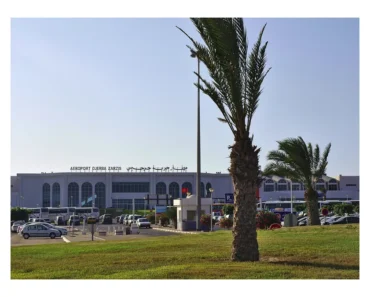
Abeid Amani Karume International Airport
Abeid Amani Karume International Airport
About
Abeid Amani Karume International Airport — designated IATA code ZNZ and ICAO code HTZA — is the primary gateway to Zanzibar, the semi-autonomous archipelago off the coast of mainland Tanzania. Named after Abeid Amani Karume, the first President of Zanzibar and a foundational figure in the island’s post-independence history, the airport occupies a strategically significant position in East African aviation. It serves as the principal entry point for one of the continent’s most visited leisure destinations, channelling a substantial share of Tanzania’s inbound tourism through a single facility that must balance high seasonal demand with the operational constraints typical of island airports. For aviation analysts, ZNZ represents a compelling case study in tourism-driven airport development; for travellers and journalists, it is simply the door to the Spice Islands.
The airport’s origins trace to the colonial era, when a basic aerodrome was established on Unguja, the main island of the Zanzibar archipelago. Commercial scheduled services expanded significantly following Tanzanian independence and the union of Tanganyika and Zanzibar in 1964. The facility was progressively upgraded through the latter decades of the twentieth century to accommodate jet aircraft and growing tourist volumes, with the airport formally assuming its current name in honour of Karume.
Ownership and operational oversight sit with the Zanzibar Airports Authority (ZAA), which operates under the broader regulatory framework of the Tanzania Civil Aviation Authority (TCAA). A notable expansion of the passenger terminal was completed in the 2010s, substantially increasing the airport’s processing capacity and improving the landside experience for arriving and departing passengers. Further infrastructure investment has been discussed and partially advanced in subsequent years, reflecting the Zanzibar government’s stated ambition to position the archipelago as a premium Indian Ocean tourism destination competitive with Mauritius and the Maldives.
Country
Tanzania is a sovereign republic in East Africa, with Dodoma as its official capital and Dar es Salaam as its largest city and commercial hub. Home to a population estimated in the tens of millions — making it one of the most populous nations on the continent — Tanzania borders Kenya, Uganda, Rwanda, Burundi, the Democratic Republic of Congo, Zambia, Malawi, and Mozambique, and holds a long Indian Ocean coastline. It is a member of the East African Community (EAC) and the African Union, and its economy is anchored by agriculture, mining, and an expanding tourism sector that draws visitors to landmarks including Mount Kilimanjaro, the Serengeti, and the Zanzibar archipelago. Zanzibar itself operates with a degree of political and administrative autonomy within the United Republic of Tanzania, a distinction that occasionally affects regulatory and operational matters at ZNZ.
→ Read the Tanzania expert briefing
Airlines based here
ZNZ does not function as a hub for a single dominant home carrier in the conventional sense. Precision Air, the Tanzanian private carrier headquartered in Dar es Salaam, operates scheduled domestic services connecting Zanzibar with mainland Tanzania and has historically been among the most consistent presences at the airport. Coastal Aviation, a Tanzanian operator specialising in light aircraft and charter services across East Africa, also maintains a meaningful operational presence at ZNZ, particularly for onward connections to bush airstrips and safari destinations. Air Tanzania, the state-owned national carrier, operates scheduled services through ZNZ as part of its domestic and regional network. None of these carriers formally designates ZNZ as a primary hub; rather, the airport functions as a high-priority focus city for each of them given Zanzibar’s tourism significance. International carriers — including Kenya Airways, Ethiopian Airlines, Oman Air, Qatar Airways, and Condor, among others — operate as visiting carriers on scheduled or seasonal routes, with no basing operations on the island.
Flights and destinations
The route network at ZNZ reflects the airport’s overwhelmingly tourism-oriented character. Domestically, the most heavily trafficked connection is the short hop to Julius Nyerere International Airport in Dar es Salaam, which functions as a feeder hub for onward long-haul travel. Kilimanjaro International Airport (JRO) is also served on the domestic network, linking Zanzibar with the northern safari circuit. Regionally within Africa, Nairobi’s Jomo Kenyatta International Airport is a key connection, served by Kenya Airways, providing East African regional access. Addis Ababa Bole International Airport is served by Ethiopian Airlines, integrating ZNZ into that carrier’s extensive pan-African and intercontinental network. Beyond the continent, Zanzibar has attracted direct or near-direct services from the Gulf, with Oman Air linking Muscat and Qatar Airways connecting Doha, both routes catering to high-value leisure travellers. European charter and scheduled services — particularly from Germany, the United Kingdom, and Italy — have historically been significant, with carriers such as Condor operating seasonal routes. Industry estimates suggest European leisure traffic constitutes a substantial share of total international arrivals. The overall network, while not large by continental hub standards, is well-calibrated to Zanzibar’s source markets.
Facilities and capacity
ZNZ operates a single passenger terminal building, expanded and modernised in the 2010s to improve both airside and landside functionality. The terminal accommodates international and domestic operations, though the separation of these flows has at times been a subject of operational commentary given the airport’s growth trajectory. The airport is served by a single paved runway, oriented to accommodate the prevailing wind conditions of the island, and capable of handling narrow-body and wide-body jet aircraft. Cargo facilities exist but are limited in scale, consistent with an airport whose primary commercial function is passenger tourism rather than freight logistics. By standard industry classification, ZNZ would be characterised as a medium-sized regional airport — larger and more complex than a purely domestic facility, but operating well below the throughput thresholds of major African hubs such as OR Tambo, Cairo, or Nairobi. According to publicly disclosed traffic data from relevant periods, the airport has processed several hundred thousand international passengers annually, with figures sensitive to global travel conditions and seasonal patterns. Planned or ongoing expansion works — including discussions around terminal capacity and apron infrastructure — have been reported by the Zanzibar Airports Authority, though the precise scope and timelines of committed projects should be verified against current ZAA announcements.
Visa regulations
Travellers arriving at ZNZ are subject to Tanzania’s national visa regime, administered by the Tanzania Immigration Services Department. As of 2026, Tanzania operates an eVisa system that allows travellers from most countries — including the United States, the United Kingdom, and European Union member states — to apply for a tourist visa online prior to travel, a process that has streamlined arrival procedures considerably. Visa on arrival has also been available for many nationalities, though travellers are strongly advised to confirm current arrangements before departure, as processing conditions and eligibility can change. Citizens of several East African Community member states benefit from simplified entry arrangements under regional integration agreements. Some African passport holders may qualify for visa-free access depending on bilateral agreements in force at the time of travel. Visa fees, validity periods, and permitted activities vary by nationality and visa category. Because visa regulations are subject to revision by the Tanzanian government, travellers, journalists, and researchers should consult the live lookup tool for current requirements.
→ Check current visa requirements for Tanzania
Recent developments
The 24 months leading into 2026 have been an active period for ZNZ. The post-pandemic recovery of international leisure travel to East Africa accelerated demand on Zanzibar routes, prompting several carriers to restore or expand frequencies that had been suspended or reduced during the 2020–2022 period. New and reinstated European services have been among the more visible developments, with seasonal charter operations from Italian and German leisure markets returning to prominence. Air Tanzania has continued to develop its network, and its presence at ZNZ has grown in line with the carrier’s broader fleet and route expansion programme. Infrastructure discussions have advanced, with the Zanzibar government and the ZAA publicly signalling intent to upgrade apron capacity and improve terminal processing to reduce congestion during peak arrival windows — typically coinciding with European winter holiday periods. Regulatory coordination between the ZAA and the TCAA has also been a recurring administrative theme, reflecting the semi-autonomous governance structure of Zanzibar. Industry observers have noted the airport’s increasing attractiveness to Gulf carriers seeking to capture Indian Ocean leisure traffic, a trend that may shape the route development agenda in the near term.
News and reports
Researchers and journalists tracking developments at ZNZ should consult several authoritative sources. The Zanzibar Airports Authority publishes operational updates and press releases through its official communications channels, and these represent the primary source for infrastructure and capacity announcements. The Tanzania Civil Aviation Authority (TCAA) issues regulatory notices, safety oversight reports, and traffic statistics that cover ZNZ within the national aviation system. IATA’s Africa regional office produces periodic market intelligence and traffic analysis covering East African airports, and its reports are a standard reference for aviation analysts assessing network trends and passenger volume trajectories. The ICAO Eastern and Southern African Regional Office (ESAF), based in Nairobi, provides regulatory and safety oversight documentation relevant to Tanzanian airports including ZNZ. Regional aviation trade publications — including those covering the broader African aviation market — regularly report on route launches, airline capacity decisions, and airport development across the continent and are a useful complement to official sources.