Sharm el-Sheikh International Airport
Sharm el-Sheikh International Airport
About
Sharm el-Sheikh International Airport (IATA: SSH / ICAO: HESH) occupies a singular position in African and Middle Eastern aviation: it is one of the continent’s most recognisable leisure gateways, channelling millions of sun-seeking travellers each year into the Sinai Peninsula’s resort corridor. Sitting at the southern tip of Sinai, the airport serves not merely as a point of entry to Egypt’s Red Sea Riviera but as a barometer for the health of international tourism across North Africa more broadly. For aviation analysts, it offers a compelling case study in a single-purpose, high-volume tourist airport operating within a complex geopolitical and regulatory environment.
The airport’s origins trace to the early 1970s, when the site was developed to support the growing strategic and commercial importance of the Sharm el-Sheikh area. Civil aviation infrastructure was formalised and expanded significantly through the 1990s and 2000s as Egypt’s government, under the Egyptian Airports Company (EAC) — a state-owned entity operating under the Ministry of Civil Aviation — invested heavily in positioning the Red Sea coast as a premium charter and scheduled tourism destination. The airport underwent notable terminal expansions in the 2000s to accommodate surging European charter demand, particularly from the United Kingdom, Germany, Russia, and Scandinavia.
A further phase of infrastructure investment followed in the 2010s, with airside upgrades intended to improve passenger throughput and ground-handling efficiency. The airport has historically operated across two principal terminal buildings, handling both charter and scheduled international traffic. Ownership and operational oversight remain with the Egyptian Airports Company, which reports to the Egyptian Civil Aviation Authority (ECAA), the national regulatory body responsible for all civil aviation matters in Egypt.
Country
Egypt is a transcontinental nation straddling northeastern Africa and the Sinai Peninsula of western Asia, with Cairo as its capital and a population that, according to official estimates, has surpassed 100 million, making it one of the most populous countries on the African continent. Egypt’s geographic position — bridging Africa, the Arab world, and the Mediterranean basin — gives it outsized strategic relevance in regional trade, diplomacy, and aviation connectivity. As a member of the African Union and the Arab League, and as the host nation of the Suez Canal, Egypt functions as a critical transit and tourism node for the wider region.
→ Read the Egypt expert briefing
Airlines Based Here
Sharm el-Sheikh International Airport does not function as a primary hub for any single carrier in the conventional sense; rather, it operates as a focus city and high-frequency destination for a wide range of scheduled and charter operators. EgyptAir, Egypt’s national flag carrier and a Star Alliance member, maintains scheduled services into SSH from Cairo International Airport, effectively acting as the domestic and connecting spine for the airport. EgyptAir’s presence, while not a hub operation, is the most consistent scheduled airline presence at the airport year-round.
Beyond EgyptAir, the airport’s traffic profile is dominated by visiting carriers operating charter and leisure-scheduled services. European low-cost and leisure carriers including Ryanair, Wizz Air, TUI fly (operating under various national brands across Germany, Belgium, and the Netherlands), Jet2.com, and easyJet have at various points operated seasonal or year-round services into SSH. Russian carriers including Pobeda and Aeroflot historically represented a major traffic segment, though services from Russia have been subject to significant disruption and regulatory review following the 2015 Metrojet incident and subsequent geopolitical developments. The gradual resumption of Russian charter traffic in the early 2020s has been closely monitored by the ECAA and international aviation bodies.
Flights and Destinations
The airport’s route network is overwhelmingly oriented toward European leisure markets, with a secondary layer of regional Arab world connectivity. Representative destinations served from SSH include London Gatwick and London Stansted in the United Kingdom; Frankfurt, Berlin, and Munich in Germany; Warsaw and Kraków in Poland; Budapest in Hungary; Milan and Rome in Italy; Moscow and St Petersburg in Russia (subject to current operational status); and Dubai in the United Arab Emirates. Domestically, Cairo remains the primary and most frequent connection, enabling onward transfer across EgyptAir’s intercontinental network. Regional services to other Arab capitals have been operated periodically, reflecting demand from Gulf-based travellers visiting the Red Sea resorts. The network is highly seasonal, with capacity peaking in the European winter sun-seeking period and again in spring and autumn shoulder seasons.
Facilities and Capacity
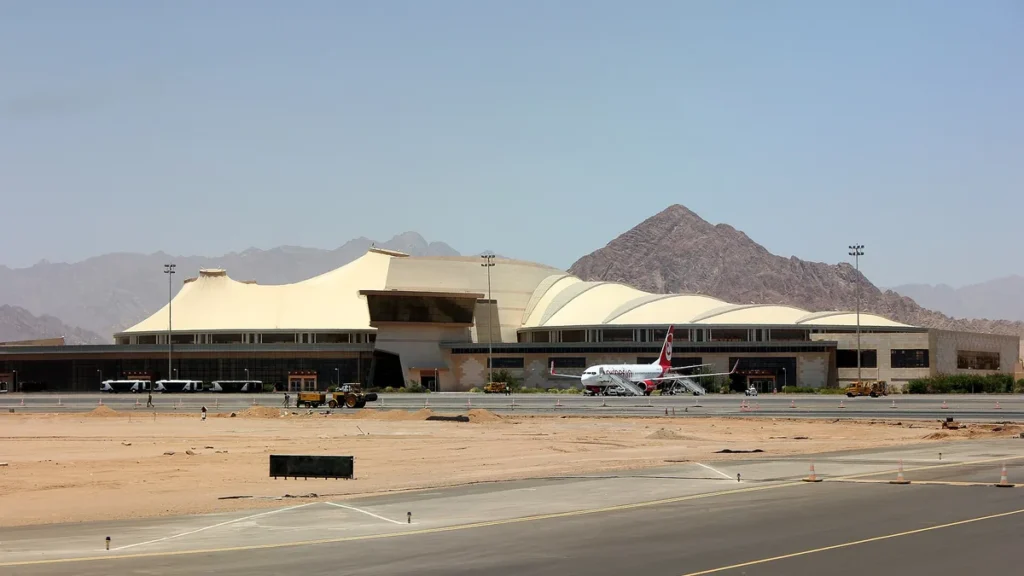
Sharm el-Sheikh International Airport operates across two terminal buildings, commonly referred to as Terminal 1 and Terminal 2, which together handle international charter, scheduled international, and domestic traffic. The airport is served by two asphalt runways — the primary runway (04/22) is understood to be capable of accommodating wide-body aircraft including the Boeing 747 and Airbus A330 families, which has been essential to its role as a high-volume charter destination. Ground-handling services are provided by a combination of state-affiliated and contracted handlers operating airside.
Cargo facilities at SSH are limited relative to Egypt’s primary freight hub at Cairo International Airport; the airport’s cargo throughput is largely incidental to its passenger-tourism function. In terms of passenger traffic classification, SSH is best characterised as a medium-volume specialist leisure hub — significant in absolute passenger numbers during peak season, but narrower in network diversity than a full-service hub airport. According to publicly disclosed traffic data from the Egyptian Airports Company and ECAA periodic reports, the airport has historically processed several million passengers annually, with figures sensitive to geopolitical events and European travel demand cycles. Planned and ongoing infrastructure works, as reported by Egyptian civil aviation authorities, have included airside apron expansions and terminal modernisation programmes, though specific budget figures and completion timelines should be verified against current ECAA or EAC official releases.
Visa Regulations
Travellers arriving at Sharm el-Sheikh International Airport are subject to Egypt’s national visa regime, administered by the Ministry of Interior and the Ministry of Foreign Affairs. As of the time of writing, Egypt offers a visa-on-arrival facility for nationals of a broad range of countries, including the United States, the United Kingdom, member states of the European Union, Canada, and Australia, typically valid for up to 30 days and subject to a fee payable in accepted currencies at the airport. Egypt’s eVisa platform, accessible through the official Egyptian government portal, allows eligible travellers to obtain a single-entry or multiple-entry tourist visa in advance of travel, which is widely recommended to reduce processing time on arrival. Nationals of many Arab League countries benefit from simplified or visa-free entry arrangements. Holders of African passports outside North Africa face more varied conditions, with some nationalities required to obtain visas in advance through Egyptian diplomatic missions. Visa regulations are subject to change at short notice and may differ by nationality, travel purpose, and entry point.
→ Check the live visa requirements lookup for your nationality
Recent Developments
In the 24 months to early 2026, Sharm el-Sheikh International Airport has seen a gradual but meaningful recovery in international traffic volumes following the disruptions of the preceding years. The resumption and expansion of European charter services — particularly from Polish, Hungarian, and German leisure carriers — has been a notable feature of the airport’s recent operational picture, reflecting renewed consumer confidence in Red Sea tourism. Wizz Air and Ryanair have both expanded their footprint at SSH as part of broader Egypt network growth strategies. The Egyptian government’s sustained diplomatic and security engagement with European aviation authorities, aimed at restoring full confidence in the airport’s security protocols following the 2015 incident, has continued to yield incremental results, with the UK’s Civil Aviation Authority and equivalent European bodies maintaining updated assessments of the airport’s security posture. Industry estimates suggest that passenger throughput at SSH has trended upward in line with Egypt’s broader tourism recovery, though precise figures should be sourced from ECAA official publications. Airside infrastructure works reported by Egyptian authorities have continued, with terminal passenger flow improvements cited as a priority ahead of anticipated peak-season demand.
News and Reports
Researchers, journalists, and aviation analysts tracking Sharm el-Sheikh International Airport should consult a tiered set of primary and secondary sources. The Egyptian Civil Aviation Authority (ECAA) publishes regulatory notices, traffic statistics, and operational updates through its official communications channels and is the authoritative source for airport-specific data within Egypt. The Egyptian Airports Company (EAC) issues periodic operational and commercial updates relevant to SSH and Egypt’s wider airport network. At the international level, IATA’s Africa and Middle East regional office produces periodic market intelligence reports covering North African aviation markets, including Egypt, which are available to IATA member organisations and research subscribers. The ICAO Middle East Regional Office (based in Cairo) publishes safety oversight and regulatory compliance data relevant to Egyptian airports under ICAO’s Universal Safety Oversight Audit Programme (USOAP). For real-time route and schedule intelligence, platforms such as OAG and Cirium provide commercially licensed data on SSH’s operational network. Trade publications including Aviation Week, ch-aviation, and The Air Current provide editorial coverage of significant developments at the airport and within the Egyptian aviation sector more broadly.