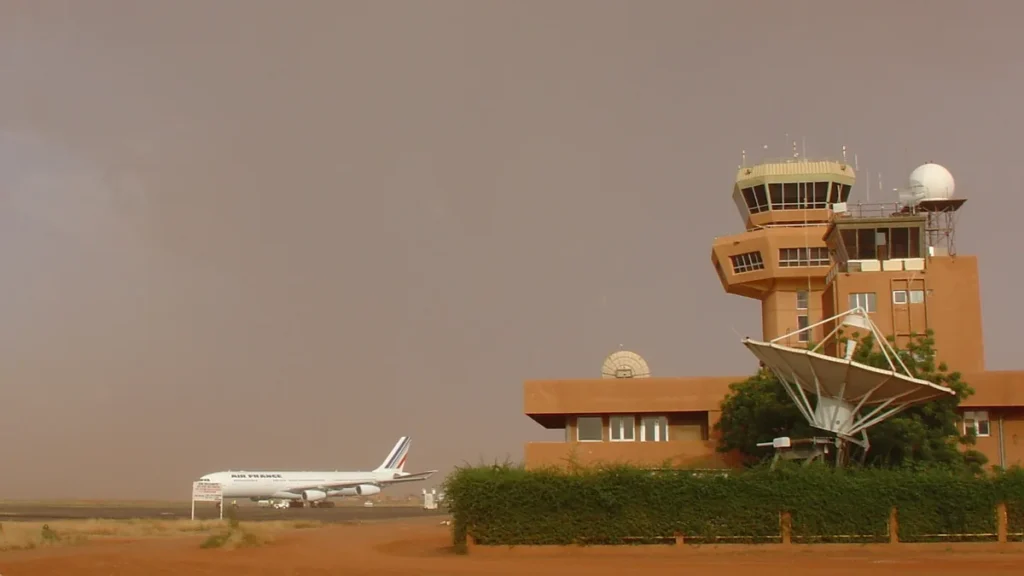
Diori Hamani International Airport
Diori Hamani International Airport
About
Diori Hamani International Airport (IATA: NIM / ICAO: DRRN) serves as Niger’s principal gateway to the world, handling the full range of scheduled international services, diplomatic traffic, humanitarian logistics, and cargo operations that connect one of West Africa’s largest landlocked nations to the wider continent and beyond. Named after Hamani Diori, Niger’s first post-independence president, the airport carries both symbolic and practical weight: it is the single international-standard facility in a country whose geography — spanning the Sahara and the Sahel — makes air connectivity not a convenience but a strategic necessity. Within the broader African aviation landscape, Niamey occupies a mid-tier position, functioning as a transit and relay point on trans-Saharan and West-to-North Africa corridors.
The airport’s origins trace to the colonial era, when a basic aerodrome was established to serve French administrative and military needs in what was then French West Africa. Following Niger’s independence in 1960, the facility was progressively upgraded to accommodate jet-age aircraft and growing international traffic. The airport was subsequently renamed in honour of President Diori Hamani, reflecting the new nation’s desire to stamp its own identity on its infrastructure. Ownership and operational oversight rests with the Nigerien state through the Direction Générale de l’Aéroport de Niamey and the broader civil aviation authority framework, though day-to-day ground handling and commercial services have at various points involved partnerships with regional and international operators.
Over the decades, the airport has undergone several rounds of rehabilitation and capacity enhancement, including runway resurfacing works, terminal refurbishment, and upgrades to navigation and instrument landing systems intended to bring the facility closer to ICAO Category standards appropriate for wide-body operations. The pace of infrastructure investment has historically been constrained by Niger’s fiscal position as one of the world’s lower-income economies, though external financing from bilateral partners and multilateral development institutions has periodically accelerated improvement programmes.
Country
Niger is a landlocked republic in West Africa, bordered by Algeria and Libya to the north, Chad to the east, Nigeria and Benin to the south, and Burkina Faso and Mali to the west. Niamey, situated on the Niger River in the country’s southwest, serves as the capital and by far the largest urban centre. With a population estimated in the tens of millions and one of the world’s highest fertility rates, Niger is a young and rapidly growing nation whose economic base rests heavily on uranium extraction, agriculture, and livestock, though the country faces persistent development challenges compounded by climate stress and regional security pressures. Niger’s geographic centrality in the Sahel places it at the crossroads of humanitarian, diplomatic, and security-related air movements that give Diori Hamani Airport a significance disproportionate to its commercial traffic volumes alone.
→ Read the Niger expert briefing
Airlines Based Here
Niger has not consistently maintained a flag carrier in the conventional sense. The former national airline, Air Niger, ceased meaningful scheduled operations years ago, leaving the market largely to foreign carriers. As of 2026, no single airline uses Diori Hamani International Airport as a primary hub in the way that a national carrier would. The closest equivalent to home-based operations comes from smaller regional charter and air taxi operators registered in Niger that use Niamey as their base for domestic and sub-regional services, though these operate at limited scale and their schedules are subject to change.
The airport’s scheduled international network is sustained almost entirely by visiting carriers. Air France has historically maintained a presence on the Niamey route as part of its West African network, connecting the city to Paris Charles de Gaulle. Ethiopian Airlines, which has built one of the continent’s most extensive intra-African networks, serves Niamey as part of its Addis Ababa-anchored hub-and-spoke system. Air Algérie connects Niamey to Algiers, reflecting the important north-south corridor across the Sahara. Turkish Airlines has at various points operated or evaluated services to Niamey as part of its aggressive African expansion strategy. Regional West African carriers including Air Burkina (or its successors following that carrier’s turbulent recent history) and operators from Nigeria have provided sub-regional links. Humanitarian and charter operators — including those contracted by United Nations agencies, which maintain a substantial presence in Niger — generate a meaningful share of movements at the airport.
Flights and Destinations
The route network at Diori Hamani International Airport reflects Niger’s position as a Sahelian hub with strong ties to francophone West Africa, North Africa, and Europe, supplemented by growing connections to East Africa and the Gulf. Representative destinations served from Niamey include Paris (Charles de Gaulle) on intercontinental services; Addis Ababa as a gateway to Ethiopian Airlines’ global connections; Algiers on the trans-Saharan corridor; Istanbul, which Turkish Airlines has targeted as part of its Africa strategy; Casablanca, connecting Niamey into Royal Air Maroc’s hub; Abidjan in Côte d’Ivoire, a key West African commercial centre; Ouagadougou in Burkina Faso, the nearest major neighbouring capital; Lagos in Nigeria, the region’s dominant economy; Bamako in Mali; and Dakar in Senegal. Domestic services within Niger are limited given the country’s sparse secondary city infrastructure, though Agadez in the north has historically been served by domestic and charter flights given its importance to uranium operations and, in earlier years, tourism.
Facilities and Capacity
Diori Hamani International Airport operates with a single main terminal building that handles both international departures and arrivals, with domestic and general aviation functions accommodated in adjacent or secondary facilities. The airport has one principal runway — runway 08/26 — with a published length sufficient to accommodate wide-body jet operations under appropriate load and temperature conditions, though the high ambient temperatures characteristic of Niamey can impose performance penalties on heavily laden aircraft. A parallel taxiway system and apron capable of handling multiple wide-body and narrow-body aircraft simultaneously supports current traffic levels.
Cargo facilities are present but modest in scale, reflecting the airport’s classification as a small-to-medium international hub by African standards. Dedicated cargo handling areas serve both commercial freight and the substantial humanitarian logistics flows generated by United Nations and NGO operations in Niger. Fuel storage and ground support equipment meet the requirements of current operators. According to publicly disclosed traffic data and industry estimates, Niamey handles passenger volumes that place it in the lower-to-middle tier of West African international airports — significantly below regional hubs such as Lagos, Abidjan, or Dakar, but maintaining consistent scheduled service from multiple international carriers. Planned or ongoing expansion works have at various points targeted terminal capacity, apron expansion, and navigation system upgrades, though the pace of delivery has been subject to financing and political conditions.
Visa Regulations
Travellers arriving at Diori Hamani International Airport are subject to Niger’s national visa regime, which has historically operated on a visa-on-arrival basis for nationals of many countries, including citizens of the United States, the United Kingdom, and European Union member states, subject to payment of the applicable fee and presentation of a valid passport, onward ticket, and proof of sufficient funds. Citizens of ECOWAS (Economic Community of West African States) member countries have generally benefited from freedom-of-movement provisions that facilitate entry without a standard visa, reflecting Niger’s membership of the regional bloc. Some nationalities may be required to obtain a visa in advance through a Nigerien embassy or consulate. It is important to note that Niger’s political situation — following the military transition that began in mid-2023 — has introduced additional uncertainty into administrative processes, and visa procedures, entry requirements, and bilateral agreements may have been affected. Travellers, journalists, and researchers should verify current requirements with official sources before travel, as rules can change with limited notice.
→ For the most current visa requirements by passport nationality, use our live lookup tool: Visa Requirements
Recent Developments
The most consequential development affecting Diori Hamani International Airport in the 24 months to early 2026 has been the broader political and security context following the July 2023 military coup that removed President Mohamed Bazoum from power. The subsequent imposition of sanctions by ECOWAS, the suspension of certain bilateral agreements, and the withdrawal or suspension of services by some international carriers significantly disrupted the airport’s route network in the immediate aftermath. Air France, among others, suspended its Niamey service during the period of heightened uncertainty, though carriers have at various points reviewed and in some cases resumed operations as the situation evolved. The new military authorities have sought to maintain and restore air connectivity as a matter of economic and logistical priority.
On the infrastructure side, works related to runway and apron maintenance have continued, and the airport authority has sought to reassure international operators of the facility’s technical readiness. The United Nations and associated humanitarian agencies have maintained their operational presence at the airport, given Niger’s continued role as a base for Sahel-region humanitarian programmes, and this has sustained a floor of activity even as commercial scheduled services fluctuated. Industry observers note that the medium-term trajectory of the airport’s network will depend heavily on Niger’s diplomatic re-engagement with regional and international partners.
News and Reports
Researchers, journalists, and aviation analysts tracking developments at Diori Hamani International Airport should consult several authoritative source categories. The Agence Nationale de l’Aviation Civile du Niger (ANAC Niger) is the primary regulatory and oversight body for civil aviation in the country and periodically publishes operational notices, safety directives, and policy updates through official government channels. The airport authority itself issues operational communications relevant to airlines and ground handlers. At the continental level, IATA’s Africa and Middle East regional office produces periodic market analyses and traffic reports that contextualise Niamey within West African aviation trends; IATA’s published materials are accessible through its official website. The ICAO West and Central Africa Regional Office (WACAF), based in Dakar, covers Niger within its remit and publishes safety oversight and capacity-building reports. For broader political and security context affecting airport operations, the UN Office for the Coordination of Humanitarian Affairs (OCHA) Niger situation reports provide relevant background. Specialist aviation trade publications including Aviation Week, ch-aviation, and The Africa Report’s aviation coverage offer ongoing commercial and operational news.
Related Research
- Niger Expert Briefing — in-depth political, economic, and security analysis for Niger
- Niger Statistics — key demographic, economic, and infrastructure data
- African Airports — profiles of international airports across the continent
- African Airlines — carrier profiles, route maps, and fleet data for African aviation
- Visa Requirements — live lookup tool for entry requirements by nationality
- Country Comparison — benchmark Niger against regional and continental peers