Ethiopian Cargo
Ethiopian Cargo
About
Ethiopian Cargo is the dedicated freight division of Ethiopian Airlines Group, one of Africa’s largest and most strategically significant aviation enterprises. Operating under the IATA designator ET and ICAO code ETH, and anchored at Addis Ababa Bole International Airport (ADD), Ethiopian Cargo has grown into the continent’s pre-eminent air freight carrier — a status built on geographic advantage, sustained investment, and the broader commercial ambitions of its parent group. For investors tracking African logistics infrastructure and for journalists covering the continent’s trade corridors, Ethiopian Cargo represents a bellwether for how African aviation can compete on a genuinely global stage.
Ethiopian Airlines itself was founded in 1945 with operational assistance from Trans World Airlines, making it one of the oldest continuously operating carriers on the continent. The cargo division evolved organically from the parent airline’s belly-hold freight operations before being formalised and expanded into a standalone business unit with dedicated freighter aircraft, its own commercial teams, and a distinct operational identity. The airline is wholly owned by the Ethiopian government, operating under the Ethiopian Airlines Group structure, which also encompasses a maintenance, repair and overhaul (MRO) division, an aviation academy, and a catering subsidiary.
In recent years, Ethiopian Airlines Group has pursued an aggressive pan-African strategy — taking equity stakes in carriers including Zambia Airways, Malawi Airlines, and others — and the cargo division has been a direct beneficiary of that network expansion. The Group’s stated ambition to become the gateway airline connecting Africa to the world has translated into tangible infrastructure investment at ADD, including the development of a dedicated cargo terminal designed to handle significantly increased throughput volumes.
Bases and Hubs
Addis Ababa Bole International Airport (ADD), Ethiopia — The primary hub and operational nerve centre for Ethiopian Cargo, benefiting from ADD’s position as one of Africa’s busiest international airports and its location roughly equidistant between major markets in Asia, Europe, and the Americas.
Liège Airport (LGG), Belgium — Ethiopian Cargo has established a significant European freight hub at Liège, a dedicated cargo airport that provides efficient onward distribution into continental European markets without the congestion constraints of major passenger hubs.
Shanghai Pudong International Airport (PVG), China — A key Asian gateway reflecting the volume of trade flows between China and the African continent, particularly in manufactured goods, electronics, and e-commerce freight.
Fleet
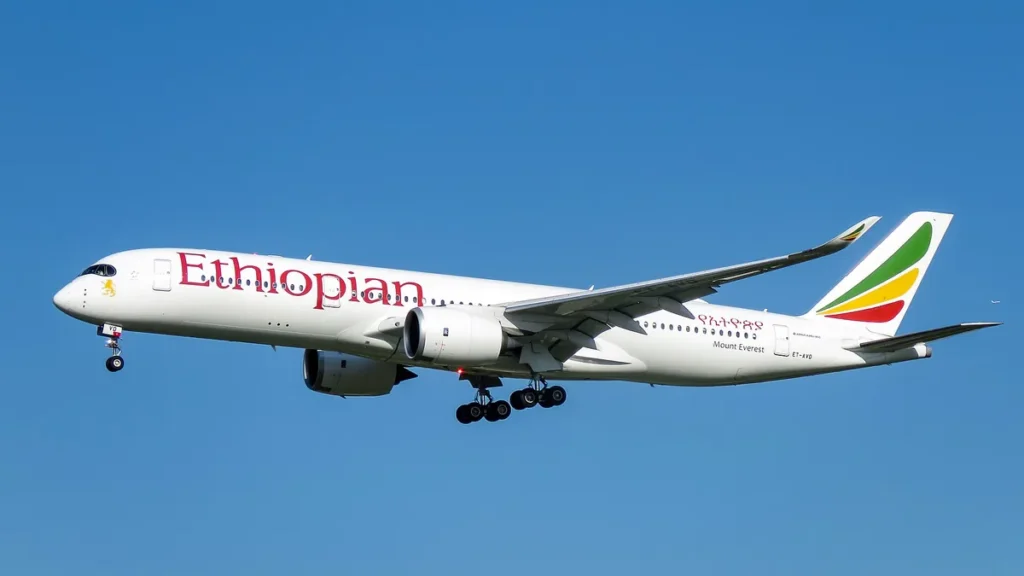
Ethiopian Cargo operates a mixed widebody freighter fleet centred on Boeing aircraft types. According to publicly disclosed fleet data, the backbone of the freighter operation comprises Boeing 777 Freighter (777F) aircraft, which offer the range and payload capacity required for long-haul intercontinental routes between Africa, Asia, Europe, and North America. The fleet also includes Boeing 737 Freighter variants deployed on shorter regional and intra-African sectors where widebody economics are less favourable. Industry observers have noted that Ethiopian Airlines Group has been among the more active African operators in pursuing fleet modernisation, and the cargo division has been included in broader group-level discussions around next-generation freighter acquisitions. Any confirmed new orders or delivery schedules should be verified against current manufacturer announcements, as fleet composition evolves on an ongoing basis.
Destinations
Ethiopian Cargo’s network spans four broad categories: intra-African routes, Middle East connections, Asian corridors, and transatlantic services. The intra-African network leverages ADD’s hub position to connect major commercial centres including Nairobi (NBO), Lagos (LOS), Johannesburg (JNB), Casablanca (CMN), and Accra (ACC), supporting the movement of perishables, cut flowers, pharmaceuticals, and manufactured goods across the continent. The Middle East corridor — serving cities including Dubai (DXB) and Doha (DOH) — handles significant volumes of time-sensitive cargo transiting between Africa and global markets. Asian routes, particularly to Shanghai (PVG), Hong Kong (HKG), and Guangzhou (CAN), carry high-value manufactured imports into Africa. Transatlantic services to destinations including Chicago (ORD) and Washington Dulles (IAD) serve the North American market, while European services through Liège (LGG), Frankfurt (FRA), and London (LHR) handle the continent’s largest trading partner bloc.
Codeshare and Alliance
Ethiopian Airlines is a member of the Star Alliance, the world’s largest airline alliance by member count, and this membership extends reputational and interline benefits to the cargo division’s commercial relationships. On the freight side, Ethiopian Cargo has developed interline and cooperative agreements with a range of logistics and freight forwarding partners globally. The airline has worked with major integrators and forwarders including DHL and Kuehne+Nagel in various market contexts, though the precise terms of any current commercial arrangements should be confirmed directly with the airline. The Star Alliance cargo cooperation framework also facilitates connections with fellow member carriers’ freight operations across key trade lanes.
Notable Incidents
Ethiopian Cargo does not have major cargo-specific incidents on its recent public safety record that this profile can cite with verified confidence. Readers and researchers requiring a comprehensive safety history should consult the Aviation Safety Network (ASN) database and the Ethiopian Civil Aviation Authority (ECAA) for authoritative records. It should be noted separately that Ethiopian Airlines flight ET302, a passenger service, was involved in a fatal accident in March 2019 involving a Boeing 737 MAX 8; this event had significant implications for the broader Ethiopian Airlines Group and the global aviation industry, though it was not a cargo operation.
Financial and Operational Situation
Ethiopian Airlines Group has historically been one of the few African carriers to report consistent profitability, and the cargo division has been a meaningful contributor to that performance — particularly during the 2020–2022 period when global air freight demand surged and passenger belly capacity contracted sharply due to the COVID-19 pandemic. Industry estimates suggest that cargo revenues represented a significantly elevated share of group income during that period, accelerating investment in dedicated freighter capacity. As of 2026, the freight market has normalised from pandemic-era peaks, and Ethiopian Cargo, like its global peers, is navigating a more competitive pricing environment. The airline’s state ownership provides a degree of financial stability and access to sovereign-backed financing for fleet and infrastructure investment, though it also means the carrier operates within the constraints and priorities of Ethiopian government economic policy. Full audited financial statements are not consistently published in the public domain; analysts tracking the carrier typically rely on IATA industry data and group-level disclosures where available.
Recent Developments
In the 24 months leading into 2026, Ethiopian Cargo has continued to expand its footprint on key trade corridors, with particular attention to intra-African freight capacity as the African Continental Free Trade Area (AfCFTA) framework begins to stimulate cross-border commerce. The airline has been active in discussions around cold-chain logistics infrastructure at ADD, reflecting the strategic importance of Ethiopia’s perishables export sector — particularly cut flowers and fresh produce destined for European markets. Fleet discussions at the group level have included consideration of additional widebody freighter capacity to serve growing demand on Asia-Africa lanes. The airline has also deepened its engagement with e-commerce logistics providers as cross-border online retail volumes into and across Africa continue to grow. Regulatory developments within the Ethiopian aviation sector, overseen by the ECAA, and broader Open Skies negotiations on the continent remain relevant background factors for the carrier’s network planning.