Julius Nyerere International Airport
Julius Nyerere International Airport
About
Julius Nyerere International Airport (IATA: DAR / ICAO: HTDA) is Tanzania’s principal international gateway and one of the busiest aviation hubs in East Africa. Situated approximately 12 kilometres southwest of central Dar es Salaam, the airport serves as the primary entry point for business travellers, tourists, humanitarian workers, and cargo operators moving goods across the region. Its position on the Indian Ocean seaboard, combined with Dar es Salaam’s role as a major commercial port city, gives the airport a strategic importance that extends well beyond Tanzania’s borders — it functions as a connecting node between Southern Africa, the Great Lakes region, and long-haul intercontinental routes to Europe, the Middle East, and Asia.
The airport traces its origins to the colonial era, when the site was developed as Dar es Salaam Airport under British administration. Following Tanzanian independence in 1961 and the subsequent union with Zanzibar in 1964, the facility was progressively expanded to meet the demands of a newly sovereign nation. It was later renamed in honour of Julius Kambarage Nyerere, Tanzania’s founding president and one of Africa’s most respected post-independence statesmen. The renaming was a deliberate act of national identity, anchoring the country’s main international threshold to its founding political philosophy.
Ownership and operational oversight of the airport rests with the Tanzania Airports Authority (TAA), a government body responsible for managing the country’s network of airports and airstrips. Over the decades, Julius Nyerere International Airport has undergone several phases of infrastructure investment. A significant expansion programme focused on Terminal 2 — a modern international terminal — substantially increased the airport’s handling capacity and improved passenger processing standards. Further works have addressed apron space, taxiway configurations, and cargo infrastructure. As of 2026, the airport is widely classified as a medium-to-large hub by regional standards, though it continues to face capacity pressures during peak travel periods.
Country
Tanzania is a large East African nation bordered by Kenya and Uganda to the north, Rwanda, Burundi, and the Democratic Republic of Congo to the west, and Zambia, Malawi, and Mozambique to the south. Its official capital is Dodoma, though Dar es Salaam remains the country’s commercial and administrative centre and by far its most populous city. With a national population estimated in the tens of millions and one of the continent’s more consistent records of economic growth over the past two decades, Tanzania occupies an important position in the East African Community (EAC) and the broader African Union framework. The country’s economy is anchored by agriculture, mining, tourism — particularly safari and Zanzibar beach tourism — and a growing services sector. → Read the Tanzania expert briefing
Airlines Based Here
Air Tanzania, the national flag carrier, uses Julius Nyerere International Airport as its primary hub and operational base. Reconstituted and re-equipped in recent years with support from the Tanzanian government, Air Tanzania operates both domestic routes — connecting Dar es Salaam to Kilimanjaro, Zanzibar, Mwanza, and other Tanzanian cities — and a growing portfolio of regional and intercontinental services. The airline has invested in newer widebody aircraft to support longer-haul ambitions, including routes to Asian destinations.
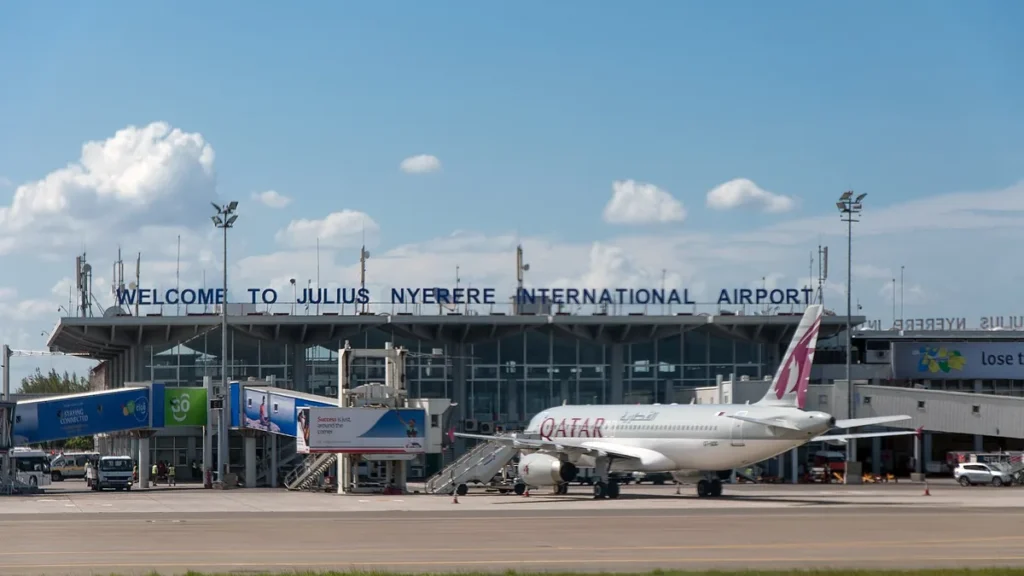
Beyond the home carrier, Julius Nyerere International Airport attracts a substantial number of visiting international carriers that treat Dar es Salaam as a focus city or scheduled stop on African network routes. Kenya Airways operates regular services linking DAR to Nairobi’s Jomo Kenyatta International Airport, providing onward connectivity across its network. Ethiopian Airlines, one of the continent’s dominant carriers, maintains a strong Dar es Salaam presence with connections through Addis Ababa Bole International Airport. Qatar Airways and Turkish Airlines both serve the airport with long-haul widebody operations, connecting Tanzanian travellers to their respective global hubs in Doha and Istanbul. Emirates has also maintained a presence on the Dar es Salaam route, reflecting the strong travel corridor between Tanzania and the Gulf. RwandAir connects the airport to Kigali, and Precision Air — a Tanzanian private carrier — operates domestic and limited regional services alongside Air Tanzania.
Flights and Destinations
The airport supports a network that spans domestic, regional African, and intercontinental routes. Domestically, frequent services connect Dar es Salaam to Zanzibar (ZNZ), Kilimanjaro International Airport (JRO), Mwanza, and Arusha. Regionally, passengers can reach Nairobi (NBO), Addis Ababa (ADD), Kigali (KGL), Entebbe/Kampala (EBB), Lusaka (LUN), and Johannesburg (JNB) through direct or one-stop services. On intercontinental routes, Dar es Salaam is connected to Dubai (DXB), Doha (DOH), Istanbul (IST), Mumbai (BOM), and Guangzhou (CAN) — the last reflecting Tanzania’s growing trade ties with China. European connectivity, while more limited in terms of direct services, is achievable through Gulf hub connections, making the airport reasonably well integrated into global long-haul networks for a city of its size and economic profile.
Facilities and Capacity
Julius Nyerere International Airport operates two principal passenger terminals. Terminal 1 handles a mix of domestic and some regional traffic, while Terminal 2 — the newer international facility — was designed to international standards with improved check-in capacity, immigration processing lanes, airside retail, and aircraft contact stands. The airport is served by two runways, with the main runway oriented to accommodate large commercial jet operations including widebody aircraft such as the Boeing 787 and Airbus A330. Runway length and pavement strength are sufficient for the intercontinental operations currently scheduled, though infrastructure analysts have noted that sustained traffic growth will require continued investment in apron expansion and ground handling capacity.
Cargo facilities at the airport serve Tanzania’s export economy, handling perishable goods including fresh flowers and fish, as well as general freight and humanitarian logistics. The airport’s cargo infrastructure has been a subject of ongoing investment attention given Tanzania’s ambitions to grow its role as a regional logistics hub. According to publicly disclosed traffic data and industry estimates, the airport processes several million passengers annually, placing it in the medium-to-large category for sub-Saharan Africa, though it remains smaller in absolute throughput than regional giants such as Nairobi, Johannesburg, or Addis Ababa. Expansion planning, including discussions around a potential new terminal or significant Terminal 2 extension, has been reported in Tanzanian government and aviation authority communications, though confirmed timelines and budgets should be verified against current TAA announcements.
Visa Regulations
Travellers arriving at Julius Nyerere International Airport are subject to Tanzania’s national visa regime, which has evolved in recent years toward greater accessibility. Citizens of the United States, the United Kingdom, and most European Union member states are generally required to obtain a visa to enter Tanzania, but Tanzania has made the eVisa system — available through the official Tanzanian immigration portal — the preferred and increasingly mandatory channel for advance applications. Visa on arrival has historically been available at DAR for many nationalities, though travellers are strongly advised to confirm current arrangements before departure, as processing policies can change with limited notice. Within the East African Community, citizens of Kenya, Uganda, Rwanda, Burundi, and South Sudan benefit from facilitated entry arrangements, and several other African Union member state passport holders may qualify for visa-free or simplified access under bilateral agreements. Visa fees, validity periods, and permitted activities vary by nationality and purpose of travel. Because visa regulations are subject to change, travellers, journalists, and researchers should consult the live lookup tool: → Check current visa requirements
Recent Developments
In the 24 months leading into 2026, Julius Nyerere International Airport has seen a number of operationally significant developments. Air Tanzania has continued to expand its route network, with new or resumed intercontinental services attracting attention from regional aviation analysts as evidence of the airline’s recovery and growth trajectory following earlier financial difficulties. The airport has also seen renewed interest from Gulf carriers in maintaining and in some cases increasing frequency on Dar es Salaam routes, reflecting sustained demand from the Tanzanian diaspora and the tourism sector. Infrastructure works within the terminal complex have been reported, focused on improving passenger flow and upgrading airside facilities to meet growing demand. The Tanzania Civil Aviation Authority (TCAA) has continued its regulatory engagement with ICAO standards compliance, an area of ongoing importance for the airport’s international standing. Regional connectivity has also been a theme, with East African carriers adjusting schedules in response to competitive dynamics across the Nairobi–Dar es Salaam–Addis Ababa triangle. Researchers and journalists tracking specific route launches or regulatory decisions should cross-reference TAA and TCAA official communications for confirmed details.
News and Reports
Ongoing operational and strategic news about Julius Nyerere International Airport is best tracked through a combination of official and industry sources. The Tanzania Airports Authority publishes press releases and operational updates through its official communications channels and should be the first reference point for confirmed infrastructure and capacity announcements. The Tanzania Civil Aviation Authority (TCAA) is the relevant regulatory body and publishes safety, licensing, and compliance information relevant to the airport’s operational environment. At the continental level, IATA’s Africa regional office produces periodic reports on African aviation market trends, traffic data, and infrastructure investment that contextualise DAR’s performance within the broader East African and sub-Saharan market. The ICAO regional office for Eastern and Southern Africa (ESAF), based in Nairobi, is the appropriate reference for safety oversight and standards compliance matters. Specialist aviation trade publications including ch-aviation, Anna.aero, and The Africa Report’s aviation coverage provide route-level news and airline strategy analysis. For Tanzania-specific economic and policy context, the Bank of Tanzania and the National Bureau of Statistics publish data relevant to the airport’s commercial environment.