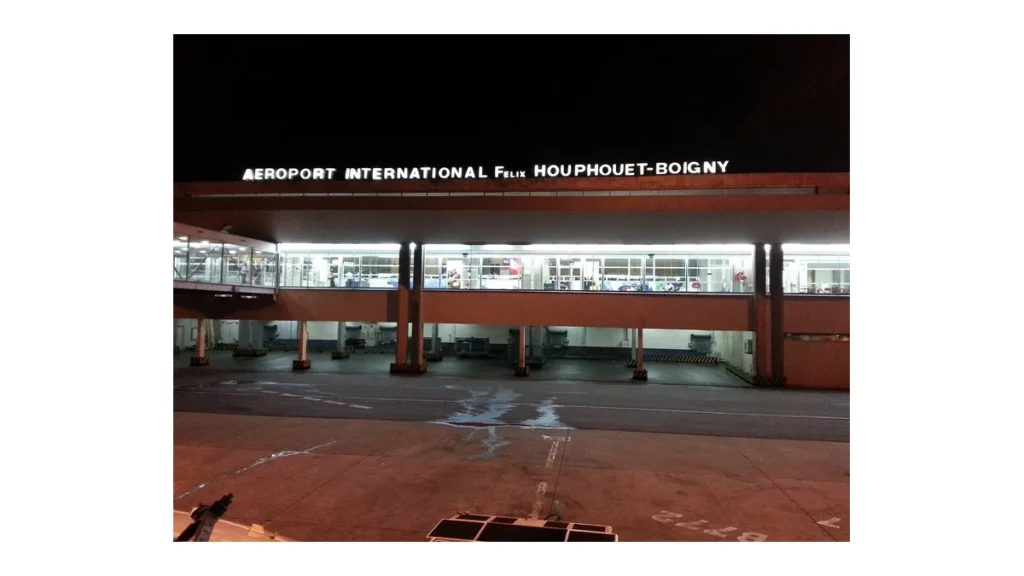
Félix-Houphouët-Boigny International Airport
Félix-Houphouët-Boigny International Airport
About
Félix-Houphouët-Boigny International Airport (IATA: ABJ / ICAO: DIAP) is the principal international gateway to Côte d’Ivoire and one of the most strategically significant aviation hubs in West Africa. Situated on the southern edge of Abidjan — the country’s commercial capital and largest city — the airport anchors a regional air-transport network that connects francophone West Africa to Europe, the Middle East, and the wider African continent. For travellers, journalists, and aviation analysts alike, ABJ represents a useful barometer of air-traffic growth across the Gulf of Guinea corridor.
The airport bears the name of Côte d’Ivoire’s founding president, Félix Houphouët-Boigny, who led the country from independence in 1960 until his death in 1993. The facility itself has roots in the colonial-era aerodrome infrastructure developed during the mid-twentieth century, and it was progressively upgraded following independence to serve the demands of a rapidly urbanising Abidjan. Ownership and operational oversight sit with the Ivorian state, with the Autorité Nationale de l’Aviation Civile de Côte d’Ivoire (ANAC-CI) serving as the civil aviation regulatory authority and Aéroport International Félix-Houphouët-Boigny (AIFHB) as the managing entity.
The airport has undergone several phases of modernisation since the 1990s, with notable infrastructure investment accelerating in the 2010s as Abidjan reasserted itself as a regional business hub following the end of the country’s post-electoral crisis. Expansion works have addressed terminal capacity, airside apron space, and cargo-handling infrastructure. As of 2026, further development phases remain either under discussion or in progress, reflecting the Ivorian government’s stated ambition to position ABJ as a premier West African hub competitive with Dakar’s Blaise Diagne International Airport and Accra’s Kotoka International Airport.
Country
Côte d’Ivoire is a West African nation bordered by Ghana, Burkina Faso, Mali, Guinea, and Liberia, with a southern coastline on the Gulf of Guinea. Its administrative capital is Yamoussoukro, though Abidjan functions as the economic and commercial heart of the country and hosts the majority of its international diplomatic missions. With a population estimated in the tens of millions and one of the more diversified economies in the ECOWAS region — anchored by cocoa, cashew, and a growing services sector — Côte d’Ivoire occupies a pivotal position in West African trade, finance, and transport logistics. The country’s relative political stability since 2011 has underpinned sustained investor confidence and rising passenger demand at ABJ.
→ Read the Côte d’Ivoire expert briefing
Airlines based here
Air Côte d’Ivoire, the national flag carrier established in 2012 as a successor to the defunct Air Ivoire, uses Félix-Houphouët-Boigny International Airport as its primary hub and operational base. The airline operates a regional network across West and Central Africa, and ABJ serves as its maintenance and crew base. A second home-market carrier, Côte d’Ivoire’s charter and regional operators, also use the airport for domestic and sub-regional services, though the scheduled international market is dominated by visiting foreign carriers. Among the long-haul and medium-haul carriers with a consistent presence at ABJ, Air France maintains one of the most established services, reflecting the deep historical and commercial ties between France and Côte d’Ivoire. Brussels Airlines, which has built a significant West Africa network, operates scheduled services through ABJ. Ethiopian Airlines — one of the continent’s largest carriers — serves Abidjan as part of its pan-African hub-and-spoke model. Royal Air Maroc connects ABJ to Casablanca, providing onward connectivity to Europe and North America. Turkish Airlines has in recent years expanded its African footprint to include Abidjan. Middle Eastern carriers including Air Arabia and, at various points, carriers from the Gulf have also served the route. Regional African carriers including ASKY Airlines — which is partly affiliated with Ethiopian Airlines and is based in Lomé — use ABJ as a key spoke destination within their West African networks.
Flights and destinations
The airport supports a network that spans intra-African regional routes, intercontinental long-haul services, and short-haul connections within the ECOWAS zone. Within Africa, ABJ is connected to Dakar (Senegal), Accra (Ghana), Lagos (Nigeria), Nairobi (Kenya), Addis Ababa (Ethiopia), Casablanca (Morocco), and Douala (Cameroon), among others. Intercontinentally, Paris Charles de Gaulle remains the single highest-frequency long-haul destination, a reflection of the volume of business and diaspora travel between France and Côte d’Ivoire. Brussels, Istanbul, and Dubai represent other intercontinental points served with regularity. Within the immediate sub-region, cities such as Bamako (Mali), Ouagadougou (Burkina Faso), Conakry (Guinea), and Lomé (Togo) are served with relatively high frequency, making ABJ a practical transit point for travellers moving across francophone West Africa. The airport does not currently support a significant volume of transatlantic non-stop services, meaning North American travellers typically connect through European or Middle Eastern hubs.
Facilities and capacity
The airport operates with two runways, configured to handle wide-body jet operations, which enables it to accommodate aircraft types including the Boeing 777, Airbus A330, and Boeing 787 that are common on African long-haul routes. The passenger terminal infrastructure has been subject to phased modernisation, with the main international terminal offering check-in, immigration, customs, and airside retail facilities. A dedicated cargo terminal supports Abidjan’s role as a significant export node for agricultural commodities, particularly cocoa and cashew, and the airport handles both belly-hold freight on passenger services and dedicated freighter operations. By the classification standards used in African aviation analysis, ABJ is generally regarded as a medium-to-large hub within the West African context, though it remains smaller in total annual throughput than the continent’s largest gateways such as Johannesburg O.R. Tambo or Cairo International. According to publicly disclosed traffic data and industry estimates, passenger volumes at ABJ have trended upward in the post-pandemic recovery period, though precise current-year figures should be verified against ANAC-CI or Airports Council International Africa publications.
Visa regulations
Travellers arriving at Félix-Houphouët-Boigny International Airport are subject to Côte d’Ivoire’s national visa regime, which has evolved in recent years as part of broader efforts to facilitate tourism and business travel. As a general framework: citizens of many ECOWAS member states benefit from visa-free or simplified entry arrangements under the community’s free-movement protocols. For travellers holding passports from the United States, the United Kingdom, and European Union member states, Côte d’Ivoire has made an eVisa system available, allowing pre-travel authorisation to be obtained online prior to departure — a significant practical improvement over earlier requirements for embassy-issued visas. Visa-on-arrival arrangements have also been reported as available for certain nationalities, though conditions and eligibility can change with limited notice. It is strongly advisable for all travellers to verify their specific nationality’s current entry requirements well in advance of travel, as visa policies are subject to revision by the Ivorian government. For a live, nationality-specific lookup, see our visa requirements tool.
Recent developments
In the 24 months leading into 2026, Félix-Houphouët-Boigny International Airport has seen a number of operationally significant developments. Air Côte d’Ivoire has continued to expand its regional network, adding or restoring routes that were disrupted during the COVID-19 pandemic period, and the carrier has been reported to be evaluating fleet renewal options to support longer-range operations. On the infrastructure side, works associated with terminal capacity and apron expansion have been ongoing, consistent with the Ivorian government’s stated infrastructure investment priorities under its national development planning frameworks. Several international carriers have either launched new services to ABJ or increased frequencies on existing routes, reflecting growing confidence in the Abidjan market. The airport authority has also engaged with ICAO and IATA on safety and operational standards compliance, an area of ongoing focus for West African aviation regulators. Travellers and analysts should note that the regional security environment — including developments in neighbouring Burkina Faso and Mali — has had some bearing on route planning decisions by carriers operating in the sub-region, though ABJ itself has continued to operate without significant disruption.
News and reports
Ongoing operational and commercial news relating to Félix-Houphouët-Boigny International Airport is best tracked through a combination of official and industry sources. The Autorité Nationale de l’Aviation Civile de Côte d’Ivoire (ANAC-CI) publishes regulatory notices, safety directives, and periodic traffic summaries through its official communications channels. The airport management entity issues press releases on major commercial and infrastructure developments. At the pan-African level, the African Airlines Association (AFRAA) and Airports Council International Africa (ACI Africa) produce annual and quarterly reports that contextualise ABJ’s performance within the broader continental picture. IATA’s Africa regional office publishes market analysis covering West African aviation trends. The ICAO Western and Central African regional office (WACAF) is the relevant body for safety oversight and standards compliance reporting. Specialist aviation trade publications including ch-aviation, Cirium, and The Air Current provide route-level and fleet-level intelligence that is particularly useful for analysts tracking carrier strategies at ABJ. Journalists covering Ivorian business and infrastructure will also find relevant reporting in outlets such as Jeune Afrique and Agence Ecofin.