Oran Es Sénia Airport
Oran Es Sénia Airport
About
Oran Es Sénia Airport (IATA: ORN / ICAO: DAOO) is Algeria’s second-busiest international gateway and one of the more strategically significant airports on the North African Mediterranean rim. Serving Oran — the country’s second-largest city and its commercial and cultural capital of the west — the airport functions as a critical node connecting Algeria’s interior to Europe, the Middle East, and sub-Saharan Africa. For aviation analysts tracking North Africa’s post-pandemic recovery, and for travellers and journalists moving through the Maghreb, Es Sénia represents both a practical transit point and a useful barometer of Algerian civil aviation’s broader trajectory.
The airport’s origins trace to the French colonial period, when the site at Es Sénia, roughly ten kilometres southeast of central Oran, was developed as a military and civil aerodrome. Commercial operations expanded significantly following Algerian independence in 1962, and the airport was progressively upgraded through the 1970s and 1980s as Oran consolidated its role as the economic engine of western Algeria. The facility is owned by the Algerian state and operated under the authority of the Établissement National de la Navigation Aérienne (ENNA) and the broader framework of Algeria’s Ministry of Transport.
A major modernisation programme was undertaken in the 2000s and early 2010s, delivering an expanded terminal building, improved apron capacity, and upgraded navigation infrastructure. The airport was also a focal point of infrastructure investment ahead of the 2022 Mediterranean Games hosted by Oran, which prompted accelerated works on passenger-handling facilities, road access, and airside logistics. Industry observers note that while the 2022 improvements raised the airport’s functional ceiling, longer-term capacity questions remain on the agenda for Algerian aviation planners.
Country
Algeria is the largest country by land area in Africa and the Arab world, with a population estimated at over 46 million people and its capital at Algiers. Positioned at the crossroads of the Maghreb, the Sahel, and the southern Mediterranean, Algeria occupies a pivotal geopolitical and economic role in the region — a major hydrocarbons exporter, a significant partner for European energy security, and an increasingly active voice in African Union affairs. Oran, as Algeria’s second city, anchors the country’s northwestern corridor and maintains strong demographic and commercial ties with France, Spain, and the wider diaspora communities of Western Europe.
→ Read the Algeria expert briefing
Airlines based here
Air Algérie, the Algerian national carrier, is the dominant operator at Oran Es Sénia and treats the airport as a key focus city within its domestic and international network. While Algiers Houari Boumediene Airport serves as Air Algérie’s primary hub, the airline maintains a substantial schedule from ORN covering both domestic routes and international services to Europe and the Middle East. Tassili Airlines, a subsidiary historically associated with the hydrocarbons sector and domestic charter operations, also operates from Oran on selected routes.
On the visiting carrier side, several European airlines serve Oran on a scheduled basis. Transavia France and Vueling have operated routes connecting Oran to French and Spanish cities respectively, catering heavily to the large Algerian diaspora in Western Europe. Air Arabia, the Sharjah-based low-cost carrier, has maintained a presence on the Oran–Middle East corridor. Seasonal and charter capacity from operators based in France, Belgium, and the Netherlands has historically supplemented scheduled services, particularly during summer peak periods when diaspora travel demand intensifies.
Flights and destinations
The route network at Oran Es Sénia is shaped primarily by two demand drivers: the large Algerian diaspora concentrated in France, Spain, and Belgium, and domestic connectivity within Algeria’s own air transport system. Internationally, Paris (Charles de Gaulle and Orly), Marseille, Lyon, and Madrid rank among the most consistently served European destinations. Montreal is served on a seasonal or periodic basis, reflecting the significant Algerian-Canadian community. Within the Middle East, Dubai and Sharjah have featured as destinations, with Air Arabia providing low-cost access to the Gulf.
Domestically, Air Algérie connects Oran to Algiers, Constantine, Annaba, Tamanrasset, and other regional centres, supporting both business travel and connectivity for communities in Algeria’s south and east. Intra-African international routes remain limited compared to the airport’s European traffic, though there is periodic service to Tunis and Casablanca, reflecting Maghreb regional ties. Industry estimates suggest that the airport’s international traffic is heavily weighted toward France, which accounts for the plurality of seat capacity in most scheduling seasons.
Facilities and capacity
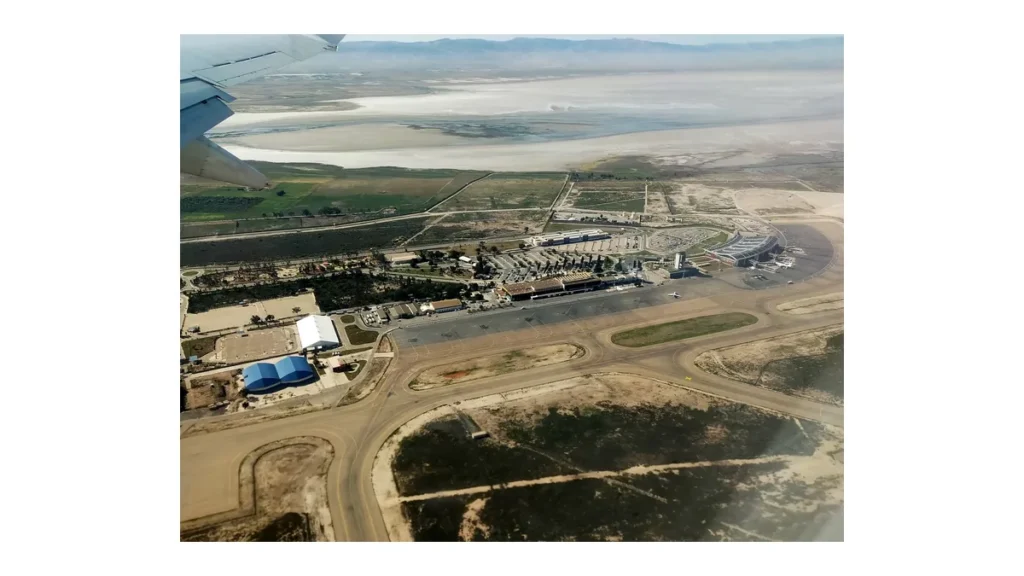
Oran Es Sénia operates a single primary passenger terminal, which was substantially refurbished and expanded in the lead-up to the 2022 Mediterranean Games. The terminal handles both domestic and international traffic, with segregated processing areas for arriving and departing international passengers. The airport has two runways — the main instrument runway oriented to accommodate the prevailing wind conditions of the Oran plateau — and a hardstand apron capable of handling narrow-body and wide-body jet aircraft, including Airbus A330-class equipment on longer international services.
Cargo facilities at Es Sénia are functional but modest in scale relative to the airport’s passenger throughput, reflecting Algeria’s broader pattern of cargo moving predominantly through Algiers. According to publicly disclosed traffic data and airport authority communications, Oran sits in the medium-hub category for African airports — significant at the national level, but below the threshold of major continental hubs such as Cairo, Casablanca, or Addis Ababa. Discussions around longer-term capacity expansion, including potential new terminal infrastructure, have been reported in Algerian transport policy forums, though confirmed project timelines and budgets have not been publicly finalised as of early 2026.
Visa regulations
Travellers arriving at Oran Es Sénia Airport are subject to Algeria’s national visa regime, which as of 2026 remains relatively restrictive by regional standards. Citizens of most Western countries — including the United States, the United Kingdom, and European Union member states — are generally required to obtain a visa prior to arrival; Algeria does not operate a widely available visa-on-arrival scheme for these markets, and a formal eVisa system has not been fully rolled out for all nationalities. Holders of passports from certain Arab League and African Union member states may benefit from bilateral visa exemptions or simplified entry arrangements, though these vary considerably by country of origin and are subject to change. Travellers are strongly advised to verify current requirements with the Algerian embassy or consulate in their country of residence well in advance of travel.
Visa rules change frequently and the above is a general orientation only. → Check the live visa requirements lookup for current, country-specific guidance.
Recent developments
The period from 2024 to early 2026 has seen a gradual recovery and modest expansion of traffic at Oran Es Sénia, consistent with the broader rebound in North African aviation following the disruptions of the early 2020s. Several European carriers have restored or increased frequency on Oran routes, driven by sustained diaspora demand and improving bilateral air services arrangements between Algeria and EU member states. Air Algérie has periodically announced new or reinstated international routes from Oran as part of its network development strategy, with the airline’s management publicly signalling intent to grow the airport’s role as a western Algeria gateway rather than routing all international traffic through Algiers.
Infrastructure works associated with the 2022 Mediterranean Games legacy programme have continued into the post-Games period, with ongoing refinements to terminal passenger flow and airside logistics. Algerian civil aviation authorities have also been engaged in broader regulatory modernisation aligned with ICAO standards, which has implications for operational procedures at all major Algerian airports including Es Sénia. Industry observers note that the airport’s competitive position relative to Algiers will depend significantly on whether Air Algérie and potential new entrants choose to develop Oran as a genuine secondary hub or maintain it primarily as a point-to-point focus city.
News and reports
Ongoing operational and commercial news relating to Oran Es Sénia Airport can be tracked through several authoritative sources. The Établissement National de la Navigation Aérienne (ENNA) and Algeria’s Ministry of Transport periodically publish press releases and official communications on infrastructure developments and regulatory matters. Air Algérie’s corporate communications channel provides route and schedule announcements relevant to the airport. For regional context, the ICAO Middle East and Africa regional offices publish safety oversight and infrastructure development reports that cover Algerian airports within their broader assessments. IATA’s Africa regional publications and its annual World Air Transport Statistics provide comparative data on North African airport performance. Specialist aviation trade publications including ch-aviation, Cirium, and Aviation Week cover Algerian route developments and airline capacity data on an ongoing basis and are reliable sources for journalists and analysts tracking the airport’s commercial evolution.