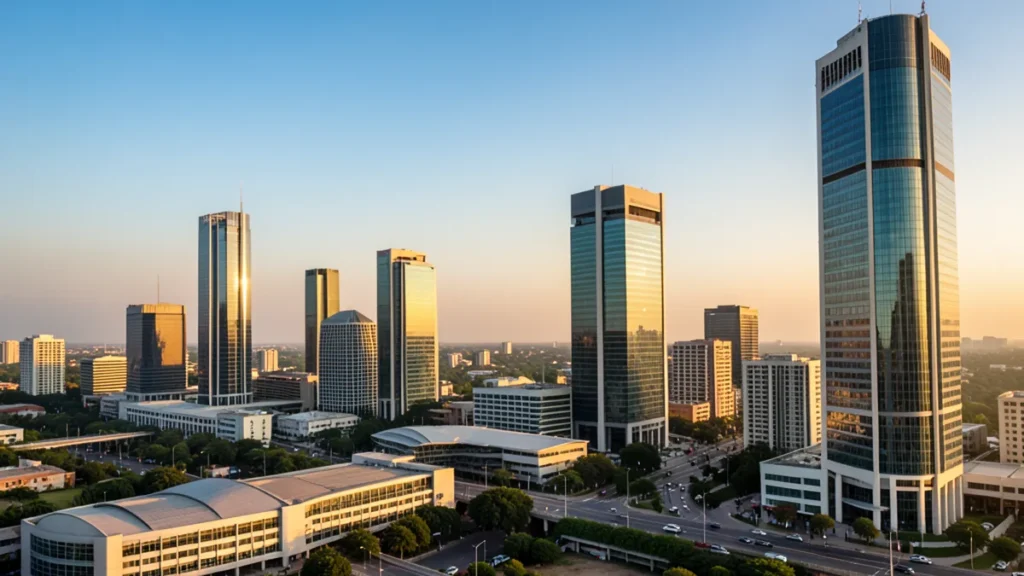
The African economy — drivers, integration, and 2026 outlook
Africa’s economy in 2026 occupies a paradoxical position: it is simultaneously the world’s fastest-growing demographic story and one of its most structurally constrained fiscal environments. With a continental population now exceeding 1.5 billion people, a combined GDP estimated at roughly USD 3 trillion, and a median age well below 25, Africa carries more latent economic potential than almost any other region on earth. Yet that potential continues to be tested by currency volatility, debt-service pressures, commodity dependence, and governance gaps that no single reform agenda has yet fully resolved. What follows is a structured overview of where the continent stands in 2026 and where the evidence suggests it is heading.
The Macroeconomic Landscape: Growth, Demographics, and the Dividend That Has Not Yet Fully Arrived
Aggregate GDP figures for Africa mask enormous variation. Nigeria, Egypt, South Africa, Algeria, Morocco, Ethiopia, and Kenya together account for the majority of continental output, yet their economic models, growth trajectories, and structural challenges differ sharply. Nigeria remains the largest economy by nominal GDP, though persistent naira depreciation since the 2023 unification of the exchange rate has compressed dollar-denominated output considerably. Egypt has leaned heavily on IMF support — a USD 8 billion Extended Fund Facility agreed in March 2024 was subsequently augmented — while managing a foreign-currency squeeze that has weighed on imports and industrial activity. South Africa, still the continent’s most industrialised economy, continues to grapple with structural unemployment above 30 percent and the lingering effects of load-shedding on business confidence, even as Eskom’s operational position has gradually stabilised. Ethiopia and Kenya represent the more dynamic end of the spectrum: Addis Ababa has pursued an ambitious industrial-park strategy and, despite the economic scars of the Tigray conflict, has attracted renewed manufacturing interest, while Nairobi has consolidated its position as East Africa’s financial and technology hub. Morocco, buoyed by phosphate revenues, a growing automotive and aerospace manufacturing base, and its role as a gateway for European nearshoring, has been among the continent’s more consistent performers. Algeria, sitting on substantial hydrocarbon reserves, has benefited from elevated global energy prices but has made slower progress on economic diversification. The demographic dividend — the growth acceleration that can follow a rising share of working-age population — remains more promise than reality in most markets, held back by skills mismatches, insufficient formal-sector job creation, and urban infrastructure deficits. Industry estimates suggest the continent will need to create well over 20 million new jobs annually through the 2030s simply to absorb new labour-market entrants.
Trade, AfCFTA, and the Long Road to Economic Integration
The African Continental Free Trade Area formally entered its operational phase several years ago, but the gap between its legal architecture and its on-the-ground impact remains wide. Intra-African trade as a share of total continental trade has historically lagged far behind comparable figures for Europe or Southeast Asia, and while AfCFTA has begun to shift that needle — particularly in corridors such as East Africa, where the Northern Corridor linking Mombasa to Kampala and Kigali has seen measurable volume growth — non-tariff barriers, inadequate cross-border infrastructure, and divergent regulatory standards continue to suppress the agreement’s full potential. The Guided Trade Initiative, which piloted real transactions among a subset of member states, has provided proof-of-concept data, and sector-specific protocols on services and investment are at various stages of ratification. The most tangible near-term gains are visible in manufactured goods and agro-processing, where regional value chains are beginning to emerge. The Pan-African Payment and Settlement System (PAPSS), operationalised under the auspices of Afreximbank, is reducing the dollar-intermediation cost of intra-African transactions, a structural inefficiency that had long penalised regional commerce. Progress is real but incremental, and the political will required to dismantle entrenched customs interests varies considerably by member state.
Debt, Fiscal Pressure, and the Restructuring Cycle
The post-pandemic borrowing surge left a significant portion of sub-Saharan Africa in acute debt distress. Zambia completed a landmark external debt restructuring in 2023 after years of negotiations under the G20 Common Framework, reaching agreements with both its official creditors — a group that included China as a major bilateral lender — and its commercial bondholders. Ghana similarly underwent a painful domestic and external debt restructuring process beginning in 2023, with Eurobond holders accepting substantial haircuts. Ethiopia’s own restructuring negotiations have been protracted. These cases have exposed the limitations of the Common Framework as a mechanism for timely debt resolution, particularly given the complexity of coordinating between Paris Club creditors, Chinese policy banks such as China Development Bank and Export-Import Bank of China, and dispersed commercial Eurobond holders. Across the continent, debt-service-to-revenue ratios remain elevated, constraining the fiscal space available for infrastructure investment, education, and healthcare. The IMF and World Bank have both flagged that a number of African sovereigns are spending more on external debt service than on either health or education. Currency depreciation compounds the problem: where debt is denominated in dollars or euros and revenues are collected in local currency, exchange-rate moves directly inflate the real cost of servicing obligations. Fiscal consolidation is underway in several markets, but the social and political costs of subsidy removal and public-sector wage restraint have generated significant popular resistance, as seen in the 2024 protests in Kenya over proposed tax measures.
Critical Minerals, Extractives, and the Green-Economy Opportunity
Africa’s endowment of critical minerals has moved from a background fact to a front-page geopolitical reality. The Democratic Republic of Congo accounts for the majority of global cobalt production, a position that has drawn intensified interest from Chinese, American, and European buyers as battery supply chains tighten. Glencore and CMOC — the latter having significantly expanded its Tenke Fungurume and Kisanfu operations — are among the dominant operators, though the DRC government has pushed for greater local beneficiation and higher royalty capture. Zimbabwe has emerged as a significant lithium producer, with Prospect Lithium Zimbabwe (in which Zhejiang Huayou Cobalt holds a majority stake) among the projects that have moved into production. Zambia’s copper sector, long the backbone of its economy, is experiencing a capital-expenditure renaissance as prices remain supported by electrification demand globally; First Quantum Minerals and Ivanhoe Mines are among the companies with active expansion programmes. Madagascar holds rare-earth and graphite deposits that have attracted exploration interest, though infrastructure constraints and political risk have slowed development timelines. The central policy debate across these jurisdictions is the same: how to convert resource extraction into durable domestic value addition, employment, and fiscal revenue rather than simply exporting raw or semi-processed material. Several governments have introduced export restrictions or processing requirements — Zimbabwe’s lithium ore export ban being the most prominent example — though the effectiveness of such measures depends heavily on the availability of local refining capacity and reliable power supply, both of which remain works in progress.
Remittances, the Digital Economy, and Services Growth
Remittance flows into Africa now exceed foreign direct investment as a source of external finance in a growing number of countries, a structural shift with profound implications for household welfare, financial inclusion, and macroeconomic stability. Nigeria, Egypt, Morocco, Ghana, and Kenya are among the largest recipients in absolute terms. The cost of sending money to Africa has fallen materially over the past decade, driven by mobile-money platforms and fintech intermediaries, though it remains above the UN Sustainable Development Goal target of three percent in many corridors. MTN’s MoMo platform, M-Pesa — now operating across multiple markets under Safaricom and Vodacom — and a new generation of cross-border payment fintechs including Nala, LemFi, and others have collectively deepened financial access in ways that traditional banking infrastructure had not. The broader digital economy is expanding rapidly: according to the latest sector reports, mobile internet penetration continues to rise across sub-Saharan Africa, and the value of digital financial services transactions has grown substantially year-on-year. Agriculture, which still employs the majority of the continent’s workforce in many markets, is being touched by digital tools ranging from satellite-based crop monitoring to mobile input-finance platforms, though the gap between pilot programmes and scale remains a persistent challenge. Food security concerns — exacerbated by the aftershocks of the Russia-Ukraine conflict on fertiliser and grain prices, and by increasingly erratic rainfall patterns linked to climate change — have pushed agricultural productivity back up the policy agenda across the Sahel, the Horn, and Southern Africa.
The Structural Reform Agenda and the Outlook to 2030
The reform priorities that will determine whether Africa’s demographic dividend is realised or deferred are well understood, even where political execution remains difficult. They include exchange-rate liberalisation and the elimination of multiple-rate distortions that deter investment; domestic revenue mobilisation to reduce aid and debt dependence; energy-sector reform to address the power deficits that suppress manufacturing competitiveness; and education and skills investment calibrated to a labour market that is being reshaped by automation and the global services economy. Several governments have made meaningful progress on specific dimensions: Rwanda’s governance and ease-of-doing-business reforms have sustained investor confidence; Senegal’s emergence as a new oil and gas producer following the development of the Sangomar field and the Greater Tortue Ahmeyim LNG project with BP and Kosmos Energy has altered its fiscal outlook; and Morocco’s hosting of the 2030 FIFA World Cup (jointly with Spain and Portugal) is catalysing infrastructure investment. The continent’s trajectory to 2030 is neither uniformly optimistic nor uniformly bleak. It is differentiated — by policy quality, resource endowment, institutional capacity, and geopolitical positioning — in ways that reward careful, country-level analysis over continental generalisations. Africa-Research.org will continue to track these dynamics with the granularity that investors, policymakers, and analysts require.
Related Research
Explore further analysis across our core coverage areas: Business | Startups | Economy | Telecom Operators | Statistics