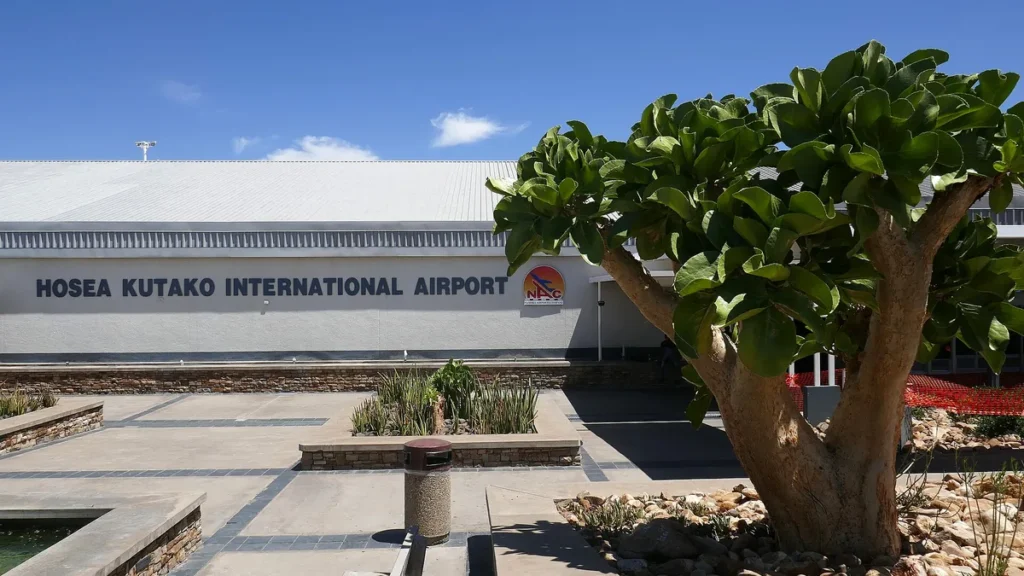
Hosea Kutako International Airport
Hosea Kutako International Airport
Hosea Kutako International Airport (WDH) — Airport Profile
Hosea Kutako International Airport (IATA: WDH | ICAO: FYWH) is Namibia’s principal international gateway, connecting southern Africa to intercontinental routes and serving as the primary point of entry for travellers, business delegations, and freight operators moving through one of the continent’s most strategically positioned nations. Named after the revered Herero chief and independence advocate Hosea Kutako, the airport carries both practical and symbolic weight in Namibia’s post-independence story.
About
Hosea Kutako International Airport sits approximately 45 kilometres east of Windhoek, the Namibian capital, in the semi-arid landscape of the Khomas Highland. It functions as the country’s dominant commercial aviation hub, handling the overwhelming majority of international passenger movements and virtually all long-haul cargo traffic entering or leaving Namibia. Within the broader African aviation network, WDH occupies a mid-tier position — smaller in volume than the continent’s mega-hubs at Johannesburg, Nairobi, or Addis Ababa, but operationally significant as a southern African spoke and, increasingly, as a point of direct intercontinental access.
The airport’s origins trace to the era of South African administration over South West Africa, when the site east of Windhoek was developed to accommodate larger jet aircraft than the older Eros Airport, which sits within the city boundary and continues to serve general aviation and domestic traffic. Hosea Kutako was formally established as the international facility and has operated in that capacity since Namibian independence in 1990, with the newly sovereign state assuming operational responsibility through what would become the Namibia Airports Company (NAC), the state-owned entity that manages the country’s principal airports.
The Namibia Airports Company has overseen several rounds of infrastructure investment at WDH since independence, including terminal upgrades, apron expansions, and improvements to navigation and ground-handling systems. Industry observers have noted that the airport’s physical capacity has at times struggled to keep pace with growth in tourist arrivals and transit traffic, prompting ongoing discussions — and, according to publicly disclosed government planning documents, formal feasibility work — around longer-term expansion of the terminal footprint and airside infrastructure.
Country
Namibia is a southern African republic bordered by South Africa, Botswana, Zambia, Angola, and the Atlantic Ocean. Its capital, Windhoek, is the administrative, economic, and aviation centre of a country whose population is estimated in the low millions — making it one of the most sparsely populated nations on the continent relative to its considerable land area. Namibia is a member of the Southern African Development Community (SADC) and the African Union, and its economy is anchored by mining, tourism, fishing, and a growing financial services sector. The country’s political stability and well-maintained road and air infrastructure give it an outsized role in regional logistics and tourism relative to its population size. → Read the Namibia expert briefing
Airlines Based Here
Air Namibia, the national flag carrier, operated from Hosea Kutako as its primary hub for decades before the airline was placed into liquidation in 2021 following sustained financial losses — a development that significantly reshaped the airport’s carrier profile. The successor initiative, Namibia’s efforts to re-establish a national carrier under the working identity of Namibia Airways or a similarly branded entity, has been the subject of ongoing government deliberation, and industry estimates suggest that a reconstituted national carrier remains a policy priority as of 2026, though operational details have evolved. In the absence of a dominant home carrier, Hosea Kutako now functions primarily as a destination and spoke airport for foreign airlines rather than a hub in the traditional sense. Ethiopian Airlines, South African Airways, Lufthansa, and Kenya Airways have all maintained scheduled services at WDH, using the airport as a point on their southern African networks. Low-cost and regional carriers, including FlySafair and Airlink — both South African operators with strong southern African footprints — provide critical short-haul connectivity, particularly on the Windhoek–Johannesburg corridor, which is the airport’s highest-frequency route.
Flights and Destinations
The route network at Hosea Kutako reflects Namibia’s position as a tourism-dependent economy with strong ties to Europe, southern Africa, and East Africa. The Windhoek–Johannesburg route, served by multiple operators, is the airport’s busiest corridor and functions as the primary onward connection for travellers routing through OR Tambo International Airport. Direct intercontinental services have historically included Frankfurt, a route that has been served by Lufthansa and previously by Air Namibia, making it one of the few direct European links available to Namibian travellers. Addis Ababa is served by Ethiopian Airlines, providing a critical connection into that carrier’s extensive African and intercontinental network. Nairobi, served by Kenya Airways, links WDH into East Africa’s aviation grid. Within the southern African region, destinations including Cape Town, Harare, Lusaka, and Gaborone feature in the network, supporting both business and leisure travel. Seasonal and charter services expand the airport’s effective reach during peak tourism periods, connecting WDH to additional European markets. The overall network, while not extensive by the standards of a major African hub, covers the key corridors that Namibia’s inbound tourism and outbound business travel demand.
Facilities and Capacity
Hosea Kutako International Airport operates a single passenger terminal building, which handles both international arrivals and departures. The terminal incorporates airside retail, food and beverage concessions, and standard international processing facilities including immigration, customs, and security screening. The airport is served by two runways — the primary instrument runway oriented to accommodate the prevailing wind conditions of the Khomas Highland plateau, and a secondary runway — giving it redundancy uncommon among airports of its traffic class in the region. The elevation of the airport, sitting at over 1,700 metres above sea level, is an operationally relevant factor that affects aircraft performance calculations, particularly for heavily loaded long-haul departures. Cargo facilities are present on the airfield, supporting Namibia’s export of perishable goods, fish products, and minerals, though the cargo operation is modest in scale compared to major African freight hubs. By standard industry classification, Hosea Kutako is a medium-sized regional hub — larger than many single-country African airports but well below the traffic volumes of the continent’s primary gateways. According to publicly disclosed traffic data from the Namibia Airports Company, passenger movements have fluctuated in the post-pandemic period, with recovery trajectories broadly consistent with regional trends.
Visa Regulations
Namibia operates a relatively open visa regime for many of the source markets that generate significant traffic through Hosea Kutako. Citizens of the United States, the United Kingdom, and most European Union member states have historically been eligible to enter Namibia visa-free for stays up to 90 days, subject to holding a valid passport and meeting standard entry conditions. Many regional African passport holders — including those from South Africa, Botswana, Zimbabwe, and other SADC member states — also benefit from visa-free or simplified entry arrangements under bilateral and regional agreements. For nationals of countries not covered by visa-free provisions, Namibia has offered visa-on-arrival facilities at Hosea Kutako, though travellers are strongly advised to verify current arrangements before departure, as visa policies are subject to change through ministerial notice. An eVisa system has been under consideration and development as part of Namibia’s broader tourism facilitation agenda; travellers should confirm the current status of any electronic visa option through official Namibian government channels. Visa rules change — visit the live visa requirements lookup for current information by passport.
Recent Developments
The most consequential development affecting Hosea Kutako in recent years has been the continued reshaping of its carrier landscape following the liquidation of Air Namibia in 2021. The airport’s management and the Namibian government have worked to attract replacement capacity, and the period from 2024 to 2026 has seen ongoing discussions with potential airline partners about establishing or restoring direct services on key routes, including the Frankfurt corridor. Airlink has consolidated its position as a significant operator at WDH, expanding its southern African network connections through the airport. Terminal maintenance and airside works have continued under the Namibia Airports Company’s capital programme, though the scale and timeline of any major expansion remain subject to government budget approvals and traffic demand projections. The broader policy environment — including Namibia’s ambitions around its green hydrogen economy and the associated expectation of increased business travel — has been cited in industry commentary as a potential driver of future aviation demand at WDH. Regulatory engagement between the Namibia Civil Aviation Authority and ICAO’s regional office has continued in the areas of safety oversight and airspace modernisation.
News and Reports
Travellers, journalists, and analysts tracking developments at Hosea Kutako International Airport and the wider Namibian aviation sector should consult several authoritative sources. The Namibia Airports Company publishes operational updates and press releases through its official communications channels. The Namibia Civil Aviation Authority (NCAA) is the regulatory body responsible for safety oversight, licensing, and airspace management, and issues formal notices and regulatory publications relevant to operators and researchers. At the continental level, IATA’s Africa and Middle East regional office produces periodic reports on African aviation market conditions, capacity trends, and regulatory developments that contextualise WDH’s performance within the broader regional picture. ICAO’s Eastern and Southern African Office (ESAF), based in Nairobi, covers Namibia within its regional safety and technical assistance mandate and publishes relevant documentation through ICAO’s official channels. Aviation trade publications including ch-aviation, Anna.aero, and the African Business Aviation Association’s communications also provide route-level and operational reporting on southern African airports.
Related Research
- Namibia Expert Briefing — in-depth country analysis for researchers and investors
- Namibia Statistics — demographic, economic, and infrastructure data
- African Airports — comparative profiles across the continent
- African Airlines — carrier analysis and network data for African aviation
- Visa Requirements — live lookup tool for entry requirements by passport and destination
- Country Comparison — benchmark Namibia against peer economies and aviation markets