African telecom — operators, infrastructure, and mobile money
Africa’s telecommunications sector has undergone a structural transformation over the past decade that few analysts predicted in its speed or depth. From the fragmented, state-owned monopolies of the 1990s to a continent now served by pan-African giants managing hundreds of millions of subscribers across dozens of regulatory jurisdictions, the industry has become one of the most consequential arenas for investment, policy, and economic development on the continent. As of 2026, the convergence of mobile money, subsea cable infrastructure, spectrum liberalisation, and independent tower infrastructure is reshaping what connectivity means for African households, businesses, and governments alike.
The Dominant Operators: Scale, Strategy, and Market Reach
No conversation about African telecoms begins anywhere other than MTN Group. Headquartered in Johannesburg, MTN operates across more than 18 markets spanning West, Central, East, and Southern Africa, as well as the Middle East, and its subscriber base consistently ranks among the largest of any operator globally. MTN’s strategic pivot toward fintech and digital services — anchored by its MTN MoMo platform — has repositioned it less as a traditional telco and more as a technology and financial services company with a mobile network underneath. Airtel Africa, listed in London and majority-owned by India’s Bharti Airtel, operates across 14 African markets with particular strength in East and Central Africa, including Uganda, Kenya, Tanzania, Zambia, and Nigeria. Its own mobile money business, Airtel Money, was partially carved out ahead of a planned separate listing, signalling how much value investors now assign to the payments layer independent of voice and data. Orange Middle East and Africa — the continental arm of the French incumbent — brings a different profile: deep penetration in Francophone West Africa and North Africa, with Orange Money embedded across markets including Côte d’Ivoire, Senegal, Mali, and Cameroon. Vodacom, majority-owned by Vodafone, anchors Southern Africa with dominant positions in South Africa, Tanzania, Mozambique, and the Democratic Republic of Congo, while its acquisition of a controlling stake in Safaricom — the Nairobi-listed operator behind M-Pesa — extended its East African footprint considerably. Maroc Telecom, controlled by the UAE’s e& (formerly Etisalat), operates across Morocco and more than a dozen sub-Saharan markets, giving it an unusual North-to-West corridor. Etisalat’s broader African presence, now consolidated under the e& brand, has grown through both direct operations and strategic stakes, with the group increasingly active in Egypt and parts of West Africa. Together, these operators define the competitive architecture of the continent, though national champions and smaller regional players continue to hold meaningful positions in individual markets.
Mobile Money: The Financial Layer That Changed Everything
If there is a single innovation that has defined African telecoms in the twenty-first century, it is mobile money. M-Pesa, launched by Safaricom in Kenya in 2007, demonstrated that a mobile network could function as a bank for populations that commercial banks had structurally ignored. By 2026, M-Pesa processes transaction volumes that rival the GDP of several African nations on an annualised basis, and its expansion into Ethiopia — one of the continent’s most populous and historically closed markets — represents one of the most watched commercial experiments in the region. MTN MoMo has scaled aggressively across MTN’s footprint, with industry estimates suggesting it now serves well over 50 million active wallets, making it one of the largest mobile money platforms globally by active users. Airtel Money and Orange Money have similarly embedded themselves as critical financial infrastructure in markets where bank account penetration remains low. The regulatory evolution around mobile money has been uneven but broadly positive: central banks in Ghana, Tanzania, Uganda, and Rwanda have developed relatively sophisticated licensing frameworks, while others are still working through the tension between financial inclusion mandates and prudential oversight. The interoperability question — whether wallets across different operators can transact seamlessly — remains partially unresolved in several markets, though Ghana’s interoperability framework has been cited as a regional model. The next competitive frontier is merchant payments, credit, and insurance layered on top of the wallet infrastructure, areas where all the major operators are investing heavily.
4G Expansion and the Slow March Toward 5G
4G LTE coverage has expanded substantially across African capitals and secondary cities over the past five years, driven by spectrum auctions, network sharing agreements, and falling equipment costs. South Africa, Nigeria, Kenya, Egypt, and Morocco have the most mature 4G ecosystems, with urban coverage in major cities broadly comparable to mid-tier emerging markets elsewhere. South Africa conducted its long-delayed spectrum auction in 2022, releasing sub-1GHz and mid-band spectrum that operators including MTN South Africa, Vodacom, Rain, and Telkom had lobbied for over nearly a decade. The auction’s conclusion was widely seen as unblocking a significant investment cycle. 5G, meanwhile, is live in South Africa, Nigeria, Kenya, and Egypt, though according to the latest sector reports, 5G penetration remains in the low single digits across even the most advanced markets. The economics of 5G rollout in Africa differ materially from those in Europe or East Asia: lower average revenue per user, vast geographic distances, unreliable power grids, and a device ecosystem still dominated by 4G-capable handsets mean that operators are deploying 5G selectively in high-density urban corridors and enterprise zones rather than pursuing blanket coverage. Fixed wireless access — using 5G or advanced 4G to deliver home broadband — has emerged as a more immediately viable use case than consumer mobile 5G in several markets, particularly in South Africa where Rain has built a business almost entirely on this model.
Subsea Cables and the Backbone of African Connectivity
Africa’s international bandwidth story has been transformed by a wave of subsea cable investment that accelerated through the early 2020s and continues into 2026. The 2Africa cable — a consortium project involving Meta, MTN, Orange, Vodafone, and others — is among the longest subsea cable systems ever built, circumnavigating the continent and connecting it to Europe and Asia with capacity that dwarfs anything previously available to African landing points. Google’s Equiano cable, landing in Nigeria, Namibia, South Africa, and other points along the West African coast, brought hyperscaler-grade capacity directly to the continent for the first time at scale. These join older but still-operational systems including WACS (West Africa Cable System), EASSy (Eastern Africa Submarine System), and SAT-3, which despite its age remains part of the infrastructure stack in several West African markets. The practical effect of this cable buildout is a dramatic reduction in international bandwidth costs, which in turn is enabling local internet service providers, cloud providers, and content delivery networks to serve African users with latency and pricing that were simply not achievable five years ago. The bottleneck has shifted inland: terrestrial fibre networks connecting landing stations to population centres remain underdeveloped in many countries, and the last-mile problem — getting affordable broadband from a city’s fibre ring to individual homes and businesses — is still largely unsolved outside a handful of markets.
Tower Infrastructure: The Rise of Independent Towercos
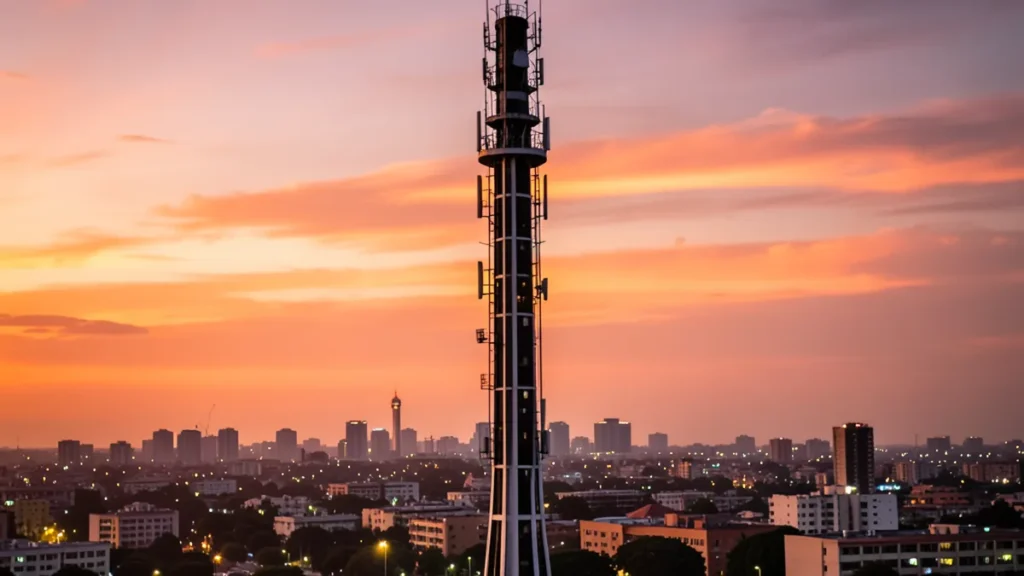
One of the less visible but structurally significant shifts in African telecoms has been the separation of passive tower infrastructure from active network operations. IHS Towers, listed on the New York Stock Exchange, is the largest independent tower company in Africa and one of the largest in the world, with a portfolio spanning Nigeria, South Africa, Zambia, Rwanda, Cameroon, and several other markets. Helios Towers, listed in London, operates across a complementary set of markets including Tanzania, DRC, Ghana, Senegal, and South Africa. The business model — owning towers and leasing space to multiple operators — improves capital efficiency for the operators while giving towercos a recurring, contracted revenue stream. Airtel Africa has been among the most active in monetising its tower assets, completing a series of sale-and-leaseback transactions across multiple markets that generated significant balance sheet proceeds while retaining operational access to the infrastructure. MTN has similarly divested tower portfolios in several markets. The colocation ratio — the average number of tenants per tower — remains below the levels seen in mature markets like India or the United States, which means there is meaningful organic growth available to towercos simply by adding tenants to existing structures. Regulatory treatment of towercos varies considerably across jurisdictions, and spectrum-sharing and active infrastructure sharing remain more contentious than passive sharing in most regulatory environments.
The Rural-Urban Divide and the Road Ahead
Despite the scale of investment and the genuine progress made, the rural-urban digital divide in Africa remains one of the sector’s defining challenges. Industry estimates suggest that while urban mobile broadband penetration in major African cities has reached levels broadly comparable to other emerging markets, rural connectivity — particularly meaningful data connectivity rather than basic voice coverage — lags significantly. The economics are difficult: low population density, long distances from fibre backhaul, unreliable grid power requiring costly diesel generation or solar solutions, and lower average revenues per user make rural network investment challenging to justify on purely commercial terms. Universal service funds, funded by levies on operators, exist in most jurisdictions but have a mixed record of deployment effectiveness. Satellite connectivity — particularly low-earth orbit solutions from providers including Starlink, which has received licences in a growing number of African markets — offers a potential bridge for remote areas, though affordability of terminal equipment remains a barrier for the populations most in need. Over the next two years, the sector’s trajectory points toward continued consolidation among smaller operators, deeper integration of financial services into operator platforms, accelerating 5G deployment in urban markets, and ongoing tension between regulators seeking to maximise spectrum revenue and operators arguing for pricing that enables broader coverage investment. The African telecom sector in 2026 is not a story of problems solved but of infrastructure being built in real time, with enormous consequences for economic inclusion across a continent of 1.4 billion people.