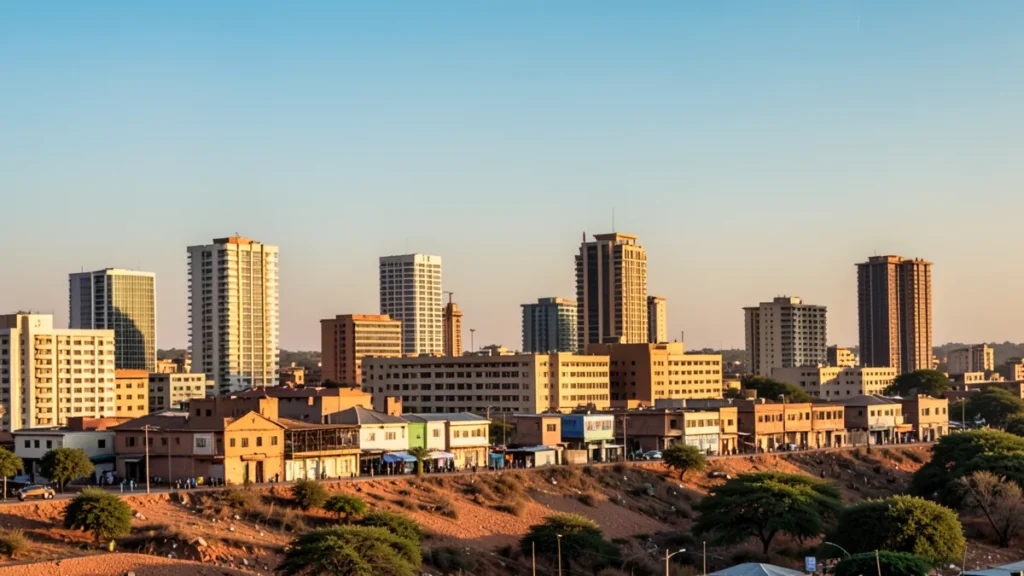
Sudan statistics — population, economy, trade and telecom
Sudan occupies a pivotal position in northeast Africa, sharing borders with seven countries and sitting at the crossroads of sub-Saharan Africa and the Arab world. Yet the country’s statistical profile in 2026 reflects a nation under profound stress. The civil war that erupted in April 2023 between the Sudanese Armed Forces and the Rapid Support Forces has displaced millions, collapsed public services, and shattered an already fragile economy. Understanding Sudan’s data — however incomplete — is essential for humanitarian planners, investors, and policymakers tracking one of the continent’s most consequential crises.
Population and Demographics
Sudan’s population is estimated at approximately 48 to 49 million people as of 2025, making it one of the larger nations in Africa by headcount, though reliable census data remains elusive given the ongoing conflict. The UN Population Division projects an annual growth rate of roughly 2.5 to 2.7 percent, sustained by high fertility rates that place the total fertility rate at approximately 4.5 births per woman. The median age is estimated at around 19 to 20 years, reflecting an overwhelmingly young population with significant dependency pressures on working-age cohorts. Urbanisation stands at roughly 36 to 38 percent, with Khartoum — or what remains of its functional urban core following intense fighting — historically accounting for the largest urban concentration. Conflict-driven displacement has dramatically distorted internal migration patterns; the UN estimates that by late 2024 Sudan had become home to one of the world’s largest internal displacement crises, with well over eight million internally displaced persons and several million more who had fled to neighbouring countries including Egypt, Chad, and South Sudan.
Economic Indicators
Sudan’s economy has been in freefall since the outbreak of conflict. IMF estimates put GDP at roughly 35 to 40 billion USD in nominal terms for 2024, though the margin of uncertainty is exceptionally wide given the collapse of statistical reporting capacity. GDP per capita is estimated at approximately 700 to 800 USD, placing Sudan among the lower-income economies on the continent. The IMF projected GDP contraction of somewhere between 12 and 20 percent for 2023–2024 combined, with recovery prospects highly contingent on a ceasefire that had not materialised at the time of writing. Inflation has been catastrophic: consumer price inflation was running at triple-digit levels through much of 2024, with some estimates suggesting annual inflation exceeded 200 percent at its peak, driven by currency collapse, supply chain disruption, and fuel shortages. The Sudanese pound has lost the vast majority of its value against the US dollar on parallel markets. Unemployment, already elevated before the war at roughly 19 to 22 percent, has surged as businesses shuttered across Khartoum and Darfur. Debt-to-GDP ratios were already unsustainable before the conflict; World Bank data indicated Sudan’s external debt burden exceeded 150 percent of GDP in the pre-war period, and the conflict has made debt restructuring negotiations effectively impossible to progress.
Trade and External Accounts
Sudan’s export base was already narrow before the war. Gold has been the dominant export commodity since South Sudan’s secession in 2011 removed the majority of Sudan’s oil reserves. Industry reports suggest gold accounted for roughly 70 to 80 percent of formal export revenues in the years immediately preceding the conflict, with livestock and sesame seeds representing other meaningful export lines. The UAE, Saudi Arabia, China, and Egypt have historically been Sudan’s principal trading partners. On the import side, Sudan relies heavily on fuel, wheat, medicines, and manufactured goods. The current account deficit was already substantial before the war; the conflict has further compressed export capacity while humanitarian import needs have surged. Formal trade data for 2024 is fragmentary, but the overall picture is one of severe external account deterioration, with foreign exchange reserves critically depleted and access to international financial markets effectively closed.
Key Sectors
Agriculture remains the backbone of Sudan’s economy in terms of employment, historically engaging roughly 40 to 45 percent of the labour force. Sudan possesses significant arable land and water resources, including access to the Nile system, and produces sorghum, millet, wheat, sesame, groundnuts, and cotton. Livestock herding is culturally and economically central, particularly in Darfur and Kordofan — regions now severely affected by fighting. The mining sector, centred on artisanal and semi-industrial gold extraction, had been a growth driver in the 2010s, with Sudan ranking among Africa’s top ten gold producers. However, conflict has disrupted mining operations and diverted revenues through informal and RSF-controlled channels, according to multiple investigative reports. Industry and manufacturing were concentrated in Khartoum and remain largely non-functional in conflict-affected areas. The services sector, including retail, finance, and transport, has contracted sharply. Tourism, never a major contributor, has effectively ceased. Petroleum production, centred on fields now largely within South Sudan, contributes marginally through transit fees and residual northern fields, though these revenues have also been disrupted.
Telecommunications and Digital
Sudan’s telecommunications sector entered the conflict period with relatively modest but growing penetration metrics. ITU and GSMA data from the pre-conflict period indicated mobile penetration at approximately 65 to 70 percent of the population on a SIM-card basis, though unique subscriber penetration was considerably lower. Internet penetration was estimated at roughly 30 to 35 percent, with mobile internet accounting for the dominant share of connectivity. The principal operators have historically included Zain Sudan, MTN Sudan, and Sudani (Sudan Telecom). Network infrastructure across Khartoum and conflict zones has suffered significant physical damage, and deliberate internet shutdowns — a tactic used by Sudanese authorities in prior years — have compounded connectivity collapse during the war. Mobile money services were at an early stage of development relative to East African peers; platforms such as Zain Cash had begun gaining traction but penetration remained limited. Restoring digital infrastructure will be a foundational requirement for any post-conflict economic recovery, given the role of mobile finance in humanitarian cash transfer programming.
Sources and Methodology
This dashboard draws on data and estimates from the World Bank’s World Development Indicators and Sudan country pages, the International Monetary Fund’s Article IV consultations and World Economic Outlook databases, the United Nations Population Division, the UN Office for the Coordination of Humanitarian Affairs (OCHA) Sudan situation reports, the African Union, the International Telecommunication Union (ITU), and GSMA Intelligence. Where Sudan’s Central Bureau of Statistics has published accessible data, it has been referenced; however, the ongoing conflict has severely degraded national statistical capacity, and many figures cited here carry wide confidence intervals. Readers should treat all economic estimates for 2023–2025 as indicative rather than definitive, and should consult the most recent IMF and World Bank Sudan-specific publications for updated projections. Figures cited reflect the best available information as of early 2026.
For deeper qualitative analysis of Sudan’s political economy, conflict dynamics, and reconstruction outlook, visit the Sudan expert briefing. To compare Sudan’s indicators with those of other African nations, explore all African country statistics on this platform. For broader context on macroeconomic trends shaping the continent, see the African economy pillar.