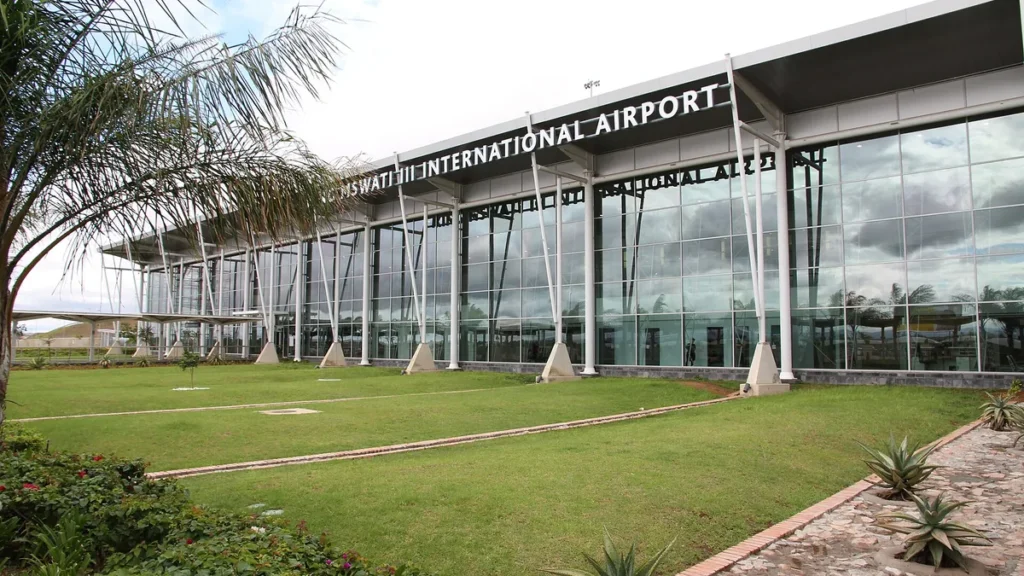
King Mswati III International Airport
King Mswati III International Airport
King Mswati III International Airport is Eswatini’s principal gateway to the world — a small but strategically positioned facility that reflects both the ambitions and the constraints of one of sub-Saharan Africa’s most compact landlocked kingdoms. For travellers, journalists, and aviation analysts tracking the evolution of regional air connectivity across southern Africa, the airport offers a revealing case study in how a small-state airport navigates the pressures of tourism dependency, carrier consolidation, and infrastructure investment in a competitive neighbourhood dominated by OR Tambo International in Johannesburg.
About
King Mswati III International Airport (IATA: SHO; ICAO: FDSK) serves the city of Manzini, Eswatini’s commercial hub, and functions as the country’s sole international airport. It sits in the Sikhuphe area of the Lubombo region in eastern Eswatini, positioned to draw traffic from both the domestic population and cross-border visitors travelling from Mozambique and South Africa. The airport is named in honour of King Mswati III, the reigning monarch of Eswatini, and its construction and opening represented a deliberate statement of national sovereignty and economic aspiration for a country that had previously relied heavily on Matsapha Airport — a smaller, operationally limited facility closer to Manzini — for its limited scheduled air services.
The airport was developed as a greenfield project intended to replace Matsapha Airport and was inaugurated in 2014, though commercial operations ramped up gradually in subsequent years as carriers assessed the viability of routes into the new facility. The Civil Aviation Authority of Eswatini (CAAE) oversees regulatory functions, while the Eswatini Airports Company manages day-to-day operations. The project was financed with a combination of government funding and external development support, and the facility was designed from the outset to international standards capable of handling wide-body jet aircraft — a deliberate upgrade from the limitations of Matsapha.
Since opening, the airport has undergone incremental operational improvements rather than large-scale physical expansion, with the primary challenge being route development and carrier attraction rather than physical capacity. Industry observers note that the airport’s catchment area is constrained by Eswatini’s small population and the proximity of major South African airports, which continue to draw Swati travellers for long-haul connections.
Country
Eswatini — formerly known internationally as Swaziland until the country’s official renaming in 2018 — is a landlocked kingdom in southern Africa, bordered by South Africa to the north, west, and south, and Mozambique to the east. The administrative capital is Mbabane, while Lobamba serves as the royal and legislative capital; Manzini is the largest city by population and the country’s commercial centre. With a population estimated in the low millions, Eswatini is one of Africa’s smallest nations by both area and population, yet it maintains a distinct cultural identity, a significant tourism sector anchored by wildlife reserves and cultural festivals, and a manufacturing base that has historically benefited from trade preference agreements. Its regional position — wedged between two larger economies — shapes both its aviation market and its economic outlook in fundamental ways. → Read the Eswatini expert briefing
Airlines based here
Eswatini does not currently operate a national flag carrier in the conventional sense following the cessation of operations by earlier Swati airline ventures. King Mswati III International Airport therefore functions primarily as a point-of-call airport for visiting regional carriers rather than as a hub for a home airline. Airlink, the South African independent regional carrier, has been the most consistent scheduled operator at SHO, providing the critical link between Eswatini and Johannesburg’s OR Tambo International Airport that forms the backbone of the airport’s commercial schedule. Airlink operates this route as part of its extensive southern African regional network and is the carrier most travellers and business passengers rely upon for onward connections to intercontinental services. Other carriers have examined the market at various points, and charter operators serve the airport in connection with Eswatini’s tourism and corporate travel demand, but as of 2026 the scheduled network remains narrow, with Airlink occupying a dominant position among commercial operators.
Flights and destinations
The airport’s scheduled network is anchored by its Johannesburg (OR Tambo) connection, which serves as the primary hub through which Swati travellers access intercontinental routes to Europe, North America, Asia, and beyond. This single link is commercially significant because it feeds passengers into one of Africa’s busiest hub airports, effectively integrating Eswatini into the global aviation network despite the country’s limited direct international services. Beyond Johannesburg, the airport has at various times supported or attracted interest in connections to Maputo in Mozambique — a logical regional pairing given the shared border — as well as Durban (King Shaka International) and Cape Town within South Africa, reflecting the travel patterns of both leisure visitors and the business community. Harare in Zimbabwe and Lusaka in Zambia represent logical future regional destinations given Eswatini’s position within the southern African Development Community (SADC) travel market. Charter and seasonal services have also connected the airport to destinations aligned with Eswatini’s tourism calendar. The overall network profile places SHO firmly in the category of a thin-route regional airport with a hub-dependent connectivity model rather than a multi-destination international gateway in its own right.
Facilities and capacity
King Mswati III International Airport was designed and built to international standards, featuring a single terminal building that incorporates both departures and arrivals functions under one roof, with dedicated areas for check-in, immigration, customs, and a modest retail and food and beverage offering. The terminal was conceived to handle international traffic with appropriate processing facilities including immigration counters capable of managing both Eswatini nationals and foreign visitors. The airport has a single paved runway capable of accommodating wide-body jet aircraft, which represents a significant operational upgrade over the former Matsapha facility and allows carriers operating larger regional jets and narrow-body aircraft to serve the airport without restriction. Cargo handling facilities are present, supporting both belly-hold freight on scheduled services and dedicated cargo movements, which are relevant to Eswatini’s manufacturing and agricultural export sectors. According to publicly disclosed information, the airport is classified as a small international airport by regional standards — it does not approach the traffic volumes of medium or large African hubs — but its infrastructure specification exceeds what its current traffic levels strictly require, a deliberate investment in future capacity. Planned or ongoing facility improvements have focused on operational efficiency and passenger experience rather than major physical expansion, reflecting the airport’s current traffic profile.
Visa regulations
Travellers arriving at King Mswati III International Airport are subject to Eswatini’s national visa regime, which is generally regarded as relatively open by regional standards. Citizens of the United States, the United Kingdom, and most European Union member states have historically been able to enter Eswatini without a prior visa for short stays, typically up to 30 days, under visa-free arrangements — though travellers are advised to verify current conditions before departure as policies are subject to change. Citizens of neighbouring South Africa and Mozambique, as well as most other SADC member states, similarly benefit from facilitated entry arrangements reflecting the region’s integration agenda. For nationalities not covered by visa-free access, Eswatini has offered visa-on-arrival facilities, and the government has at various stages explored or implemented eVisa systems to streamline pre-travel authorisation. Passport validity requirements, proof of onward travel, and sufficient funds requirements apply as standard conditions of entry. Because visa regulations change and individual circumstances vary, travellers should consult official sources before travel. → Check the live visa requirements lookup
Recent developments
In the period from approximately 2024 to 2026, King Mswati III International Airport has continued to operate within a challenging commercial environment shaped by the broader pressures facing thin-route African aviation: fuel cost volatility, currency constraints, and the ongoing dominance of South African hub airports in capturing regional traffic. Airlink has maintained its Johannesburg service as the commercial spine of the airport’s scheduled operations, and industry estimates suggest that load factors on this route reflect a stable if modest demand base. Discussions around attracting additional scheduled carriers to the airport have continued at the level of the Civil Aviation Authority of Eswatini and the relevant government ministries, with tourism promotion identified as a key lever for stimulating new route development. The airport authority has also focused on improving ground handling standards and passenger processing efficiency as part of efforts to position SHO as a credible entry point for the growing adventure tourism and cultural tourism market that Eswatini actively promotes. No major runway or terminal expansion projects have been publicly confirmed as fully funded and under construction as of early 2026, though the airport’s longer-term master planning continues to account for potential traffic growth scenarios.
News and reports
Researchers and journalists tracking developments at King Mswati III International Airport should consult several authoritative source categories. The Civil Aviation Authority of Eswatini publishes regulatory notices, safety oversight reports, and operational updates through its official communications channels and is the primary domestic authority for matters relating to the airport’s certification and compliance status. The Eswatini Airports Company, as the operator, periodically releases information on operational matters and development plans. At the regional and continental level, the International Air Transport Association (IATA) produces Africa-focused aviation market reports that contextualise Eswatini’s airport within broader southern African traffic trends, while the ICAO Eastern and Southern African Regional Office (ESAF) in Nairobi provides regulatory and safety oversight data relevant to the country’s aviation system. Aviation trade publications including ch-aviation, Anna.aero, and the African Aviation journal regularly cover route developments and airport news across the continent and are useful secondary sources for tracking carrier announcements and traffic trends at smaller African airports such as SHO. Travellers seeking current operational information — flight schedules, terminal hours, ground transport — should consult airline booking platforms and the airport operator directly.
Related research
- Eswatini Expert Briefing — in-depth country analysis for researchers and investors
- Eswatini Statistics — key economic, demographic, and trade data
- African Airports Directory — profiles of airports across the continent
- African Airlines Directory — carrier profiles and route network analysis
- Visa Requirements Lookup — live tool for checking entry requirements by nationality
- Country Comparison Tool — compare Eswatini with peer economies across key indicators