National Museum of Ethiopia
National Museum of Ethiopia
About
The National Museum of Ethiopia in Addis Ababa is one of the most scientifically significant museums on the African continent. It holds the original fossil remains of some of humanity’s earliest known ancestors, making it a pilgrimage site not only for tourists but for paleoanthropologists, evolutionary biologists, and anyone with a serious interest in where the human story begins. Few museums anywhere in the world can claim to house evidence this old, this consequential, or this well-contextualised within a living national culture.
The museum was founded in 1958, initially operating under the imperial government of Haile Selassie I. It was established to consolidate Ethiopia’s growing collections of natural history, archaeology, and ethnography under a single national institution. In its early decades it functioned partly as a royal showcase, reflecting the prestige ambitions of the imperial court, but its scientific mandate steadily deepened as international research partnerships expanded through the 1960s and 1970s.
The museum’s profile rose dramatically in 1974 when the fossilised remains of Australopithecus afarensis — the specimen the world came to know as Lucy — were excavated in the Afar region by a team led by Donald Johanson and Yves Coppens. Lucy’s remains were eventually housed at the National Museum, where they remain today. The institution has since become the anchor of Ethiopia’s paleoanthropological identity, drawing researchers and visitors from across the world to its ground-floor fossil galleries.
Country and city context
Ethiopia is a landlocked country in the Horn of Africa with a population exceeding 120 million, making it one of the continent’s most populous nations. It is the only African country never to have been formally colonised, a fact that shapes its cultural institutions with a particular sense of sovereign pride. Addis Ababa, the capital, sits at roughly 2,400 metres above sea level and functions simultaneously as Ethiopia’s political centre and the diplomatic hub of the African Union. The city is fast-changing, with new infrastructure sitting alongside older neighbourhoods, and the museum occupies a central position within this layered urban fabric. → Read the Ethiopia expert briefing
Collection highlights
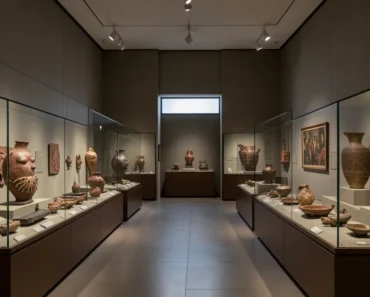
The museum’s collections span four floors and range from deep prehistory to the twentieth century. The following pieces and galleries are among its most visited and most discussed.
- Lucy (AL 288-1) — The partial skeleton of Australopithecus afarensis, dated to approximately 3.2 million years ago, displayed on the ground floor; the original bones are shown alongside a cast that visitors can study in detail.
- Selam — The fossilised skull and partial skeleton of a juvenile Australopithecus afarensis child, sometimes called “Lucy’s baby,” discovered in 2000 and representing one of the most complete early hominin juvenile specimens ever found.
- Ardi (Ardipithecus ramidus) — Cast and interpretive material relating to the 4.4-million-year-old hominin discovered in the Middle Awash, pushing the known record of bipedal ancestors further back than Lucy.
- Prehistoric stone tool collections — Oldowan and Acheulean tools recovered from Ethiopian sites, tracing the development of early human technology across hundreds of thousands of years.
- Imperial throne and regalia — Artefacts from the court of Haile Selassie I, including ceremonial objects that document the final chapter of Ethiopia’s three-thousand-year imperial tradition.
- Ethnographic gallery — A broad collection of traditional dress, jewellery, musical instruments, and ritual objects representing Ethiopia’s more than eighty distinct ethnic groups.
- Medieval and Aksumite collections — Coins, crosses, and inscribed objects from the Aksumite Empire and the medieval Christian kingdom, contextualising Ethiopia’s deep pre-colonial civilisational record.
Architecture and building
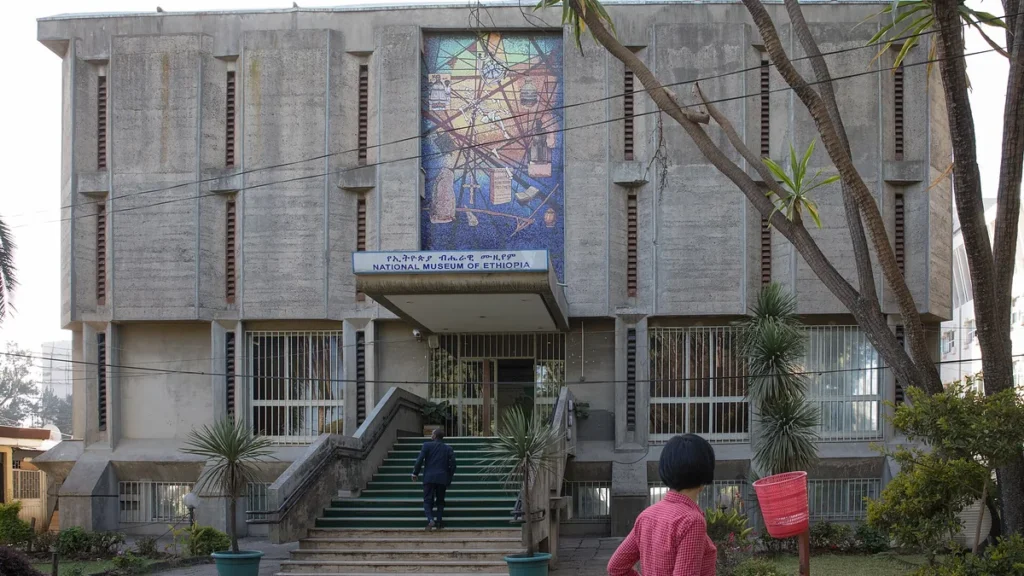
The National Museum of Ethiopia occupies a building in the King George VI Street area of central Addis Ababa. The structure dates to the mid-twentieth century and reflects the institutional architecture of the late imperial period, functional and formal rather than monumental. The building is not widely attributed to a single celebrated architect in the public record. Renovation and upgrading work has been carried out at various points to improve gallery presentation, climate control for the fossil collections, and visitor facilities, though the museum has operated continuously without a major structural overhaul. Discussions about a purpose-built or significantly expanded facility have circulated for years given the scale and sensitivity of the collections, but no confirmed construction timeline has been publicly established as of the time of writing.
Visiting practical
The museum is located on King George VI Street in central Addis Ababa, within walking distance of several major hotels and easily reachable by taxi or ride-hailing app. It is generally open Tuesday through Sunday; visitors should confirm current hours directly with the museum before travelling, as opening times have varied. Ticket prices fall in a low band by international standards, with a modest differential between Ethiopian nationals and foreign visitors — a common and legally permitted practice in Ethiopian cultural institutions. Concessions are typically available for students with valid identification. The building has limited accessibility infrastructure for visitors with mobility impairments; those with specific requirements are advised to contact the museum in advance. Photography policies for the fossil galleries, particularly around Lucy’s original remains, should be confirmed on arrival.
Repatriation and debates
The National Museum of Ethiopia occupies an unusual position in global repatriation conversations: it is more often the institution seeking the return of objects than the one being asked to return them. Ethiopia has pursued the repatriation of cultural artefacts held in European collections for decades, most prominently the Obelisk of Axum, which was removed by Italian forces during the occupation of 1935–1941 and returned by Italy in sections between 2005 and 2008. The National Museum has been part of the broader institutional framework through which Ethiopia asserts its cultural sovereignty. Separately, the temporary loan of Lucy’s remains to the United States for a touring exhibition between 2007 and 2013 generated significant internal debate among Ethiopian scientists and heritage officials about the risks of moving irreplaceable fossils, and that debate has informed more cautious policies around the physical movement of original specimens since. The museum’s ethnographic holdings do not carry the same colonial-acquisition history that burdens many European ethnographic museums, given Ethiopia’s uncolonised status, though questions about community access and representation within the country remain part of ongoing curatorial discussion.
Recent developments
Confirmed reporting from the past 24 months on specific new exhibitions, leadership appointments, or structural expansions at the National Museum of Ethiopia is limited in the international press. The museum has continued to operate as a key node in Ethiopia’s cultural tourism infrastructure during a period of broader national recovery following the Tigray conflict, which ended with a peace agreement in November 2022 and whose aftermath has shaped public investment priorities across the country. Researchers and journalists planning to cover the museum’s current programming are advised to contact the institution directly or consult the Ethiopian Ministry of Tourism and Culture for the most current information. This profile will be updated as verified developments are confirmed.