Yves Saint Laurent Museum (Marrakech)
Yves Saint Laurent Museum (Marrakech)
Yves Saint Laurent Museum, Marrakech
The Yves Saint Laurent Museum in Marrakech stands at a rare intersection of haute couture and African cultural geography — a purpose-built institution dedicated to one of the twentieth century’s most influential designers, housed in the city that shaped much of his creative vision. It is one of two YSL museums in the world, the other being in Paris, and it remains among the most visited contemporary museums on the African continent.
About
Yves Saint Laurent first visited Marrakech in 1966 alongside his partner Pierre Bergé, and the city became a lifelong refuge and creative catalyst. The colours of the souks, the geometry of Islamic architecture, and the light of the Maghreb filtered through decades of his work. When Saint Laurent died in 2008, Bergé committed to honouring that relationship in a permanent, institutional form. The Fondation Pierre Bergé – Yves Saint Laurent, which had long managed the designer’s Parisian archive, drove the project forward.
The museum opened in October 2017, inaugurated by Pierre Bergé just months before his own death. It was conceived not as a retrospective monument but as a living archive — a place where the collection would rotate, breathe, and be studied. The Fondation continues to oversee programming and acquisitions, working in close collaboration with Moroccan cultural authorities. The institution sits adjacent to the Jardin Majorelle, the celebrated botanical garden that Saint Laurent and Bergé purchased in 1980 and restored from near-ruin, giving the museum complex a coherent biographical geography.
The museum’s curatorial direction has emphasised both the breadth of Saint Laurent’s archive — spanning roughly forty years of ready-to-wear and haute couture — and the specific Moroccan thread running through it. Exhibitions have been developed in dialogue with fashion historians, textile specialists, and Moroccan scholars, reflecting an awareness that the institution sits on African soil and carries responsibilities beyond simple brand commemoration.
Country and city context
Morocco occupies the north-western corner of the African continent, a country of striking geographic and cultural range — from the Atlas Mountains to Atlantic coastline, from Saharan fringe to Mediterranean port. Marrakech, founded in the eleventh century by the Almoravid dynasty, functions today as Morocco’s cultural and touristic heartland. Its medina is a UNESCO World Heritage Site, and the city draws millions of international visitors annually, sustaining a dense ecosystem of galleries, craft workshops, riads-turned-hotels, and contemporary art spaces. The presence of the YSL Museum has reinforced Marrakech’s position as a serious destination for design and fashion tourism, complementing rather than competing with the city’s older cultural institutions. → Read the Morocco expert briefing
Collection highlights
The permanent collection and rotating exhibitions draw from an archive of thousands of garments, sketches, and objects. Among the most significant holdings and display areas:
- Haute couture gowns: Rotating selections from Saint Laurent’s couture seasons, including pieces that directly reference Moroccan colour palettes and embroidery traditions.
- Sketch archive: Original design sketches displayed in dedicated gallery space, offering an unusually transparent view of the designer’s working process from concept to construction.
- The Moroccan inspiration gallery: A thematic room tracing the explicit influence of Marrakech — its markets, zellige tilework, and djellaba silhouettes — on specific collections across the decades.
- Accessories and jewellery: A curated display of statement pieces, including collaborations with jeweller Roger Vivier and the bold costume jewellery that became a YSL signature.
- Photography and portraiture: Works by photographers including Helmut Newton and David Seidner, contextualising the garments within the visual culture of their era.
- The auditorium programme: Not a static collection piece but a programmatic highlight — the museum’s 130-seat auditorium hosts lectures, film screenings, and symposia connecting fashion to broader cultural history.
Architecture and building
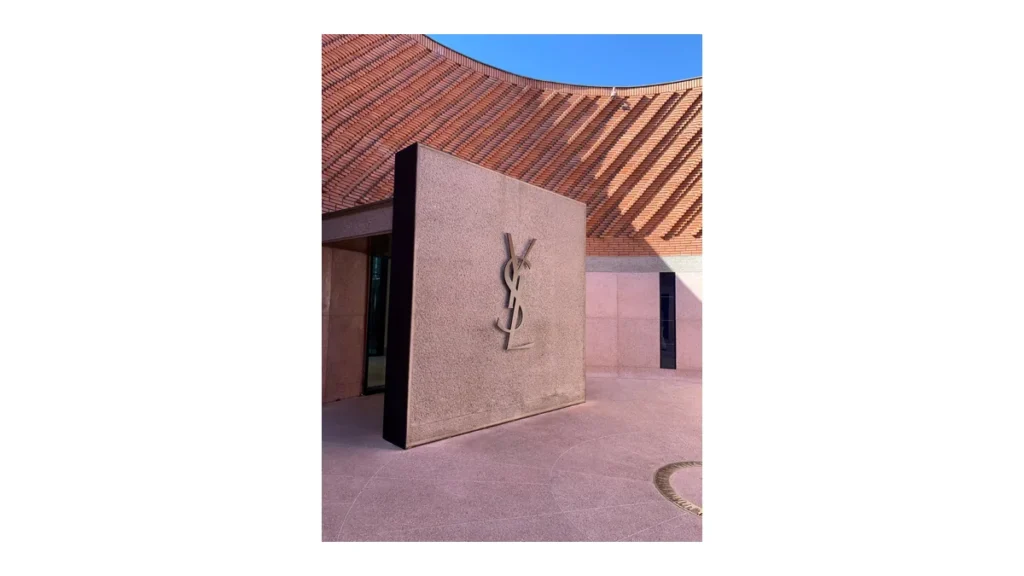
The museum building was designed by the Paris-based Studio KO, the architectural practice founded by Karl Fournier and Olivier marty, who have worked extensively in Morocco and are known for their sensitivity to local material culture. The structure, completed and opened in October 2017, covers approximately 4,000 square metres. Its exterior is clad in terracotta-coloured brick laid in a latticed pattern that references traditional Moroccan mashrabiya screens — a deliberate dialogue between contemporary architecture and regional craft heritage. The interior circulation moves visitors through naturally lit transitional spaces before drawing them into the more controlled lighting of the gallery rooms. No major structural renovations have been publicly announced since opening, though the museum has undertaken ongoing improvements to its climate-control systems to meet archival conservation standards.
Visiting practical
The museum is located on Rue Yves Saint Laurent in the Guéliz neighbourhood of Marrakech — the city’s French-era new town, walkable from major hotels and well served by taxis and the city’s petit taxi network. It is open most days of the week, typically Tuesday through Sunday, with Monday closures standard; visitors should verify current hours directly with the museum before travel as seasonal adjustments apply. Ticket prices fall in the moderate band for Morocco — broadly comparable to a mid-range museum entry in a European capital, with reduced rates available for students and young visitors. The building was designed with accessibility in mind, and the main gallery floors are step-free; visitors with specific accessibility requirements are advised to contact the museum in advance. An on-site bookshop and café extend the visit comfortably.
Repatriation and debates
The Yves Saint Laurent Museum does not hold ethnographic collections or objects acquired under colonial extraction, and it is therefore not a direct participant in the repatriation debates that surround many European and North American institutions holding African material heritage. Its collection is a private fashion archive, assembled by the designer and his foundation, and its legal and ethical status is not contested in the way that, for example, royal treasures or ceremonial objects held in Western museums are. That said, the museum’s existence raises adjacent questions worth acknowledging: it is a French-founded institution, bearing a French designer’s name, operating on Moroccan soil and drawing heavily on Moroccan cultural geography as both subject matter and aesthetic resource. Scholars of cultural appropriation and postcolonial fashion history have examined the relationship between Saint Laurent’s Moroccan inspiration and the economic and creative conditions of the Moroccan artisans and visual traditions he drew upon. The museum has begun to address some of these questions through its public programming, though critics argue that a more systematic engagement — including greater platform for Moroccan designers and craftspeople within the institution itself — remains a work in progress.
Recent developments
In the period from 2023 to 2025, the museum has continued an active temporary exhibition programme, presenting thematic shows that move beyond straightforward retrospective display to examine Saint Laurent’s work in dialogue with contemporary fashion and Moroccan visual culture. The institution has also expanded its educational partnerships with Moroccan universities and design schools, offering structured access for students and researchers to its archive and library holdings. Following the broader disruption to Marrakech’s tourism sector caused by the September 2023 earthquake — which struck the Al Haouz region south of the city — the museum worked with local cultural bodies to support recovery efforts and maintained its programming through the period of regional difficulty. No major leadership changes at the Fondation have been publicly confirmed at the time of writing, and the museum’s curatorial direction appears stable.
Related research
- Morocco expert briefing — political, economic, and cultural context for researchers and travellers
- Visa requirements — entry requirements for Morocco by nationality
- Travel industry — analysis of African tourism trends and infrastructure
- African airports — gateway hubs including Marrakech Menara Airport
- Country comparison — compare Morocco with other African destinations by key indicators