Mohammed VI Museum of Modern and Contemporary Art
Mohammed VI Museum of Modern and Contemporary Art
About
The Mohammed VI Museum of Modern and Contemporary Art (MMVI) stands as the largest museum of its kind on the African continent, a landmark institution that has reshaped conversations about where African and Arab modernism sits within global art history. Located in the heart of Rabat, Morocco’s administrative capital, it opened in 2014 under the patronage of King Mohammed VI and represents a deliberate state investment in cultural infrastructure — one that positions Morocco as a serious player in the international museum world rather than merely a destination for heritage tourism.
The museum was inaugurated on 19 October 2014, coinciding with Rabat’s designation as a UNESCO World Heritage Site for its historic medina and Hassan Tower ensemble. Its founding mandate was explicit: to collect, preserve, and exhibit modern and contemporary art with a strong emphasis on Moroccan artists, while situating their work alongside international peers. This dual focus — national pride and global dialogue — runs through every curatorial decision the institution makes.
The MMVI operates under the National Foundation of Museums of Morocco (Fondation Nationale des Musées), which oversees a network of cultural institutions across the country. The Foundation has worked with international curators and institutions to develop programming that moves beyond a purely celebratory national narrative, inviting critical engagement with Moroccan artistic production from the early twentieth century to the present day.
Country and city context
Morocco occupies a singular position at the intersection of African, Arab, Amazigh, and Mediterranean cultures, a crossroads identity that infuses its contemporary art scene with genuine complexity. Rabat, the capital, is often overshadowed by Casablanca’s commercial energy and Marrakech’s tourist magnetism, yet it is here that the country’s institutional cultural life is concentrated. The city’s UNESCO-listed medina, its French Protectorate-era boulevards, and its Atlantic coastline create an urban fabric that is simultaneously ancient and modernist — a fitting home for a museum wrestling with questions of tradition, rupture, and renewal. → Read the Morocco expert briefing
Collection highlights
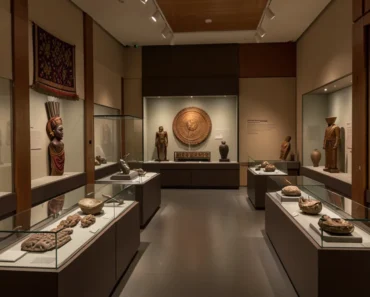
The MMVI’s permanent collection spans roughly 1,400 works and rewards careful attention. Among the highlights visitors and researchers consistently note:
- Works by Mohamed Melehi — bold geometric canvases from the Casablanca School, whose optical energy challenged both Western abstraction and folkloric expectations of “African” art in the 1960s.
- Farid Belkahia’s copper and leather works — tactile, talisman-like pieces that deliberately rejected Western canvas and oil in favour of materials rooted in Moroccan craft traditions.
- Jilali Gharbaoui paintings — emotionally raw expressionist works by one of Morocco’s most tragic modernist figures, whose career bridged Paris and Fez.
- The contemporary photography galleries — rotating selections that document urban transformation, gender, and identity across North and sub-Saharan Africa.
- International loan exhibitions — the museum has hosted major works by artists including Pablo Picasso and Joan Miró in temporary shows, framing Moroccan modernism within broader Mediterranean dialogues.
- The Orientalist collection — a deliberately contextualised display of European Orientalist paintings that invites visitors to interrogate the colonial gaze rather than simply consume it.
Architecture and building
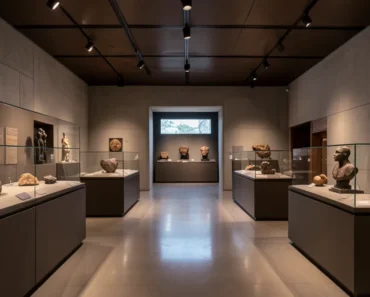
The museum occupies a purpose-built structure in Rabat’s administrative quarter, near the Mohammed V Theatre and the city’s main cultural axis. The building was designed to accommodate large-scale contemporary works alongside more intimate gallery spaces, with natural light carefully managed to protect sensitive pieces. Opened in October 2014, the structure draws on a restrained modernist vocabulary that nods to Moroccan geometric ornament without resorting to pastiche. As of the time of writing, no major structural renovation has been publicly announced, though the Foundation has made ongoing investments in climate control and conservation infrastructure to meet international loan standards.
Visiting practical
The MMVI is located on Avenue Moulay Hassan in central Rabat, within comfortable walking distance of the medina and the main train station (Rabat-Ville). The museum is generally open Tuesday through Sunday, with Monday closures standard practice; visitors should verify current hours directly with the institution before travelling, as holiday schedules vary. Ticket prices fall in the budget-to-moderate band by international standards — affordable for most international travellers and structured to remain accessible to Moroccan residents. Concessions are typically available for students and children. The building is accessible to visitors with reduced mobility, with lift access to upper galleries, though prospective visitors with specific requirements are advised to contact the museum in advance. Guided tours in French and Arabic are available; English-language options should be confirmed ahead of visit.
Repatriation and debates
The MMVI is not primarily an ethnographic museum and does not hold the kind of colonial-era looted material that has placed institutions such as the Tervuren or the Quai Branly at the centre of repatriation disputes. Its collection is largely composed of works acquired through purchase, commission, and donation from living or recently deceased artists and their estates. That said, the museum’s deliberate inclusion of European Orientalist paintings — works produced under and in service of the colonial imagination — raises adjacent questions about how formerly colonised nations choose to hold, display, and critically frame art made about them by outsiders. The MMVI’s curatorial approach to this material, which foregrounds critical context rather than aesthetic celebration, represents one model for how institutions can engage honestly with uncomfortable inheritance without simply returning or suppressing it. Broader conversations about the return of Moroccan cultural objects held in French and Spanish collections remain active at a diplomatic level, though these discussions centre on heritage ministries rather than the MMVI specifically.
Recent developments
In the period spanning 2023 and 2024, the MMVI continued an active temporary exhibition programme, with shows exploring contemporary African photography and the legacies of the Casablanca School attracting both regional and international attention. The museum has strengthened partnerships with European and Gulf cultural institutions, reflecting Morocco’s broader diplomatic positioning as a cultural bridge between Africa, the Arab world, and Europe. The National Foundation of Museums has also signalled ambitions to expand the wider national museum network, with Rabat remaining the flagship. Visitors and researchers planning trips in 2025 should monitor the Foundation’s official communications for newly announced exhibitions, as the programme evolves on a rolling basis.