Khartoum International Airport
Khartoum International Airport
Khartoum International Airport (KRT) — Airport Profile
Khartoum International Airport (IATA: KRT / ICAO: HSSS) is Sudan’s principal gateway for international air travel, situated in the capital city of Khartoum at the confluence of the Blue and White Nile rivers. As the country’s only airport handling scheduled long-haul and wide-body international services, KRT occupies a strategically significant position in northeast African aviation — bridging the Arab world, sub-Saharan Africa, and East Africa along corridors that have been commercially important for decades. For travellers, journalists, and researchers seeking to reach Sudan, it remains the default point of entry and departure.
About
Khartoum International Airport has served Sudan’s capital since the mid-twentieth century, with its origins traceable to the colonial-era aerodrome infrastructure developed under British administration. The airport was formally developed as a civilian international facility in the post-independence period following Sudan’s independence in 1956, and it has undergone successive phases of expansion to accommodate jet-age aircraft and growing passenger volumes. Ownership and operational oversight rests with the Sudanese state, administered through the Sudan Civil Aviation Authority (SCAA), which regulates airspace, licensing, and airport standards across the country.
A significant expansion and modernisation programme was initiated in the 2000s and 2010s, including upgrades to the terminal building, apron infrastructure, and navigation systems. Plans for a new international airport to replace or supplement KRT — sometimes referred to in regional aviation planning documents as the New Khartoum International Airport — have been discussed at various points, though the timeline and scope of that project have been subject to revision in line with Sudan’s broader political and economic circumstances. The airport’s infrastructure, while functional for current operations, is widely regarded by industry observers as constrained relative to the potential demand of a country of Sudan’s size and geographic centrality.
The airport sits at an elevation of approximately 1,260 feet (384 metres) above sea level and operates in a hot desert climate, with summer temperatures regularly exceeding 40°C — a factor that influences aircraft performance calculations and scheduling patterns, particularly for wide-body operations.
Country
Sudan is a northeast African nation with Khartoum as its capital, home to a population estimated in the tens of millions and spanning a vast territory that borders Egypt to the north, Ethiopia and Eritrea to the east, South Sudan to the south, and Libya and Chad to the west. Following the secession of South Sudan in 2011, Sudan remains one of Africa’s larger states by area and retains significant strategic importance as a land and air corridor connecting the Arab world with sub-Saharan and East Africa. The country’s political environment has experienced considerable turbulence in recent years, with consequences for its aviation sector, foreign investment, and international connectivity. → Read the Sudan expert briefing
Airlines Based Here
Sudan Airways, the national flag carrier, has historically used Khartoum International Airport as its primary hub and operational base. The airline, which is state-owned, has faced well-documented financial and operational difficulties over the years, including periods of reduced fleet availability and route suspensions, but continues to operate scheduled services from KRT. Sudan Airways functions as the de facto home carrier at the airport, maintaining its maintenance base and administrative headquarters in Khartoum.
Beyond Sudan Airways, Khartoum has attracted a range of visiting international carriers that treat KRT as a point-to-point destination rather than a hub. Carriers including EgyptAir, Ethiopian Airlines, flydubai, Qatar Airways, Turkish Airlines, and Saudi Arabian Airlines have at various points operated scheduled services into KRT, reflecting the airport’s role as a connecting node between Sudan and the major aviation hubs of Cairo, Addis Ababa, Dubai, Doha, Istanbul, and the Gulf. The precise roster of active carriers has fluctuated in line with Sudan’s political situation and bilateral air service agreements. Travellers and analysts should verify current schedules directly with airlines or through the SCAA.
Flights and Destinations
Khartoum International Airport supports a network that spans continental African routes, Middle Eastern connections, and limited intercontinental services. The airport’s strongest connectivity is with the Gulf region and North Africa, reflecting both trade ties and the large Sudanese diaspora communities in those areas. Representative destinations served from KRT — subject to current schedule availability — include Cairo (Egypt), Addis Ababa (Ethiopia), Dubai (UAE), Doha (Qatar), Istanbul (Turkey), Jeddah and Riyadh (Saudi Arabia), Nairobi (Kenya), Entebbe (Uganda), and Amman (Jordan). Domestic routes connecting Khartoum to secondary Sudanese cities have also been operated by Sudan Airways and smaller regional carriers, though domestic network reliability has varied. Intercontinental services beyond the Middle East and Turkey have historically been limited, with passengers typically connecting through Gulf hubs for onward travel to Europe, Asia, or the Americas.
Facilities and Capacity
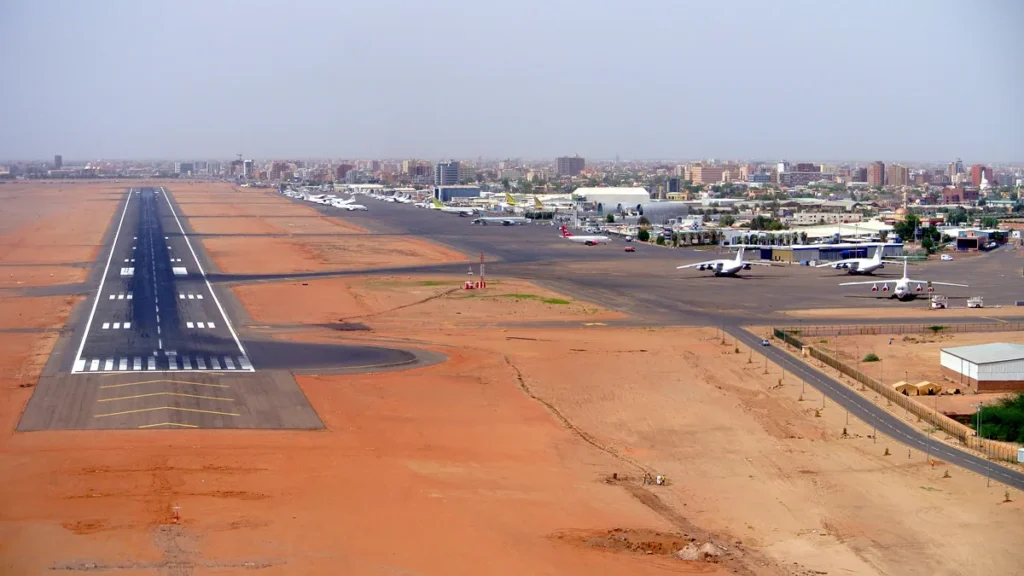
Khartoum International Airport operates with a single primary passenger terminal building that handles both departing and arriving international and domestic traffic. The terminal has been subject to periodic refurbishment, though industry observers generally classify KRT as a medium-capacity regional hub rather than a large-scale international gateway. The airport is served by two runways — the primary runway oriented to accommodate the prevailing wind patterns of the Khartoum basin — and the apron infrastructure supports a mix of narrow-body and wide-body aircraft types, including Boeing 737 and Airbus A320 family jets as well as larger wide-body aircraft on select routes.
Cargo facilities at KRT serve Sudan’s import and export needs, with freight handling capacity supporting both belly-hold cargo on passenger aircraft and, historically, dedicated freighter operations. According to publicly disclosed traffic data and industry estimates, the airport’s annual passenger throughput has placed it in the medium-tier category among African international airports, though volumes have been materially affected by the country’s political instability in recent years. A VIP terminal and separate facilities for government and diplomatic traffic are also maintained on the airport campus.
Visa Regulations
Travellers arriving at Khartoum International Airport are subject to Sudan’s national visa regime, which has historically been among the more restrictive on the African continent. Citizens of most Western countries — including the United States, United Kingdom, and European Union member states — have generally been required to obtain a visa in advance of travel, typically through a Sudanese embassy or consulate. Visa on arrival has been available to nationals of certain countries under specific bilateral arrangements, and Sudan has at various points explored or piloted eVisa systems, though the consistency of these programmes has varied. Nationals of some Arab League and African Union member states may benefit from preferential arrangements under regional agreements, but travellers should not assume visa-free access without verification. Visa regulations are subject to change at short notice, particularly given Sudan’s evolving diplomatic relationships. → Check the live visa requirements lookup for current entry rules before travel.
Recent Developments
The past 24 months at Khartoum International Airport have been shaped significantly by the broader conflict that erupted in Sudan in April 2023 between the Sudanese Armed Forces and the Rapid Support Forces. The fighting, which caused severe humanitarian disruption across the country, had direct consequences for the airport’s operations, including periods during which scheduled commercial services were suspended or severely curtailed. Several international carriers temporarily halted flights to KRT in response to the security situation, and the airport itself sustained reported damage during the conflict period. As of 2026, the operational status of the airport and the resumption of commercial services has been a subject of ongoing assessment by airlines, the SCAA, and international aviation bodies including ICAO. Travellers and analysts are strongly advised to consult current advisories from their national governments and from the relevant airline operators before planning travel through KRT. Any resumption of regular scheduled services and infrastructure rehabilitation efforts represent closely watched developments in the regional aviation community.
News and Reports
Ongoing operational and regulatory news relating to Khartoum International Airport can be sourced from several authoritative channels. The Sudan Civil Aviation Authority (SCAA) is the primary national regulatory body and periodically issues notices to airmen (NOTAMs) and operational bulletins relevant to KRT. IATA’s Africa regional office publishes periodic assessments of African airport and airline performance that may include Sudan-specific data when conditions permit. The ICAO Regional Office for the Middle East and Africa covers Sudan within its safety oversight and air navigation programmes and publishes relevant documentation through official ICAO channels. International aviation trade publications including Aviation Week, ch-aviation, and Cirium track airline route changes and airport developments across Africa and provide contemporaneous reporting on KRT’s operational status. Humanitarian and conflict-monitoring organisations such as the UN Office for the Coordination of Humanitarian Affairs (OCHA) have also published situation reports relevant to airport access during Sudan’s crisis period.
Related Research
- Sudan Expert Briefing — political, economic, and security context
- Sudan Statistics — key demographic and economic indicators
- African Airports — full directory and comparative profiles
- African Airlines — carrier profiles and network analysis
- Visa Requirements — live lookup tool for Sudan and all African destinations
- Country Comparison — benchmark Sudan against regional peers