Tunisair
Tunisair
About
Tunisair — operating under IATA code TU and ICAO designator TAR — is Tunisia’s flag carrier and one of the longest-established commercial airlines on the African continent. Headquartered at Tunis-Carthage International Airport (TUN), it occupies a pivotal position in North African aviation, connecting the Maghreb to Europe, the Middle East, and sub-Saharan Africa while serving as the primary scheduled carrier for a country whose economy depends heavily on tourism and diaspora travel.
The airline was founded in 1948, initially operating under French colonial-era frameworks before being reconstituted as a fully Tunisian national carrier following independence in 1956. For much of its history it has operated as a state-owned enterprise, with the Tunisian government retaining a majority shareholding. Minority stakes have at various points been held by institutional and private investors, though the ownership structure has remained predominantly public.
In recent years, Tunisair has undergone a series of restructuring efforts aimed at addressing chronic financial pressures and modernising its operational model. The airline has faced the same headwinds that have buffeted many African flag carriers — currency volatility, high fuel costs, competition from low-cost carriers on European leisure routes, and the lingering effects of reduced tourism following regional security concerns in the mid-2010s. Corporate governance reforms and partial privatisation discussions have been reported periodically, though as of 2026 the carrier remains substantially state-controlled.
Bases and Hubs
Tunis-Carthage International Airport (TUN) — The airline’s principal hub and primary operational base, handling the vast majority of Tunisair’s scheduled departures and serving as the connecting point for its European and intercontinental network.
Monastir Habib Bourguiba International Airport (MIR) — A secondary focus city serving Tunisia’s central coastal region, particularly important for charter and leisure traffic from Europe during the summer season.
Djerba–Zarzis International Airport (DJE) — A key leisure gateway in southern Tunisia, used by Tunisair to capture inbound tourism from France, Germany, and other European markets.
Fleet
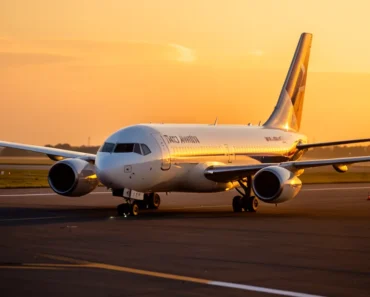
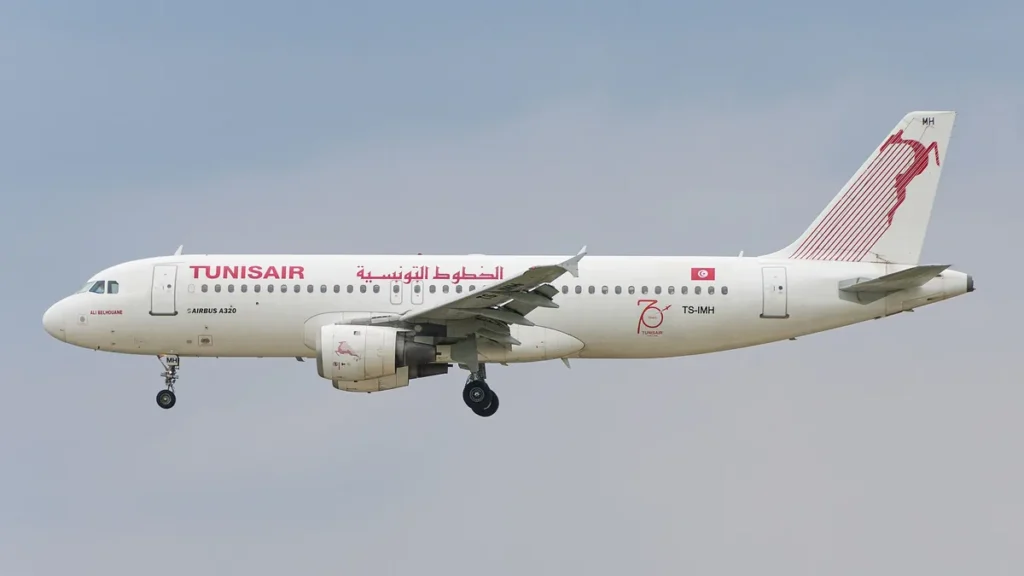
Tunisair’s fleet has historically been built around Airbus narrowbody types, with the Airbus A320 family — including A319 and A320 variants — forming the backbone of operations. According to publicly disclosed fleet data, the carrier has also operated Airbus A330 widebody aircraft on higher-density and longer-haul routes. Fleet renewal has been a recurring strategic priority: the airline has explored transitioning toward more fuel-efficient next-generation narrowbodies, and industry observers have noted interest in the A320neo family as a replacement for older-generation frames. The overall fleet size, as indicated by available industry tracking sources, places Tunisair in the mid-tier range among African carriers — large enough to sustain a meaningful international network, but constrained compared to the continent’s largest operators. No confirmed firm order for new aircraft has been publicly announced at the time of writing, though discussions with manufacturers are understood to be ongoing.
Destinations
Tunisair’s network is shaped primarily by three demand pillars: European leisure and diaspora routes, intra-Arab and Middle Eastern connections, and a more limited set of sub-Saharan African services. Europe accounts for the largest share of scheduled capacity, with France — particularly Paris Charles de Gaulle (CDG), Lyon (LYS), and Marseille (MRS) — representing the airline’s most commercially significant corridor, driven by Tunisia’s large diaspora community in France. Other key European destinations include Geneva (GVA), Frankfurt (FRA), Brussels (BRU), Rome (FCO), and Milan (MXP).
Within the Arab world, Tunisair operates to destinations including Cairo (CAI), Beirut (BEY), Riyadh (RUH), Jeddah (JED), and Dubai (DXB), serving both business travellers and the Tunisian expatriate workforce. On the African continent, the airline maintains services to a selection of West and Central African cities, though this segment of the network has fluctuated in response to demand and operational economics. Intra-Maghreb connectivity — including routes to Casablanca (CMN) and Algiers (ALG) — rounds out the regional picture.
Codeshare and Alliance
Tunisair is not a member of any of the three major global airline alliances — Star Alliance, SkyTeam, or oneworld. The carrier has historically maintained bilateral codeshare agreements with a number of European and regional partners, including Air France and Alitalia (now ITA Airways) among others, primarily to facilitate connectivity for passengers travelling beyond Tunis on European trunk routes. The absence of a full alliance affiliation limits Tunisair’s ability to offer seamless interline benefits at scale, and joining an alliance has been discussed as a longer-term strategic aspiration, contingent on financial stabilisation and fleet standardisation.
Notable Incidents
Tunisair does not have a significant cluster of major safety incidents on its recent public record. The airline’s most widely documented historical event is the loss of a Tunisair Boeing 727 in 1985, which has been reported in aviation safety databases. In recent years, no major hull losses or fatal accidents attributable to the carrier have been prominently recorded in publicly available safety reporting. Travellers and analysts are encouraged to consult the Aviation Safety Network and ICAO safety audit disclosures for the most current and authoritative assessments.
Financial and Operational Situation
Tunisair’s financial position has been a source of sustained concern for analysts and the Tunisian government alike. The carrier has reported losses across multiple consecutive years, a pattern common among state-owned African flag carriers operating in liberalised European markets without the cost structures to compete effectively against low-cost carriers such as Ryanair and easyJet on leisure routes. Industry estimates suggest the airline carries a significant debt burden, partly a legacy of fleet financing and partly a consequence of operating subsidies that have not been matched by revenue growth. The Tunisian dinar’s limited convertibility adds a further structural constraint, complicating aircraft lease payments and fuel procurement denominated in hard currency. Successive management teams have announced turnaround plans involving route rationalisation, workforce restructuring, and revenue diversification, with mixed results reported to date.
Recent Developments
In the 24 months leading into 2026, Tunisair has continued to navigate a complex operating environment shaped by Tunisia’s broader macroeconomic challenges and the competitive dynamics of post-pandemic aviation recovery. The airline has worked to restore and in some cases expand its European schedule following capacity reductions during the pandemic period, with summer seasonal frequencies to French and Italian leisure markets receiving particular attention. Discussions around fleet modernisation have remained active, with the question of next-generation narrowbody acquisition linked directly to the airline’s ability to secure financing or government-backed guarantees. Regulatory dialogue with the European Union Aviation Safety Agency (EASA) has been a continuing operational consideration, as EU market access remains critical to the airline’s revenue base. Management changes at the executive level have also been reported, reflecting ongoing pressure from the Tunisian government to accelerate the pace of financial reform.