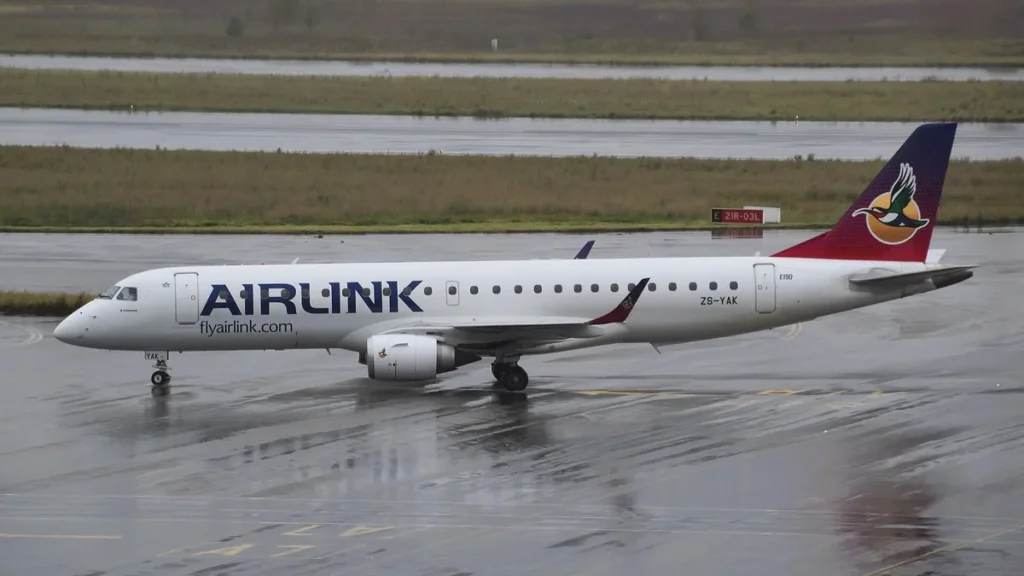
Airlink
Airlink
About
Airlink occupies a distinctive and strategically important position in African aviation: a fully independent, privately owned South African carrier that has quietly built one of the continent’s most extensive regional networks without the backing of a state sponsor or a global alliance. Operating under IATA code 4Z and ICAO designator LNK, and headquartered in Johannesburg, Airlink connects South Africa’s commercial heartland to destinations across southern and eastern Africa that larger carriers routinely overlook, making it an essential piece of the continent’s aviation infrastructure rather than simply a feeder operation.
Airlink was founded in 1992 and spent much of its early life operating as a franchise partner and capacity provider for South African Airways (SAA), feeding passengers into SAA’s mainline network under a commercial arrangement that gave Airlink scale but also dependency. That relationship defined the airline for nearly three decades. When SAA entered business rescue proceedings in late 2019 and subsequently underwent a prolonged restructuring, Airlink faced an existential question about its own future. The airline’s response was decisive: it severed its franchise agreement with SAA in 2021, rebranded with a refreshed identity, and relaunched as a fully independent scheduled carrier in its own right.
Ownership remains private and South African. The airline is controlled by its management and a group of private shareholders, a structure that has allowed it to move quickly on commercial decisions without the political constraints that have historically burdened state-linked African carriers. Since independence, Airlink has pursued an active expansion strategy, adding routes, deepening its network into sub-Saharan Africa, and positioning itself as the default regional connector for business and leisure travellers moving through southern Africa.
Bases and Hubs
Johannesburg O.R. Tambo International (JNB) — Airlink’s principal hub and operational headquarters, from which the majority of its network radiates across South Africa and into the wider continent.
Cape Town International (CPT) — A significant secondary base serving both leisure and business traffic on domestic trunk routes and select regional services.
Durban King Shaka International (DUR) — A focus city supporting domestic connectivity along the eastern seaboard of South Africa.
Harare Robert Gabriel Mugabe International (HRE) — A regional focus point underpinning Airlink’s Zimbabwe operations and broader east African connectivity.
Fleet
Airlink operates an all-Embraer jet fleet, a deliberate strategic choice that aligns aircraft capacity with the thinner route densities characteristic of regional African aviation. The backbone of the fleet is the Embraer ERJ-135 and ERJ-145 family, twin-engine regional jets well suited to shorter sectors and airports with infrastructure constraints. According to publicly disclosed fleet data, Airlink also operates the larger Embraer 170 and Embraer 190 variants, which provide additional capacity on busier domestic trunk routes and higher-demand regional services. The homogeneity of the Embraer fleet delivers meaningful maintenance and crew training efficiencies. Industry observers have noted that Airlink has been evaluating fleet renewal options consistent with its network growth ambitions, though no firm new-type orders had been publicly confirmed at the time of writing.
Destinations
Airlink’s network is emphatically regional in character, with its greatest density across South Africa and the southern African Development Community (SADC) footprint. Domestically, the airline serves a broad spread of South African cities beyond the major metros, including George (GRJ), Port Elizabeth — now Gqeberha (PLZ), East London (ELS), and Kimberley (KIM), providing connectivity that mainline carriers do not consistently maintain. Regionally, Airlink has built a meaningful presence in Zimbabwe, Mozambique, Zambia, Namibia, Botswana, eSwatini, and Lesotho. Headline regional routes include Johannesburg to Harare, Johannesburg to Maputo (MPM), Johannesburg to Lusaka (LUN), and Johannesburg to Windhoek (WDH). The airline does not operate intercontinental services; its value proposition is explicitly intra-African, and it has leaned into that positioning since its 2021 independence.
Codeshare and Alliance
Airlink is not a member of any of the three major global airline alliances — Star Alliance, SkyTeam, or oneworld. Its independence from SAA severed the informal connectivity it previously enjoyed through SAA’s Star Alliance membership. In its place, Airlink has pursued bilateral interline and codeshare agreements with a range of international carriers to ensure its passengers can connect onto long-haul services at JNB and CPT. Notably, Airlink has established a codeshare arrangement with British Airways (operated by Comair until that carrier’s closure, and subsequently renegotiated), and has interline agreements with multiple international partners. The airline has also developed a commercial relationship with Qatar Airways, which provides Airlink passengers with connectivity into the Doha hub and onward to the Gulf, Asia, and Europe — a partnership that has taken on greater significance as JNB has grown as a transit point for intercontinental traffic.
Notable Incidents
Airlink does not have any major accidents or serious incidents prominently documented in its recent public safety record. The airline operates under South African Civil Aviation Authority (SACAA) oversight and maintains safety standards consistent with its international interline obligations. As with any regional carrier operating into a diverse range of African airports, operational disruptions occur, but no events meeting the threshold of a significant safety occurrence have been identified in publicly available records for the period under review.
Financial and Operational Situation
Airlink does not publish detailed financial results as a listed company, and precise revenue or profitability figures are not in the public domain. Industry estimates suggest the airline returned to a growth trajectory following the disruption of the COVID-19 pandemic and the turbulence of its separation from SAA, with load factors on key routes recovering strongly through 2023 and 2024. The airline’s private ownership structure insulates it from the political pressures and recapitalisation cycles that have destabilised state-owned African carriers, and management has consistently emphasised operational self-sufficiency as a core principle. Cost discipline, fleet commonality, and a focus on underserved routes with limited direct competition are the structural pillars of its commercial model. Analysts covering African aviation have generally characterised Airlink as one of the more financially resilient independent carriers on the continent, though the operating environment — including fuel price volatility, currency pressures in several of its markets, and infrastructure challenges at regional airports — remains demanding.
Recent Developments
In the 24 months to early 2026, Airlink has continued to expand its footprint across sub-Saharan Africa, adding new city pairs and increasing frequencies on established routes as demand has recovered and, in several markets, exceeded pre-pandemic levels. The airline has deepened its commercial partnership with Qatar Airways, a relationship that has become increasingly central to its international connectivity proposition. Airlink has also been an active participant in discussions around the Single African Air Transport Market (SAATM), the African Union’s flagship aviation liberalisation initiative, and has publicly supported the removal of bilateral restrictions that constrain intra-African connectivity. On the operational side, the airline has continued to invest in its digital distribution and customer experience platforms, reflecting a broader industry shift toward direct booking and loyalty engagement. Fleet utilisation and on-time performance metrics have been cited positively in industry commentary, reinforcing Airlink’s reputation as a reliable operator in a region where schedule reliability is not always guaranteed.
Related Research
- South Africa Expert Briefing — full country profile for investors, journalists and analysts
- African Airlines — the africa-research.org carrier directory and analysis hub
- African Airports — infrastructure profiles across the continent
- Country Comparison Tool — benchmark South Africa against peer markets