Air Peace
Air Peace
About
Air Peace is Nigeria’s largest privately owned airline and one of the most consequential carriers in sub-Saharan African aviation. Operating under IATA code P4 and ICAO designator APK, the airline has grown from a domestic Nigerian operator into a genuine pan-African and intercontinental force, challenging the long-held assumption that West Africa cannot sustain a full-service network carrier built entirely on private capital.
Air Peace was founded in 2013 by Allen Onyema, a lawyer and businessman who serves as chairman and chief executive. The airline carried its first passengers in 2014 and expanded rapidly through a combination of aggressive route launches and fleet acquisitions that outpaced most of its regional peers. Onyema has maintained a controlling stake in the business, keeping Air Peace firmly in private hands at a time when many African governments still prop up state-owned flag carriers.
The airline’s corporate trajectory has not been without turbulence off the tarmac. In 2019, Onyema faced allegations from the United States Department of Justice relating to financial transactions; he denied all wrongdoing, and Nigerian authorities declined to extradite him. The case drew significant international attention but did not derail the airline’s operational expansion. By the early 2020s, Air Peace had repositioned itself as a symbol of Nigerian private-sector ambition, winning domestic plaudits for repatriating stranded Nigerians during regional crises and for launching routes that legacy carriers had abandoned.
Bases and Hubs
Lagos Murtala Muhammed International Airport (LOS) — The airline’s principal hub and primary international gateway, handling the bulk of Air Peace’s intercontinental and regional departures.
Abuja Nnamdi Azikiwe International Airport (ABV) — A key secondary hub serving Nigeria’s federal capital, with connections to domestic points and select regional destinations.
Port Harcourt International Airport (PHC) — A focus city serving Nigeria’s oil-industry heartland, important for corporate and energy-sector traffic.
Enugu Akanu Ibiam International Airport (ENU) — A domestic focus city in southeastern Nigeria that Air Peace has served consistently, supporting connectivity in an underserved region.
Fleet
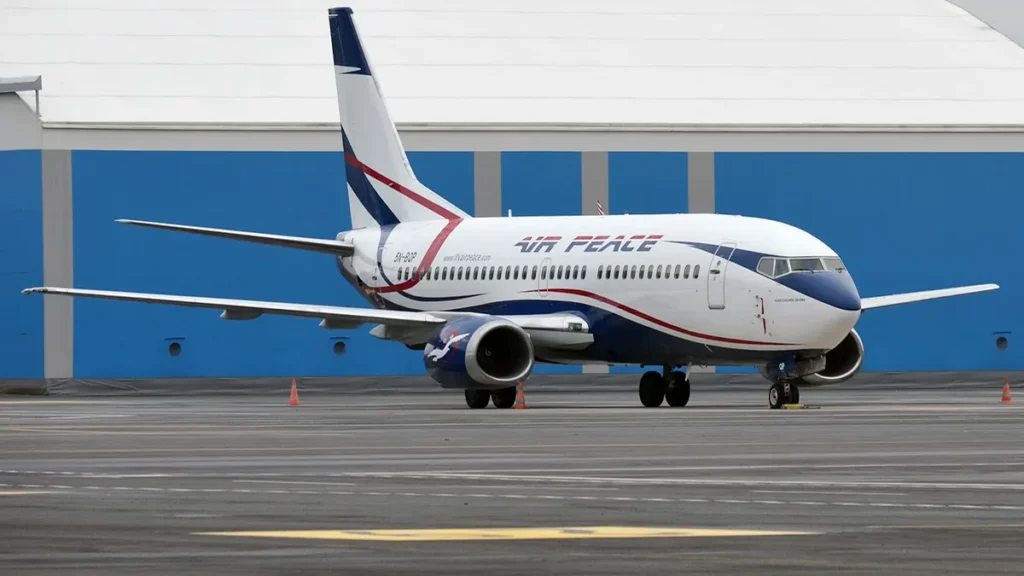
Air Peace operates a mixed fleet spanning narrowbody, widebody, and regional jet categories. According to publicly disclosed fleet data, the airline’s workhorse narrowbody operations are built around the Boeing 737 family, including the 737-300 and 737-500 classics as well as newer-generation variants. For intercontinental and high-capacity regional flying, the airline has operated Boeing 777 widebody aircraft, giving it genuine long-haul capability rare among West African private carriers. The Embraer 145 regional jet has featured in the fleet for thinner domestic and regional routes, providing schedule frequency where larger aircraft would be uneconomical.
Industry observers have noted that Air Peace has pursued fleet modernisation as a strategic priority. The airline has publicly signalled interest in newer-generation narrowbodies to improve fuel efficiency and reduce maintenance costs, though the precise composition and timing of any confirmed orders should be verified against the airline’s most recent official disclosures.
Destinations
Air Peace operates one of the broadest networks of any Nigerian carrier, spanning domestic, intra-African, and intercontinental routes. Domestically, the airline connects Lagos and Abuja to a wide range of Nigerian cities, providing the kind of schedule density that supports both business and leisure travel. Regionally, Air Peace has built a meaningful West and Central African footprint, with services to destinations including Accra (ACC) in Ghana, Lomé (LFW) in Togo, Cotonou (COO) in Benin, and Libreville (LBV) in Gabon, among others.
The airline’s most strategically significant move in recent years has been the launch of intercontinental services. Air Peace inaugurated flights between Lagos and London Gatwick (LGW), a route of enormous commercial importance given the size of the Nigerian diaspora in the United Kingdom. The airline has also operated or announced services toward the Middle East and other long-haul markets, positioning itself as a carrier capable of competing with international airlines on routes that matter most to Nigerian travellers.
Codeshare and Alliance
Air Peace is not a member of any of the three major global airline alliances — Star Alliance, SkyTeam, or oneworld. The airline operates as an independent carrier, which is consistent with the posture of most fast-growing African private airlines at this stage of development. Codeshare and interline arrangements have been discussed and pursued selectively, but Air Peace has not, as of the time of writing, announced a landmark codeshare partnership with a major global network carrier. Travellers and travel agents should consult the airline’s current commercial agreements directly for the most up-to-date interline ticketing options.
Notable Incidents
Air Peace does not have a major hull-loss or fatal accident on its publicly documented safety record. The airline has operated through the inherent challenges of the Nigerian aviation environment — including infrastructure constraints and regulatory scrutiny common across the sector — but no specific incident meeting the threshold of a major safety event has been confirmed in credible public reporting in recent years. Journalists and researchers are advised to consult the Aviation Safety Network and Nigeria’s Accident Investigation Bureau (AIB) for the most current and authoritative incident data.
Financial and Operational Situation
Air Peace is a privately held company and does not publish audited financial statements in the public domain, making precise assessment of its financial health difficult for outside analysts. Industry estimates suggest the airline has faced the same structural pressures that weigh on virtually all Nigerian carriers: a volatile naira, high jet fuel costs denominated partly in foreign currency, and airport infrastructure that adds operational friction. The sharp depreciation of the Nigerian naira in 2023 and into subsequent years created significant foreign-currency exposure for an airline that must purchase aircraft, spare parts, and fuel in dollars and euros while collecting a large share of its revenue in local currency.
Despite these headwinds, Air Peace has continued to expand rather than contract, which industry observers interpret as a sign of underlying operational resilience and owner confidence. The airline receives no direct state subsidy and is not subject to a government restructuring programme, distinguishing it from several of its African peers. Its long-term financial sustainability will depend significantly on the success of its intercontinental routes, which carry higher yields and provide a natural hedge against naira weakness through foreign-currency ticket sales.
Recent Developments
The past two years have been among the most consequential in Air Peace’s history. The airline’s launch of scheduled service between Lagos and London Gatwick was the headline event, representing the first time a Nigerian private carrier had operated a direct transatlantic-adjacent route to the United Kingdom on its own operating certificate. The route attracted significant attention from the Nigerian government, the diaspora community, and competing international carriers, some of whom responded with capacity and pricing adjustments on the same corridor.
Air Peace has also continued to expand its intra-African network, adding or restoring routes across West and Central Africa as demand for regional connectivity grows. On the regulatory front, the airline has engaged with the Nigerian Civil Aviation Authority (NCAA) on matters relating to airworthiness standards and operational approvals, as the regulator has intensified oversight across the sector. Fleet renewal discussions have remained active, with the airline publicly indicating its intention to modernise toward more fuel-efficient aircraft types as financing conditions allow. Stakeholders tracking the airline should monitor official announcements from Air Peace and the NCAA for the latest operational and regulatory developments.