Bamako–Sénou International Airport
Bamako–Sénou International Airport
About
Bamako–Sénou International Airport (IATA: BKO; ICAO: GABS) is the principal gateway to Mali and one of the most strategically significant airports in the West African Sahel. Situated approximately 15 kilometres south of central Bamako, the airport connects landlocked Mali to a network of continental African routes and a handful of intercontinental services, making it an essential node for diplomats, humanitarian workers, journalists, and business travellers operating across one of the world’s most complex regional environments. For aviation analysts, BKO represents a mid-tier African hub whose operational resilience has been repeatedly tested by political turbulence, security constraints, and the structural challenges common to Sahelian aviation markets.
The airport traces its origins to the colonial-era aerodrome developed under French administration, with the Sénou site evolving through successive decades of infrastructure investment following Mali’s independence in 1960. The facility was formally developed into an international airport capable of handling jet traffic during the latter decades of the twentieth century, with runway and terminal upgrades carried out in stages. Ownership and operational oversight rests with the Malian state, administered through the national civil aviation authority, the Agence Nationale de l’Aviation Civile et de la Météorologie (ANACIM’s Malian equivalent, formally the Direction Nationale de l’Aéronautique Civile, DNAC), with the airport authority managing day-to-day operations.
Significant infrastructure investment was channelled into the airport in the 2000s and 2010s, including terminal rehabilitation works and airside improvements intended to raise passenger handling capacity and bring the facility closer to ICAO Category standards required for wider international operations. The airport has one primary instrument runway — Runway 18/36 — with a published length sufficient to accommodate wide-body aircraft including the Boeing 737 family and, on certain configurations, larger jets. Further expansion discussions have been documented in Malian government planning frameworks, though the pace of capital works has been affected by the country’s political situation since the military transitions of 2020 and 2021.
Country
Mali is a landlocked West African republic with Bamako as its capital and, by a considerable margin, its largest city. The country’s population is estimated in the tens of millions and is growing rapidly, placing Mali among the younger and faster-growing demographic profiles on the continent. Geographically, Mali borders seven countries — Algeria, Niger, Burkina Faso, Côte d’Ivoire, Guinea, Senegal, and Mauritania — giving Bamako an outsized regional importance as a transit and logistics hub for the broader Sahel and West African Economic Community (ECOWAS) zone. The country has faced prolonged security and governance challenges since 2012, which continue to shape both its aviation market and its relationships with international partners. → Read the Mali expert briefing
Airlines Based Here
Bamako–Sénou does not currently host a large full-service national carrier in the traditional sense. Air Mali, which operated as the flag carrier at various points in the country’s aviation history, has experienced repeated suspensions and restructurings; as of the mid-2020s, its operational status has been intermittent and travellers should verify current schedules independently. The airport functions primarily as a focus city for visiting international carriers rather than as a hub anchored by a dominant home airline. Mauritania Airlines International has maintained a regional presence connecting Bamako to Nouakchott. Air Côte d’Ivoire, operating out of Abidjan, has served BKO as part of its West African regional network. Ethiopian Airlines, one of the continent’s most expansive carriers, uses Bamako as a spoke destination within its African network, providing onward connectivity through Addis Ababa Bole International Airport to East Africa, the Middle East, Asia, and Europe. Royal Air Maroc connects Bamako to Casablanca, offering European and North American codeshare options. Turkish Airlines has operated services linking BKO to Istanbul, providing a significant intercontinental corridor. Air France has historically maintained a Paris–Bamako service, though frequency and continuity should be verified against current schedules given the evolving diplomatic context between France and Mali.
Flights and Destinations
The route network at Bamako–Sénou reflects the airport’s dual role as a regional West African connector and a limited intercontinental gateway. Within Africa, the airport supports services to Dakar (Léopold Sédar Senghor / Blaise Diagne International), Abidjan (Félix Houphouët-Boigny International), Conakry (Conakry International), Ouagadougou (Thomas Sankara International), Niamey (Diori Hamani International), and Nouakchott (Nouakchott–Oumtounsy International). Addis Ababa serves as the primary African hub connection for onward long-haul travel via Ethiopian Airlines. Intercontinental services have included Casablanca (Mohammed V International) via Royal Air Maroc, Paris (Charles de Gaulle) via Air France, and Istanbul (Istanbul Airport) via Turkish Airlines. These routes collectively give Bamako reasonable, if not abundant, connectivity to Europe and the wider world. Industry observers note that the thinness of the intercontinental schedule makes BKO sensitive to any single carrier’s commercial decisions, and that route suspensions — whether driven by security advisories, diplomatic friction, or load-factor economics — can materially affect access to the country.
Facilities and Capacity
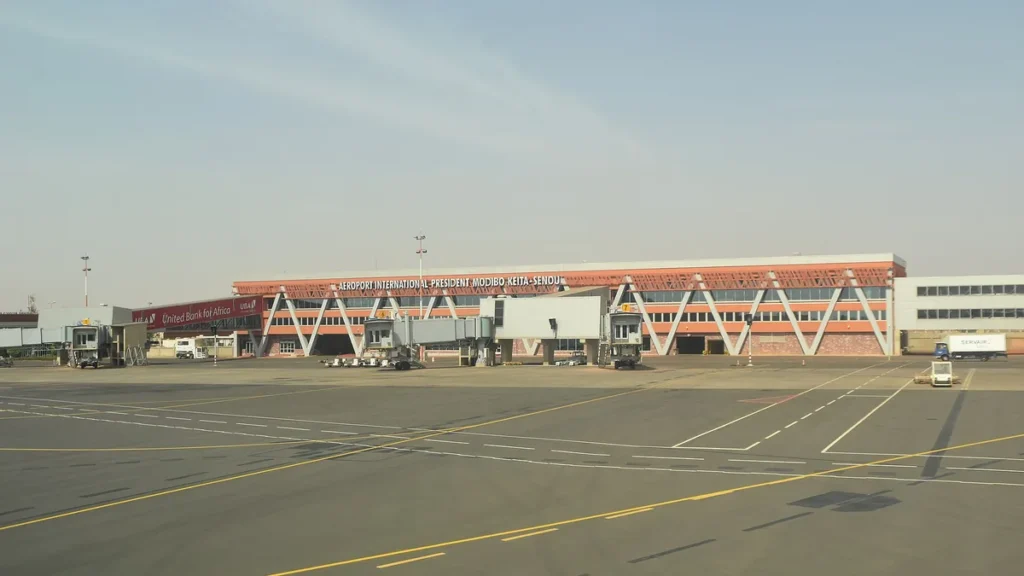
Bamako–Sénou operates with a single passenger terminal building that handles both international and domestic traffic, with functional separation of arriving and departing passengers maintained within the terminal footprint. The facility is generally classified as a medium-capacity regional hub by African aviation standards — capable of processing meaningful passenger volumes but without the multi-pier, multi-terminal infrastructure of larger African hubs such as Addis Ababa, Nairobi Jomo Kenyatta, or Johannesburg O.R. Tambo. The airport has a dedicated cargo apron and freight-handling facilities, which are of particular importance given Mali’s reliance on air freight for time-sensitive humanitarian, medical, and commercial goods given its landlocked geography. According to publicly disclosed traffic data reviewed by regional aviation bodies, BKO handles passenger volumes consistent with a mid-tier West African international airport, though precise annual figures should be sourced directly from DNAC or ICAO regional traffic reports. Runway 18/36 is the primary operational runway; its published dimensions and pavement strength ratings are documented in the ICAO Aeronautical Information Publication (AIP) for Mali, which is the authoritative reference for pilots and ground operators. Expansion plans, including potential terminal enlargement and apron extension works, have been referenced in Malian government infrastructure frameworks, though confirmed timelines and committed budgets had not been fully publicly disclosed as of early 2026.
Visa Regulations
Travellers arriving at Bamako–Sénou are subject to Mali’s national visa regime, which has undergone changes in recent years in line with broader West African mobility frameworks and bilateral agreements. As a general orientation: citizens of ECOWAS member states benefit from freedom-of-movement provisions that typically allow entry without a standard visa, though travellers should confirm current requirements given Mali’s evolving relationship with ECOWAS institutions. Citizens of the United States, United Kingdom, and European Union member states have generally been required to obtain a visa prior to travel; visa-on-arrival arrangements have existed at BKO in certain periods, but their availability is subject to change and should not be assumed without current verification. An eVisa system has been discussed and partially implemented in the Malian context, though its operational status should be confirmed through official Malian government channels or a reliable visa intelligence service. Security conditions and diplomatic shifts can affect visa processing times and entry requirements at short notice. Visa rules change frequently — visit our live visa requirements lookup for the most current information before booking travel.
Recent Developments
The 24-month period leading into 2026 has been consequential for Bamako–Sénou, shaped heavily by Mali’s geopolitical repositioning and its security environment. The withdrawal of French military forces from Mali and the deterioration of Franco-Malian diplomatic relations introduced uncertainty around Air France’s Bamako services, and travellers and analysts should monitor the carrier’s current schedule status closely. The expansion of Turkish Airlines’ African network has been broadly positive for BKO’s intercontinental connectivity, with Istanbul emerging as an increasingly important hub for Malian travellers seeking European and global connections. Ethiopian Airlines has continued to develop its West African spoke network, and Bamako has remained part of that strategy. On the infrastructure side, works to improve airside safety and navigation aids have been referenced in ICAO regional safety oversight reports, reflecting ongoing engagement between Mali’s civil aviation authority and international regulatory bodies. The airport has also continued to serve as a critical logistics point for United Nations and humanitarian flight operations in the Sahel, with the UN Humanitarian Air Service (UNHAS) maintaining a presence consistent with the scale of humanitarian operations in the region.
News and Reports
Researchers and journalists tracking developments at Bamako–Sénou International Airport should consult several authoritative source categories. The Direction Nationale de l’Aéronautique Civile (DNAC) of Mali is the primary regulatory and operational authority and periodically publishes notices, aeronautical information, and policy updates. ICAO’s African regional office (ICAO WACAF, covering West and Central Africa) produces safety oversight assessments and traffic data compilations that include Malian airport statistics. IATA’s Africa and Middle East regional team publishes market intelligence reports covering West African aviation trends, including route development and capacity data relevant to BKO. For real-time operational news, aviation trade publications including ch-aviation, Anna.Aero, and the African Aviation Tribune provide route announcement coverage and airline schedule changes. The UN OCHA and UNHAS operational updates are valuable for understanding humanitarian flight activity at the airport. Diplomatic missions in Bamako — including those of the United States, European Union, and United Kingdom — publish travel advisories that frequently reference airport access and operational conditions.
Related Research
- Mali Expert Briefing — in-depth political, economic, and security analysis for Mali
- Mali Statistics — demographic, economic, and infrastructure data for Mali
- African Airports — profiles and comparisons of airports across the continent
- African Airlines — carrier profiles, route maps, and fleet data for African aviation
- Visa Requirements — live lookup tool for entry requirements by nationality and destination
- Country Comparison — benchmark Mali against regional peers across key indicators