N’djili International Airport
N’djili International Airport
About
N’djili International Airport (IATA: FIH / ICAO: FZAA) is the principal international gateway to the Democratic Republic of the Congo and one of the most strategically significant airports in sub-Saharan Africa. Serving Kinshasa — a megacity of more than 15 million people and the continent’s third-largest urban agglomeration — N’djili occupies a critical node in Central African aviation, connecting the DRC to regional neighbours, the African continent at large, and intercontinental destinations across Europe and the Middle East. For airlines, logistics operators, humanitarian organisations, and diplomatic missions, it is effectively the front door to a country the size of Western Europe.
The airport was established during the Belgian colonial era and has operated under various administrative arrangements since Congolese independence in 1960. It takes its name from the N’djili district of eastern Kinshasa, approximately 25 kilometres from the city centre. Ownership and operational oversight rest with the Régie des Voies Aériennes (RVA), the state authority responsible for airport infrastructure across the DRC, operating under the broader framework of the country’s civil aviation authority.
The airport has undergone periodic rehabilitation efforts over the decades, reflecting both the country’s turbulent political history and the chronic underinvestment that has characterised much of Central African aviation infrastructure. Partial terminal refurbishments and airside improvements have been carried out at various points, though industry observers have consistently noted that capacity and service standards have lagged behind the airport’s strategic importance. As of 2026, discussions around more comprehensive modernisation — including terminal expansion and improved ground-handling facilities — remain active, though the pace and funding of such works continue to be subject to political and economic variables.
Country
The Democratic Republic of the Congo is the largest country in sub-Saharan Africa by area and one of the most populous nations on the continent, with a population estimated to exceed 100 million people. Its capital, Kinshasa, sits on the southern bank of the Congo River, directly across from Brazzaville, the capital of the Republic of the Congo — making this one of the world’s only pairs of national capitals visible from each other across a river. The DRC shares borders with nine countries, giving it an outsized role in Central and East African geopolitics, trade, and humanitarian logistics. Its vast mineral wealth, including significant reserves of cobalt, coltan, and copper, makes it a country of enduring interest to international investors, researchers, and policymakers alike.
→ Read the Democratic Republic of the Congo expert briefing
Airlines based here
N’djili serves as the primary operating base for Congo Airways, the DRC’s state-backed national carrier, which uses Kinshasa as its hub for both domestic routes — connecting Kinshasa to provincial cities including Lubumbashi, Goma, Kisangani, and Mbuji-Mayi — and a limited number of regional international services. The airline has operated with a modest fleet and has faced well-documented operational and financial pressures, though it remains the most prominent home-based carrier at the airport. A number of smaller Congolese private operators also use N’djili as their base for domestic and sub-regional charter and scheduled services, though fleet sizes and route networks among these carriers tend to be limited and subject to change.
Among visiting international carriers, Ethiopian Airlines maintains one of the most consistent presences, offering connections through Addis Ababa Bole International Airport that link Kinshasa to a wide network of African and intercontinental destinations. Kenya Airways serves the route from Nairobi’s Jomo Kenyatta International Airport, providing another important East African connection. Brussels Airlines has historically operated services between Kinshasa and Brussels, reflecting the longstanding ties between Belgium and the DRC. Air France has served the Paris–Kinshasa corridor, and Turkish Airlines has expanded its African footprint to include Kinshasa via Istanbul. These carriers collectively provide the bulk of the airport’s intercontinental seat capacity.
Flights and destinations
N’djili’s route network spans domestic, regional African, and long-haul intercontinental services, though the overall volume of scheduled international routes remains modest relative to the size of the population it serves. Domestically, the airport is the hub through which most of the DRC’s internal air travel flows, given the country’s limited road and rail infrastructure. Regionally, passengers can access Nairobi, Addis Ababa, Johannesburg, Lagos, Douala, Brazzaville, and Luanda, among other African cities. Intercontinentally, direct or single-stop services connect Kinshasa to Brussels, Paris, Istanbul, and Dubai, with onward connections available through hub airports to destinations across Europe, Asia, and the Americas. The airport also handles significant charter and humanitarian flight activity, given the DRC’s role as a major theatre for United Nations and NGO operations.
Facilities and capacity
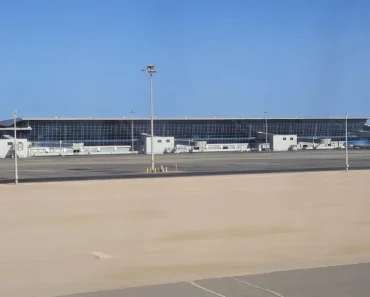
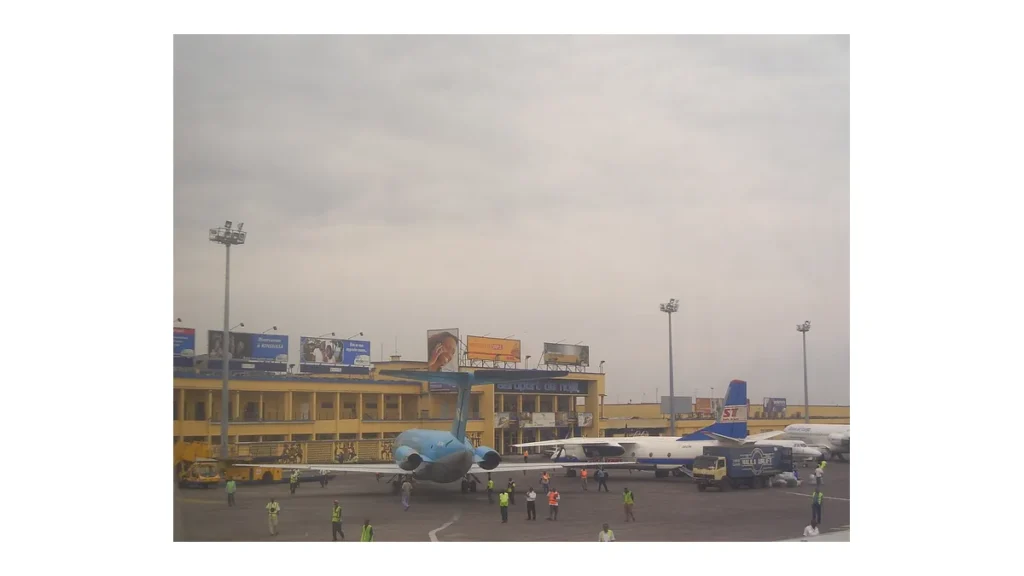
N’djili International Airport operates with a single primary passenger terminal, which handles both international and domestic departures and arrivals. The terminal layout reflects its mid-twentieth-century origins and has been subject to incremental rather than transformative improvement over the years. The airport has two runways, with the primary runway — designated 24/06 — capable of accommodating wide-body jet aircraft, which is essential for the long-haul services operated by carriers such as Brussels Airlines and Turkish Airlines. Cargo handling facilities exist on site and are used extensively by freight operators and humanitarian supply chains, though industry assessments have noted that cargo infrastructure would benefit from significant upgrading to meet growing demand. By the classification standards used in African aviation benchmarking, N’djili is generally regarded as a medium-volume hub — significant in regional context but operating well below the throughput levels of major African gateway airports such as Johannesburg O.R. Tambo, Cairo International, or Addis Ababa Bole. According to publicly disclosed traffic data and industry estimates, passenger volumes have fluctuated in recent years in line with broader economic and security conditions in the country.
Visa regulations
Travellers arriving at N’djili International Airport should be aware that the Democratic Republic of the Congo operates a relatively restrictive visa regime by regional standards. As of 2026, citizens of most Western countries — including the United States, the United Kingdom, and European Union member states — are generally required to obtain a visa prior to travel, though visa-on-arrival arrangements have been available to certain nationalities under specific conditions. An eVisa system has been introduced to streamline the application process for eligible travellers, allowing pre-approval before departure. For holders of African Union member-state passports, arrangements vary considerably by bilateral agreement, and some regional passport holders may benefit from simplified entry procedures. Visa rules, fees, and eligible nationalities are subject to change at short notice, and travellers are strongly advised to verify current requirements well in advance of travel. → Check the live visa requirements lookup tool
Recent developments
In the 24 months leading into 2026, N’djili has seen a number of notable developments. Turkish Airlines consolidated and in some periods expanded its Kinshasa service, reflecting the broader strategic push by the carrier across African markets. Ethiopian Airlines similarly maintained its Kinshasa connection as part of its continent-wide network growth. Discussions between the Congolese government and international development finance institutions regarding airport infrastructure investment have been reported in regional aviation and business media, though the translation of those discussions into confirmed, funded projects has been gradual. The DRC’s civil aviation authority has also been engaged in ongoing efforts to address safety oversight frameworks in line with ICAO standards, a process that has implications for the international standing of carriers registered in the country. Ground-handling service quality and terminal congestion have remained recurring concerns raised by airlines and passenger advocacy voices operating in the market.
News and reports
Researchers, journalists, and analysts tracking developments at N’djili International Airport and in DRC aviation more broadly should consult several authoritative sources. The Régie des Voies Aériennes (RVA) periodically issues operational and administrative communications through official Congolese government channels. The Autorité de l’Aviation Civile (AAC) of the DRC is the primary regulatory body and publishes safety and regulatory notices. At the continental level, IATA’s Africa regional office produces periodic market analysis and airline performance data relevant to Central African aviation. The ICAO regional office for Africa and the Indian Ocean (ESAF/WACAF) publishes safety oversight audit findings and regional air transport development reports. Regional aviation trade publications, including ch-aviation and The Africa Report, provide ongoing commercial and operational news coverage. Humanitarian aviation stakeholders may also find relevant operational reporting through the UN Humanitarian Air Service (UNHAS), which operates extensively in the DRC.