National Museum of Mali
National Museum of Mali
The National Museum of Mali in Bamako is one of West Africa’s most important repositories of material culture, holding collections that span millennia of human settlement, trade, and artistic production across the Sahel and Sudan regions.
About
Founded in 1953 during the late French colonial period, the institution began as a modest ethnographic collection assembled under the direction of the French Sudan administration. Its original mandate was largely documentary — cataloguing the material culture of the territories that would, in 1960, become the independent Republic of Mali. That colonial framing has shaped both the museum’s holdings and the ongoing conversations about how those holdings are interpreted and, in some cases, claimed.
After independence, the museum was reconstituted as a national institution under Malian state authority and gradually reoriented toward celebrating and preserving the country’s own heritage on its own terms. It relocated to its current purpose-built site in the Koulouba-adjacent district of Bamako, and successive Malian curators worked to expand the permanent collection beyond the ethnographic gaze of its founding years. The museum today positions itself as a living cultural institution rather than a static archive, hosting temporary exhibitions, educational programmes, and community engagement alongside its permanent galleries.
The museum’s focus on Malian textiles, masks, and Mande civilisation artefacts reflects the extraordinary cultural depth of a country that was home to the empires of Ghana, Mali, and Songhai — among the most sophisticated polities in medieval world history. For researchers and general visitors alike, the collections offer an irreplaceable window into that long arc of civilisation.
Country and city context
Mali is a landlocked Sahelian nation of roughly 22 million people, bordered by Algeria to the north and Guinea to the south, with a history that encompasses some of the most powerful empires of the medieval world. Bamako, the capital, sits on the Niger River and has grown rapidly into a city of several million — a sprawling, energetic metropolis that serves as the country’s commercial, political, and cultural hub. Despite the significant security challenges Mali has faced since 2012, Bamako itself remains the country’s primary point of entry for researchers, journalists, and travellers, and the museum sits at the centre of its cultural life. → Read the Mali expert briefing
Recent developments
Verified reporting on specific exhibitions or leadership changes at the National Museum of Mali within the past 24 months is limited in widely available English-language sources, reflecting both the country’s ongoing security situation and the relatively sparse international coverage of Sahelian cultural institutions. The museum has continued to operate and engage with regional cultural programming. Researchers planning visits or seeking current institutional contacts are advised to reach out directly to the museum or to the Malian Ministry of Culture for the most current information on programming, access, and any recent acquisitions or partnerships.
Related research
- Mali expert briefing
- Visa requirements for Mali
- Travel industry coverage
- African airports guide
- Country comparison tool
Collection highlights
The permanent collection is broad but several areas stand out as particularly significant for visitors and researchers:
- Mande masks and ceremonial objects — a substantial holding of wooden masks associated with Bamana, Dogon, and Malinké traditions, used historically in initiation and agricultural ceremonies.
- Bogolan (mud cloth) textiles — an extensive display of the distinctive hand-dyed cotton fabric whose geometric patterns encode social and symbolic meaning; one of the museum’s most visually striking permanent galleries.
- Jewellery and personal adornment — gold and silver pieces reflecting the trans-Saharan trade networks that made Mali’s medieval empires fabulously wealthy.
- Archaeological collections — pottery, tools, and figurines recovered from sites across the Niger Inland Delta, including material associated with the ancient city of Djenné-Djenno, one of sub-Saharan Africa’s earliest urban settlements.
- Musical instruments — a collection of traditional instruments including the kora, balafon, and ngoni, situating Mali’s globally recognised musical heritage within its material culture.
- Domestic and agricultural implements — everyday objects that ground the collection in the lived experience of ordinary Malians across different ecological zones, from the Saharan north to the savannah south.
Architecture and building
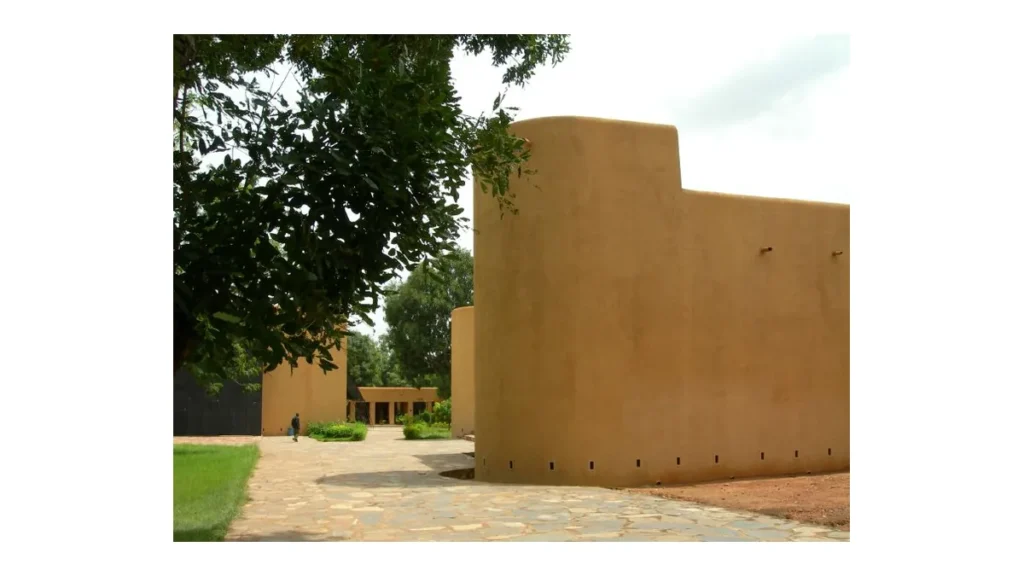
The museum’s current building was designed to reflect Sudano-Sahelian architectural traditions, incorporating elements — including earthen-toned rendered walls and recessed openings — that echo the great mosque architecture of Djenné and Mopti rather than defaulting to a generic modernist institutional form. The building opened on its present site in 1976 following the museum’s relocation and expansion under the post-independence government. Renovation and infrastructure works have been carried out periodically with support from international cultural organisations, though the building retains its original architectural character. Specific architect attribution for the 1976 structure is not widely documented in available sources.
Visiting practical
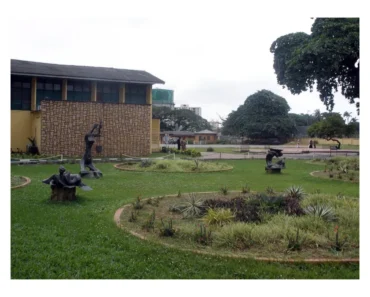
The National Museum of Mali is located in the Koulouba area of Bamako, close to the city’s administrative district and accessible by taxi from the city centre. The museum is generally open Tuesday through Sunday; visitors should confirm current hours directly with the institution before travelling, as hours have varied with staffing and seasonal programming. Admission falls in the low-cost band typical of national museums in the region — expect to pay a nominal entry fee in West African CFA francs, with reduced rates commonly available for students and children. The site includes outdoor garden spaces displaying larger sculptural works, which are accessible to visitors with limited mobility, though internal gallery accessibility varies. Guided tours in French are available and can often be arranged in advance for research groups.
Repatriation and debates
Like many African national museums, the National Museum of Mali exists in a complex relationship with the global dispersal of West African cultural objects — a dispersal accelerated by the colonial period and, in some cases, by the illicit antiquities trade that has continued into the present century. Malian artefacts, particularly Dogon objects and terracotta figurines from the Niger Inland Delta, have appeared in European and North American collections under circumstances that Malian authorities and cultural heritage advocates have repeatedly questioned. The looting of archaeological sites in the Djenné region during periods of instability drew international attention and UNESCO engagement in the 1990s and 2000s. The museum itself has been a stakeholder in broader conversations about the return of objects held in French institutions, conversations that gained new momentum following the 2018 Sarr-Savoy report commissioned by the French government, which recommended the restitution of African cultural heritage. Progress on formal repatriation agreements has been slow, and the museum’s collection — while significant — reflects the reality that a substantial portion of Mali’s most celebrated material culture remains outside the country.
Recent developments
Verified reporting on specific exhibitions or leadership changes at the National Museum of Mali within the past 24 months is limited in widely available English-language sources, reflecting both the country’s ongoing security situation and the relatively sparse international coverage of Sahelian cultural institutions. The museum has continued to operate and engage with regional cultural programming. Researchers planning visits or seeking current institutional contacts are advised to reach out directly to the museum or to the Malian Ministry of Culture for the most current information on programming, access, and any recent acquisitions or partnerships.