Apartheid Museum
Apartheid Museum
About
The Apartheid Museum in Johannesburg stands as one of Africa’s most significant historical institutions — a place where the machinery of racial segregation, resistance, and eventual democratic transition is laid bare through documents, film, photography, and artefact. Opened in 2001, it draws researchers, school groups, and international visitors who arrive wanting to understand not only what apartheid was, but how a society dismantles such a system and attempts to rebuild.
The museum was founded as a condition of a casino licence granted to the Gold Reef City complex on the southern outskirts of Johannesburg. The Krok family, who received the licence, were required to fund and build a public cultural institution of lasting value. What emerged was a purpose-built museum conceived from the outset as a narrative experience rather than a conventional collection space. It opened to the public in 2001 and quickly earned international recognition for the rigour and emotional intelligence of its permanent exhibition.
The curatorial vision was shaped by a team that included South African historians, designers, and cultural practitioners working in close consultation with anti-apartheid activists and survivors. The museum does not present a neutral account: it takes an explicit moral position against the apartheid system while grounding every claim in documented evidence. That combination of advocacy and scholarship has defined its reputation ever since.
Country and city context
South Africa is a country of eleven official languages, extraordinary geographic diversity, and a democratic constitutional order that dates only to 1994 — making the Apartheid Museum’s subject matter living memory for millions of its citizens. Johannesburg, the country’s largest city and its economic engine, grew from a gold-rush settlement in the 1880s into a sprawling metropolis whose spatial geography — townships, suburbs, motorway corridors — still reflects the enforced separations of the apartheid decades. The museum sits on the city’s southern edge, close to Soweto, the township that became a global symbol of resistance. Visiting it in Johannesburg rather than a distant capital gives the institution an immediate, grounded weight that no relocation could replicate. → Read the South Africa expert briefing
Collection highlights
The museum’s permanent exhibition spans 22 individual galleries and encompasses thousands of items. Among the most noted:
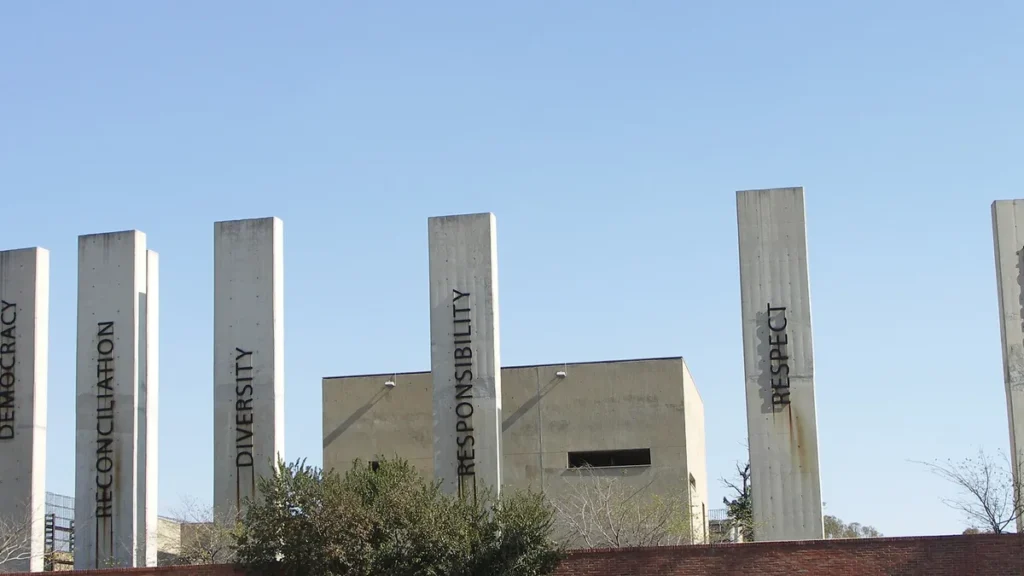
- The Pillars of the Constitution — seven steel columns engraved with the values underpinning South Africa’s post-apartheid constitution, greeting visitors at the entrance and framing everything that follows.
- The Classification Boards — original apartheid-era signage designating spaces by race, displayed in context to convey the bureaucratic mundanity of segregation.
- The Segregated Entrance Gates — visitors are assigned a race classification on their ticket and directed through separate entrances, a widely discussed experiential device that opens the visit.
- The Film Archive Galleries — extensive documentary footage covering the Sharpeville Massacre, the Soweto Uprising of 1976, and the release of Nelson Mandela in 1990.
- The Mandela Exhibition — a dedicated section tracing Mandela’s life from Qunu to Robben Island to the presidency, drawing on photographs, personal documents, and recorded testimony.
- The Winnie Madikizela-Mandela Gallery — added to give fuller account of her role in the resistance movement and the complexity of her legacy.
- The Reconciliation Section — documents the Truth and Reconciliation Commission process, including recorded hearings and written submissions, presenting both perpetrators’ testimony and survivors’ accounts.
Architecture and building
The museum was designed by the South African architectural practice Mashabane Rose Architects in association with other collaborators, and opened in 2001. The building is deliberately austere: raw concrete, steel mesh, and brick are used throughout, materials chosen to evoke the industrial harshness of the apartheid state rather than the polished neutrality of a conventional museum. Natural light is admitted selectively, creating passages of shadow and exposure that reinforce the narrative arc of the galleries. The site incorporates outdoor spaces including a bridge and reflecting elements that allow visitors to decompress between dense interior sections. No major structural renovation has been publicly announced as of mid-2025, though ongoing maintenance and gallery refreshes are part of normal operations.
Visiting practical
The Apartheid Museum is located on Northern Parkway and Gold Reef Road, Ormonde, Johannesburg, adjacent to the Gold Reef City theme park. It is open Tuesday through Sunday; Monday is typically a closing day, though visitors should confirm current hours directly with the museum before travelling. Ticket prices fall in a low-to-mid band by international standards, with reduced rates for South African citizens, students, and children — making it genuinely accessible to local school groups as well as international visitors. The site is reachable by car or taxi; public transport connections exist but require planning. The building is wheelchair accessible across the majority of its galleries, with ramps and lifts provided, though the outdoor sections involve some uneven terrain.
Repatriation and debates
The Apartheid Museum’s collection is primarily archival and documentary in character — photographs, film, signage, legal documents, personal testimony — rather than ethnographic or object-based in the way that makes repatriation a central institutional question for many African museums. As such, it does not sit at the heart of the continent-wide debates over the return of cultural objects held in European institutions. However, the museum does engage with broader questions of historical justice, memory ownership, and whose narratives are centred in the telling of South African history. Discussions within South African heritage circles about how to represent communities beyond the dominant ANC-aligned liberation narrative, and how to incorporate Khoisan, Zulu, Afrikaner, and other perspectives into national memory institutions, are conversations the museum’s curators have acknowledged publicly. These are ongoing and unresolved.
Recent developments
In the period from 2023 to mid-2025, the Apartheid Museum has continued to expand its temporary exhibition programme alongside its permanent galleries. Exhibitions addressing contemporary South African democracy, the legacy of the Truth and Reconciliation Commission thirty years on, and the lives of women in the liberation struggle have been reported in South African cultural media. The museum has also increased its digital outreach, with educational resources developed for schools unable to visit in person — a programme accelerated during the pandemic years and sustained since. Specific leadership changes at director or curatorial level during this window have not been confirmed in publicly available sources at the time of writing, and readers seeking current staffing information should consult the museum directly.