Nouvelair
Nouvelair
About
Nouvelair is a Tunisian scheduled and charter carrier that occupies a distinctive position in North African aviation: large enough to compete meaningfully on leisure routes across the Mediterranean, yet nimble enough to adapt quickly to the seasonal demand patterns that define the region’s tourism economy. Operating under IATA code BJ and ICAO designator LBT, the airline connects Tunisia’s coastal heartland to European leisure markets and select regional destinations, making it one of the most recognisable Tunisian brands in the skies above the continent.
Nouvelair was founded in 1989 and has operated for more than three decades under private ownership, a relative rarity in a North African aviation landscape long dominated by state-backed flag carriers. The airline is closely associated with the Tunisian conglomerate Mouvement Ettakatol’s broader travel and tourism interests, and has historically been linked to the Tunisian travel group Mövenpick-affiliated tourism holdings, though its ownership structure has evolved over the years. Unlike many regional peers, Nouvelair has remained outside direct state control, giving it greater commercial flexibility but also exposing it more directly to the cyclical pressures of the leisure travel market.
In recent years the airline has navigated a challenging operating environment shaped by the COVID-19 pandemic’s near-total collapse of Mediterranean tourism traffic, the subsequent recovery surge, and ongoing macroeconomic pressures affecting Tunisia more broadly. Corporate governance and strategic direction have been subjects of industry attention as the airline positions itself for the mid-2020s, with observers watching closely whether it will deepen its scheduled network or continue to anchor its model in the high-volume charter segment.
Bases and Hubs
Monastir Habib Bourguiba International Airport (MIR) — Nouvelair’s principal hub and primary base of operations, strategically located on Tunisia’s central coast and serving as the gateway to the Sousse and Sahel tourism corridor, one of the country’s most visited resort regions.
Tunis-Carthage International Airport (TUN) — A secondary focus city for the airline, used for select scheduled and charter operations serving the capital and its catchment area, and providing access to Tunisia’s largest passenger pool.
Djerba–Zarzis International Airport (DJE) — An important seasonal focus point, particularly during peak summer months, reflecting the strong leisure demand generated by the island of Djerba as a Mediterranean holiday destination.
Fleet
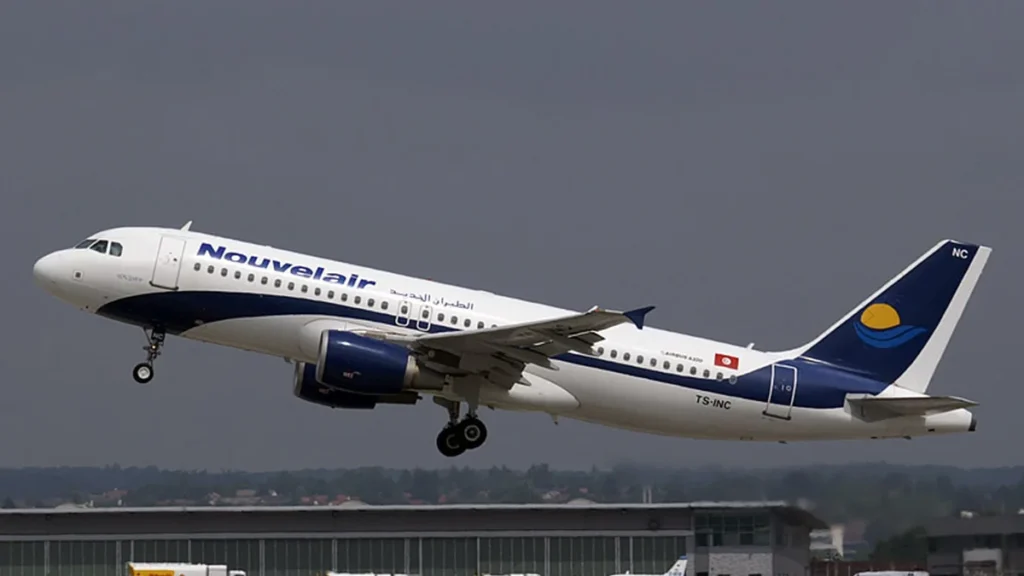
Nouvelair operates a narrowbody fleet built around the Airbus A320 family, which has formed the backbone of its operations for a sustained period. The airline has operated both the A320ceo and A319 variants, well-suited to the short- to medium-haul Mediterranean routes that define its network. According to publicly disclosed fleet data and industry tracking sources, the airline maintains a modest but operationally focused fleet sized to match its seasonal capacity requirements rather than year-round high-frequency scheduling. Industry estimates suggest the active fleet has fluctuated in line with post-pandemic recovery trajectories common across the region’s leisure carriers. There has been industry-level discussion about potential fleet modernisation toward A320neo-family aircraft, which would offer meaningful fuel efficiency gains on the airline’s core European routes, though no firm order has been publicly confirmed as of the time of writing.
Destinations
Nouvelair’s network is shaped primarily by the Mediterranean leisure corridor, with the vast majority of its capacity directed toward European source markets for Tunisian tourism. The airline operates a mix of scheduled and charter services to destinations across France, Germany, Italy, Belgium, Switzerland, the United Kingdom, and Scandinavia, reflecting the traditional European feeder markets for Tunisia’s coastal resorts. Key headline routes include services linking Monastir (MIR) and Djerba (DJE) with Paris Charles de Gaulle, Lyon, Marseille, Frankfurt, Düsseldorf, Milan, and Brussels, among others. Within the African continent, the airline maintains limited intra-regional connectivity, with some services to destinations in North Africa. Long-haul intercontinental operations do not form a significant part of the current network, with the airline’s strategic identity remaining firmly anchored in the short- and medium-haul leisure segment.
Codeshare and Alliance
Nouvelair is not a member of any of the three major global airline alliances — Star Alliance, SkyTeam, or oneworld. The airline operates independently of alliance frameworks, which is consistent with its charter-oriented heritage and its focus on point-to-point leisure traffic rather than hub-and-spoke connecting itineraries. Formal codeshare arrangements with major network carriers have not been a prominent feature of the airline’s commercial strategy, though tour operator partnerships and block-seat agreements with European travel groups have historically served a functionally similar commercial purpose. Industry observers note that deeper interline or codeshare integration could become a strategic consideration if the airline moves further toward a scheduled-first model.
Notable Incidents
Nouvelair does not appear on the public record as having been involved in any major hull-loss accidents or fatal incidents in recent years. The airline has maintained a relatively unremarkable safety profile by the standards of publicly available aviation safety databases. As with any carrier, routine operational occurrences and minor airworthiness matters are part of normal regulatory oversight, but no specific incident of significant public concern can be attributed to the airline with confidence based on verifiable sources available at the time of writing. Travellers and researchers seeking the most current safety assessments are directed to the European Union Air Safety Agency (EASA) and the International Air Transport Association (IATA) for up-to-date regulatory standing.
Financial and Operational Situation
As a privately held carrier, Nouvelair does not publish detailed financial results in the public domain, making precise assessment of its profitability difficult. Industry estimates suggest the airline, like most Mediterranean leisure carriers, experienced severe revenue contraction during the 2020–2021 pandemic period, followed by a strong recovery in 2022 and 2023 as European demand for Tunisian beach holidays rebounded sharply. The broader Tunisian economic context — including currency pressures, inflation, and the country’s ongoing fiscal challenges — creates a complex operating environment for any domestically based carrier. Nouvelair’s private ownership structure means it has not been subject to the state-led restructuring processes that have affected some regional peers, but it also means access to capital markets may be more constrained. Operationally, the airline is understood to be focused on yield management and capacity discipline as it navigates a competitive leisure market that includes both low-cost European carriers and charter specialists.
Recent Developments
In the 24 months leading into 2026, Nouvelair has continued to rebuild and selectively expand its European leisure network following the post-pandemic recovery phase. The airline has been active in restoring frequencies on core routes to France and Germany, markets that represent the largest volumes of inbound tourism to Tunisia. There has been industry-level attention to the question of fleet renewal, with the transition to more fuel-efficient narrowbody aircraft a recurring theme across the sector. Regulatory engagement with Tunisian civil aviation authorities and alignment with EASA standards has remained an operational priority, particularly given the importance of European market access to the airline’s commercial model. The broader context of Tunisia’s evolving aviation policy — including discussions around open skies frameworks and airport infrastructure investment — continues to shape the strategic environment in which Nouvelair operates.