LIFT Airline
LIFT Airline
About
LIFT Airline occupies a distinctive position in South African aviation: a privately backed, low-cost carrier that entered a market long dominated by legacy operators and state-supported incumbents, and has worked to carve out a credible niche on domestic and regional routes. Operating under IATA code GE and ICAO designator LFT, LIFT represents one of the more closely watched new-generation carriers on the continent — lean in structure, digitally oriented in its commercial approach, and acutely aware of the structural pressures that have grounded several of its predecessors.
LIFT was founded in 2020 as a joint venture between Global Aviation (the vehicle of South African entrepreneur Gidon Novick, previously a co-founder of Kulula.com) and IndiGo Partners, the Phoenix-based private equity firm with a track record of backing ultra-low-cost carriers across multiple continents. The airline received its Air Operator Certificate and launched commercial operations in December 2020, making its debut during one of the most turbulent periods in global aviation history — the height of the COVID-19 pandemic. That timing, counterintuitive as it appeared, allowed LIFT to negotiate competitive terms on aircraft leases and to recruit experienced crew at a moment when the broader industry was contracting.
In the years since launch, LIFT has pursued a measured growth strategy rather than aggressive capacity expansion, a posture that has distinguished it from some of the more ambitious — and ultimately ill-fated — South African start-ups of the preceding decade. The airline has maintained its privately held structure, and as of 2026 there has been no publicly confirmed state equity participation, a notable characteristic in a regional market where government involvement in aviation has historically been the norm.
Bases and Hubs
Johannesburg O.R. Tambo International (JNB) — LIFT’s principal hub and primary base of operations, through which the majority of its network is coordinated and from which its operational and commercial teams are headquartered.
Cape Town International (CPT) — A key focus city and the anchor of LIFT’s highest-frequency trunk route, reflecting the enduring strength of the Johannesburg–Cape Town corridor in South African domestic demand.
Durban King Shaka International (DUR) — A secondary focus city serving South Africa’s third-largest metropolitan economy and an important leisure and business market on the eastern seaboard.
Fleet
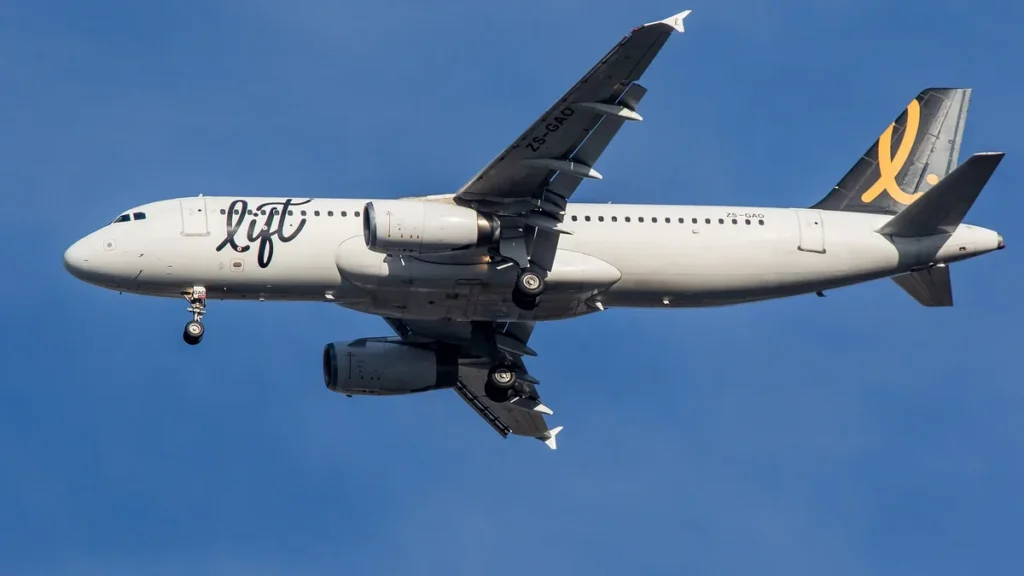
LIFT operates a narrowbody fleet built around the Airbus A320 family, a configuration consistent with its low-cost, single-type operating model and aligned with the preferences of its backer IndiGo Partners, which has historically favoured Airbus narrowbodies across its portfolio airlines. According to publicly disclosed fleet data, the airline has operated A320-series aircraft since inception, a choice that delivers commonality benefits in maintenance, crew training, and spare-parts logistics. Industry observers have noted that the A320 family’s economics suit the sub-three-hour stage lengths that characterise LIFT’s current network. The airline has not, as of 2026, publicly confirmed widebody ambitions, and its fleet strategy appears oriented toward disciplined narrowbody growth rather than type diversification.
Destinations
LIFT’s network is primarily domestic in character, anchored by the high-density triangle of Johannesburg, Cape Town, and Durban — routes that collectively represent the largest share of South African air travel demand. The Johannesburg–Cape Town service is the airline’s flagship corridor and operates at frequencies designed to compete directly with incumbent carriers on price and schedule convenience. Beyond the core triangle, LIFT has extended its reach to additional South African leisure and secondary business destinations. The airline’s intra-African and intercontinental footprint remains limited as of 2026, consistent with its focus on establishing a sustainable domestic base before pursuing more capital-intensive regional expansion. Industry estimates suggest that domestic South Africa continues to account for the substantial majority of LIFT’s seat capacity.
Codeshare and Alliance
LIFT is not a member of any of the three major global airline alliances — Star Alliance, SkyTeam, or oneworld — a position typical for low-cost carriers at its stage of development. The airline has explored interline and commercial partnership arrangements, and has publicly referenced a relationship with FlySafair and other regional operators in the context of connectivity discussions, though the precise commercial terms of any such arrangements have not been comprehensively disclosed. For investors and journalists assessing LIFT’s network reach, its distribution strategy relies heavily on direct digital channels and online travel agencies rather than traditional GDS-dependent interline architecture.
Notable Incidents
LIFT Airline has no major accidents or serious safety incidents on its publicly available record as of 2026. The airline has operated since December 2020 without a hull loss or fatality event appearing in the databases maintained by aviation safety monitoring bodies. This profile will be updated should any material safety development be confirmed by official sources.
Financial and Operational Situation
LIFT entered the market with private capital backing and has, by the accounts of its leadership, pursued a cost-disciplined operating model intended to avoid the structural vulnerabilities that contributed to the collapse of South African Airways, Comair, and other carriers in the preceding years. The airline has not published audited financial statements in the public domain, and industry estimates of its revenue and profitability should be treated with caution. Qualitatively, the airline’s posture — measured fleet growth, focus on high-yield domestic routes, avoidance of state subsidy dependence — is consistent with a management team that has internalised the lessons of South Africa’s turbulent aviation history. Whether LIFT has achieved sustained operating profitability remains a matter of informed speculation absent formal disclosure.
Recent Developments
The period from 2024 to 2026 has been consequential for LIFT in the context of a South African aviation market reshaped by Comair’s liquidation and the ongoing restructuring of South African Airways. The withdrawal of Comair — which operated both British Airways-branded and Kulula.com services — created meaningful capacity gaps on domestic routes, and LIFT was among the carriers positioned to absorb displaced demand. The airline has signalled interest in measured network expansion and has engaged with airport authorities on slot access at congested facilities. Regulatory engagement with the South African Civil Aviation Authority (SACAA) has continued as a routine operational matter. Observers tracking the carrier note that its digital-first commercial model and lean organisational structure have allowed it to respond to market shifts with greater agility than larger legacy competitors. Any confirmed fleet orders, new route launches, or partnership announcements beyond this editorial date should be verified against LIFT’s official communications and SACAA filings.