Airlink (Eswatini operations)
Airlink (Eswatini operations)
About
Airlink’s Eswatini operations represent one of the most strategically significant thin-route carriers in southern Africa — a regional specialist connecting a landlocked kingdom of roughly 1.2 million people to the wider continent through a network built on frequency, reliability, and tight integration with South Africa’s dominant aviation ecosystem. Operating under IATA code 4Z and ICAO designator LNK, the Eswatini-registered entity functions as part of the broader Airlink group, which has established itself as the pre-eminent independent regional airline in sub-Saharan Africa following its clean break from South African Airways in 2021.
Airlink traces its roots to 1992, when it was founded as a regional feeder carrier in South Africa. For nearly three decades it operated in close commercial alignment with South African Airways, functioning as a franchise partner and capacity provider on thinner routes that the national carrier could not serve economically with wide-body or large narrow-body equipment. The Eswatini operation grew out of that regional mandate, with Manzini’s King Mswati III International Airport (MTS) serving as the natural hub for services into and out of the kingdom.
The most consequential corporate moment in Airlink’s recent history came when SAA entered business rescue proceedings and Airlink’s management, led by CEO Rodger Foster, executed a management buyout that severed the franchise relationship and repositioned the group as a fully independent carrier. That transition, completed in 2021, gave Airlink full control over its scheduling, pricing, and network strategy — a freedom that has since allowed it to expand aggressively across southern and eastern Africa. The Eswatini entity benefits directly from this independence, operating under the group’s unified commercial platform while retaining its own air operator’s certificate.
Bases and Hubs
King Mswati III International Airport, Manzini (MTS) — The primary hub for Eswatini operations, MTS is a modern facility that replaced the older Matsapha Airport and serves as the kingdom’s sole international gateway; all scheduled Airlink services into Eswatini originate or terminate here.
O.R. Tambo International Airport, Johannesburg (JNB) — While technically a South African hub for the broader Airlink group, JNB functions as the critical connecting node for Eswatini-origin passengers, providing onward access to the group’s wider network and to international partners.
Fleet
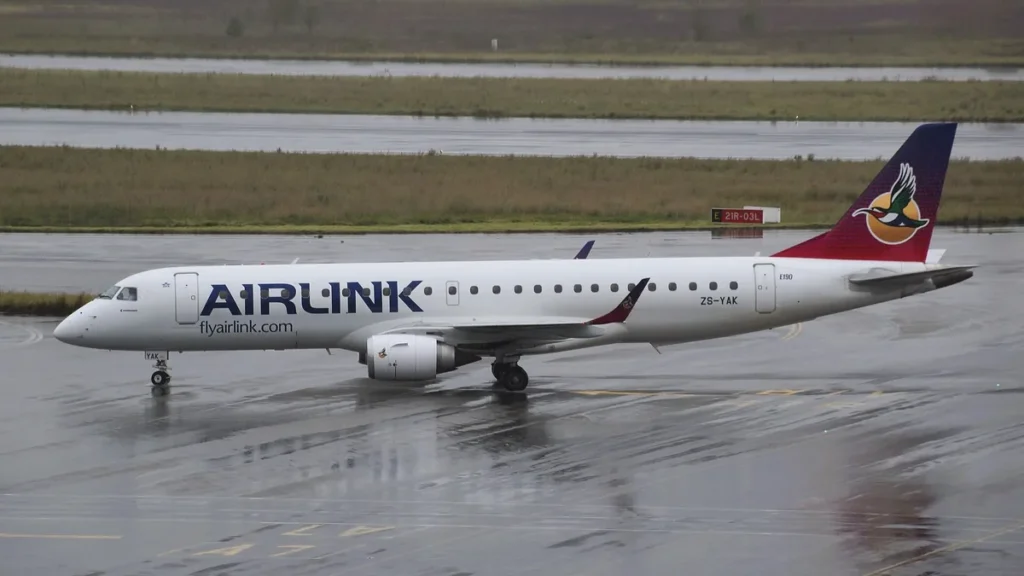
Airlink operates a fleet composed primarily of Embraer regional jets, with the Embraer ERJ-135 and ERJ-145 family forming the backbone of its thinner-route operations, and the larger Embraer 170 and Embraer 190 series deployed on higher-demand corridors. According to publicly disclosed fleet data, the group has progressively rationalized around Embraer types, phasing out older British Aerospace Jetstream turboprops that once served the most marginal routes. The Embraer platform suits the Eswatini operation well: the relatively modest passenger volumes on the MTS corridor make the economics of a 37-to-50-seat regional jet considerably more defensible than a narrow-body configuration. Industry observers have noted that Airlink’s fleet strategy prioritizes right-sizing over raw capacity, a discipline that has historically protected yields on thin routes. No firm public orders for next-generation replacement aircraft specific to the Eswatini operation had been announced as of early 2026, though the group-level fleet renewal conversation continues.
Destinations
The network shape for Eswatini operations is deliberately regional in character. The anchor route is Manzini (MTS) to Johannesburg O.R. Tambo (JNB), which operates with meaningful weekly frequency and functions as the primary economic and tourism lifeline for the kingdom’s air connectivity. Beyond Johannesburg, Airlink’s broader group network — accessible via connection at JNB — extends the effective reach of an MTS-originating passenger to destinations across southern and eastern Africa, including Cape Town, Durban, Maputo, Harare, Lusaka, and Nairobi, among others. The Eswatini operation does not itself operate long-haul or intercontinental services; its role is explicitly intra-regional, feeding the hub rather than competing with it. Leisure traffic tied to Eswatini’s tourism offering — including Mlilwane Wildlife Sanctuary and the annual Incwala and Umhlanga ceremonies — provides a seasonal demand layer that complements the year-round business and diaspora traffic.
Codeshare and Alliance
Airlink is not a member of any of the three major global airline alliances — Star Alliance, SkyTeam, or oneworld. Following its independence from SAA, the group has pursued bilateral interline and codeshare arrangements as its primary connectivity strategy. Notably, Airlink holds a codeshare agreement with Emirates, which provides meaningful feed from Dubai and the broader Emirates network onto Airlink’s southern African routes. The group has also maintained interline relationships with several other international carriers operating into Johannesburg, allowing MTS-origin passengers to book through-itineraries on a single ticket. This alliance-free positioning gives Airlink commercial flexibility but also means it lacks the automatic reciprocal frequent-flyer and lounge benefits that alliance membership confers — a consideration for corporate travel managers evaluating Eswatini routing options.
Notable Incidents
No major safety incidents involving Airlink’s Eswatini-registered operations appear on the airline’s recent public safety record. The broader Airlink group maintains a safety management system aligned with IOSA (IATA Operational Safety Audit) standards, and the carrier has not featured prominently in regional accident investigation reports in recent years. Researchers requiring a comprehensive safety history should consult the Aviation Safety Network database and the Eswatini Civil Aviation Authority’s published records directly.
Financial and Operational Situation
Airlink as a group emerged from the SAA franchise era in a financially precarious position, having navigated the twin shocks of that commercial separation and the near-total collapse of aviation demand during the COVID-19 pandemic. Industry estimates suggest the group has since returned to operational profitability, supported by its lean cost structure, right-sized fleet, and the absence of the legacy obligations that burden many state-affiliated African carriers. The Eswatini operation specifically benefits from limited direct competition on its core Manzini–Johannesburg corridor, which provides a degree of yield protection unusual in more contested markets. The airline is privately held following the management buyout, meaning detailed financial disclosures are not publicly available; qualitative assessments from regional aviation analysts characterize the group’s trajectory as cautiously positive, with load factor recovery on key routes broadly tracking pre-pandemic norms. Currency risk — given that Eswatini’s lilangeni is pegged to the South African rand — is a structural feature of the operating environment rather than an acute crisis.
Recent Developments
In the 24 months leading into 2026, several developments have shaped the Eswatini operation’s outlook. At the group level, Airlink has continued to add point-to-point routes across southern and eastern Africa, reinforcing the hub connectivity that makes MTS passengers’ onward options more attractive. The carrier has invested in its digital distribution infrastructure, improving direct booking capabilities and ancillary revenue generation — changes that benefit all network points including Manzini. Regionally, the gradual implementation of the Single African Air Transport Market (SAATM) framework continues to be watched closely by Airlink’s commercial team, as liberalization of bilateral air service agreements could both open new opportunities and introduce new competition on currently protected corridors. The Eswatini Civil Aviation Authority has also been engaged in ongoing regulatory alignment with ICAO standards, a process that affects operational certification requirements for carriers like Airlink holding Eswatini air operator certificates. Stakeholders in Eswatini’s tourism sector have publicly advocated for increased air service frequency and the potential addition of direct links to regional leisure markets, conversations in which Airlink is an active participant.
Related Research
- Eswatini Expert Briefing — full country profile, economy, and investment climate
- African Airlines — the complete carrier index for the continent
- African Airports — infrastructure profiles including King Mswati III International (MTS)
- Country Comparison Tool — benchmark Eswatini against peer markets across key indicators