RwandAir
RwandAir
About
RwandAir is Rwanda’s national carrier and one of the most closely watched growth stories in African aviation. Operating under IATA code WB and ICAO designator RWD, the airline has transformed from a modest regional operator into a credible intercontinental carrier within roughly two decades — a trajectory that mirrors Rwanda’s own ambitions to position Kigali as a premier hub for business, tourism, and transit traffic on the continent.
The airline traces its origins to Rwandair Express, which was established in 2002 following the dissolution of the earlier Rwanda Airlines. It is wholly owned by the Government of Rwanda, a structure that has given it access to state-backed capital and strategic direction aligned with the country’s Vision 2050 development agenda. Ownership through the government has also meant that commercial decisions are frequently intertwined with national economic policy, particularly around tourism and the development of Kigali as a regional meeting and conference destination.
In recent years, RwandAir has undergone a series of corporate reorientations, including leadership changes and ongoing discussions about potential strategic partnerships or partial privatisation. The airline has been cited in industry circles as a candidate for equity investment from international aviation groups, though no binding agreement had been publicly confirmed as of early 2026. Its management has consistently emphasised a long-term commitment to building a self-sustaining network rather than relying indefinitely on government subsidy.
Bases and Hubs
Kigali International Airport (KGL) — The airline’s principal hub and sole main base, located at Kanombe on the eastern edge of Kigali. KGL serves as the operational, commercial, and maintenance centre for the entire network, and is the connecting point for passengers transiting between sub-Saharan Africa and intercontinental destinations.
Focus cities — RwandAir operates point-to-point services from several African capitals that function as secondary traffic generators, including Nairobi (NBO), Entebbe (EBB), and Dar es Salaam (DAR), where frequency and scheduling are designed to capture both origin-destination and onward connecting traffic.
Fleet
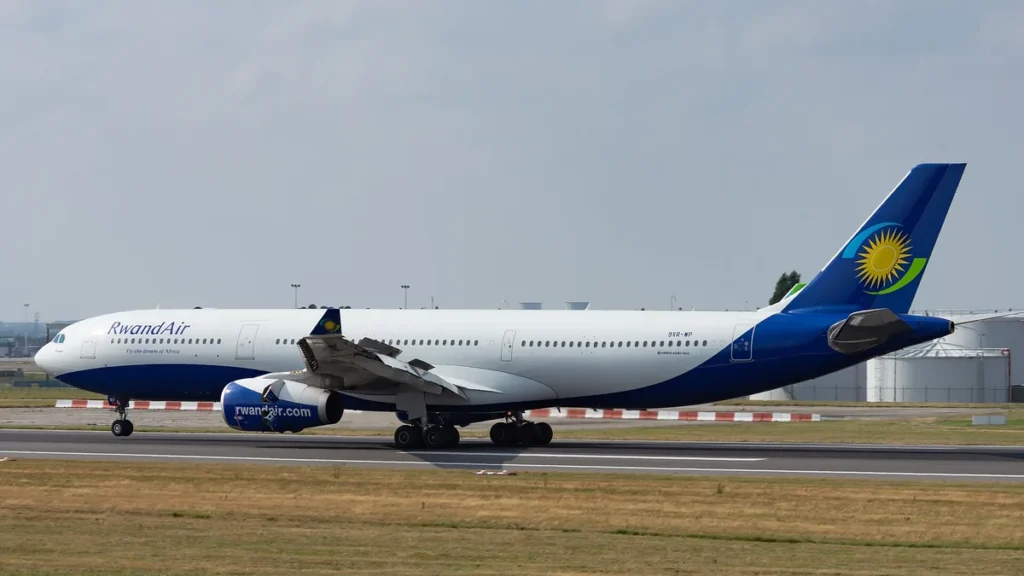
RwandAir operates a mixed fleet built around Boeing and Airbus narrowbody and widebody types. According to publicly disclosed fleet data, the airline has operated Boeing 737 series aircraft — including the 737-800 — as its narrowbody workhorse for regional and medium-haul African routes. Widebody capacity has been provided by Boeing 737 MAX variants and, notably, Airbus A330 family aircraft, which have enabled the airline to sustain long-haul services to Europe and Asia. The carrier has also historically operated Bombardier CRJ series regional jets for thinner intra-African routes, though the composition of the regional fleet has evolved over time.
Industry observers have noted that RwandAir’s fleet renewal strategy is closely tied to its route expansion ambitions. Discussions around additional widebody capacity to support new long-haul routes have been reported in aviation trade media, though specific order confirmations should be verified against the airline’s official communications and manufacturer order books.
Destinations
RwandAir’s network is structured across three broad tiers. The intra-African regional network — its largest by frequency — connects Kigali to East African capitals and major commercial cities including Nairobi, Entebbe, Dar es Salaam, Bujumbura, and Juba. A broader pan-African tier extends the network westward and southward to destinations such as Lagos, Accra, Johannesburg, and Lusaka, reflecting Rwanda’s ambition to serve as a genuine continental connector rather than a purely East African carrier.
Intercontinental services represent the airline’s most strategically significant routes. RwandAir has operated scheduled services to London Heathrow (LHR) and Brussels (BRU) in Europe, and has maintained a route to Dubai (DXB), which serves both the Gulf transit market and the large Rwandan diaspora community in the region. A service to Mumbai has also featured in the airline’s long-haul portfolio, underlining its interest in capturing South Asian traffic flows through Kigali.
Codeshare and Alliance
RwandAir is not a member of any of the three major global airline alliances — Star Alliance, SkyTeam, or oneworld — as of early 2026. The airline has instead pursued a bilateral codeshare strategy. It has maintained a notable codeshare and interline relationship with Qatar Airways, which has provided RwandAir with access to a broad global network through Doha (DOH) and has been linked to broader commercial cooperation discussions. Additional interline arrangements with other African and international carriers have been reported, though the active status of individual agreements should be confirmed with the airline directly.
Notable Incidents
RwandAir does not appear on the public record as having been involved in any major hull-loss accidents or fatal incidents. The airline has maintained a relatively clean operational safety profile in recent years, and no significant safety events attributable to RwandAir appear in the major aviation safety databases within the period of its current operational identity. Journalists and researchers are advised to consult the Aviation Safety Network and the ICAO safety audit records for the most current and authoritative assessment.
Financial and Operational Situation
As a state-owned carrier, RwandAir does not publish audited financial results in the manner of a publicly listed airline, and detailed profit-and-loss data is not consistently available in the public domain. Industry estimates suggest the airline has faced the structural challenges common to African flag carriers — high fuel costs relative to yield, thin load factors on some long-haul routes, and the capital intensity of fleet maintenance — while benefiting from government support that has allowed it to sustain network investment through periods of revenue pressure.
The post-pandemic recovery period brought improved passenger volumes across the network, consistent with broader African aviation trends. Rwanda’s growing profile as a conference and MICE (meetings, incentives, conferences, and exhibitions) destination — anchored by the Kigali Convention Centre and a series of high-profile international summits — has provided a reliable source of premium and business-class demand that supports yield on key routes. The airline’s longer-term financial sustainability is understood to be a live policy question within the Rwandan government, with partial commercialisation or strategic investment periodically discussed.
Recent Developments
In the 24 months leading into 2026, RwandAir has continued to refine its network with a focus on improving frequency and connectivity on its highest-performing routes rather than aggressive point-to-point expansion. The airline’s relationship with Qatar Airways has remained a focal point for commercial development, with the partnership seen as a mechanism for feeding long-haul traffic through Kigali. Kigali International Airport itself has been the subject of significant infrastructure investment, with expansion works aimed at increasing capacity and improving the passenger experience — developments that directly affect RwandAir’s operational environment and competitive positioning.
Discussions around the airline’s ownership structure and the potential role of a strategic equity partner have continued to surface in regional business media, reflecting a broader continental trend of African governments reassessing the optimal model for sustaining national carriers. RwandAir has also maintained its visibility at major aviation industry forums, signalling continued institutional ambition even as it navigates a challenging global operating environment marked by elevated fuel prices and currency pressures across its African markets.