Agadir–Al Massira Airport
Agadir–Al Massira Airport
About
Agadir–Al Massira Airport (IATA: AGA / ICAO: GMAD) is Morocco’s principal gateway to the Souss-Massa region and one of the continent’s most consequential leisure-oriented international airports. Positioned at the southern edge of Morocco’s Atlantic coast, it channels millions of European sun-seekers, regional business travellers, and diaspora passengers into one of Africa’s most developed resort economies. Within the broader African aviation landscape, AGA occupies a distinctive niche: it is neither a primary hub in the intercontinental sense nor a secondary feeder airport, but rather a high-frequency, seasonally intensive international terminal whose traffic profile closely mirrors that of comparable Mediterranean and North African tourist gateways.
The airport was inaugurated in 1970, constructed to serve the rapidly expanding coastal city of Agadir following the catastrophic 1960 earthquake that had effectively levelled the original urban centre and prompted a wholesale rebuilding of the city and its infrastructure. From the outset, Al Massira — the name references a landmark Moroccan political march of 1975 — was conceived with international tourism in mind, a strategic orientation that has defined its development trajectory ever since. Ownership and operational oversight rest with the Office National des Aéroports (ONDA), the Moroccan state authority responsible for managing the country’s network of civilian airports.
Significant infrastructure investment has been directed at the airport across successive decades. A major terminal expansion programme undertaken in the 2000s substantially increased passenger throughput capacity, and further works have addressed apron space, taxiway configuration, and landside access roads. According to publicly disclosed traffic data from ONDA, AGA has consistently ranked among Morocco’s top three busiest airports by passenger volume, behind Mohammed V International in Casablanca and Marrakech Menara, reflecting the enduring commercial weight of the Agadir resort corridor.
Country
Morocco is a constitutional monarchy situated at the north-western tip of the African continent, sharing land borders with Algeria to the east and Mauritania to the south, and separated from Spain by the Strait of Gibraltar. Rabat serves as the political capital, while Casablanca functions as the commercial and financial centre. With a population estimated in the tens of millions and a GDP that places it among the larger economies of the African Union, Morocco occupies a pivotal position as a bridge between sub-Saharan Africa, the Arab world, and the European Union — a geopolitical reality that shapes the country’s aviation policy, tourism strategy, and foreign investment climate in equal measure.
→ Read the Morocco expert briefing
Airlines Based Here
Royal Air Maroc (RAM), Morocco’s flag carrier and the dominant force in the country’s aviation market, operates scheduled services through AGA as part of its national network, connecting Agadir to Casablanca’s Mohammed V hub and, through that hub, to a wider intercontinental route map. RAM does not treat AGA as a primary base in the operational sense — its main maintenance, crew, and administrative infrastructure is concentrated at Casablanca — but the airline maintains a consistent year-round presence at the airport. Ryanair, the Irish ultra-low-cost carrier, has established AGA as one of its more active Moroccan points, operating multiple European routes on a high-frequency basis. easyJet, Transavia France, Transavia Netherlands, TUI fly Belgium, TUI fly Netherlands, Vueling, and Wizz Air are among the visiting carriers that deploy capacity to Agadir on a seasonal or year-round basis, reflecting the airport’s fundamental character as a destination airport for European leisure traffic rather than a carrier domicile.
Flights and Destinations
The route network at AGA is heavily weighted towards Western Europe, which supplies the overwhelming majority of inbound tourist traffic. Direct services connect Agadir to London Gatwick, London Stansted, Paris Charles de Gaulle, Paris Orly, Amsterdam Schiphol, Brussels, Madrid, Barcelona, Düsseldorf, Frankfurt, and Geneva, among other European cities. Domestic connectivity is maintained primarily through Casablanca, which functions as the national hub through which onward connections to Marrakech, Fez, Tangier, and other Moroccan cities are routed. Within the African continent, direct regional services are more limited, though connections to Dakar and other West African points have featured in the network at various times, subject to seasonal demand and airline scheduling decisions. Intercontinental services beyond Europe remain sparse at AGA itself, with passengers typically transiting Casablanca for transatlantic or Gulf-region itineraries. Charter operations — particularly from the United Kingdom, Germany, Belgium, and the Netherlands — supplement the scheduled network substantially during the October-to-April peak season when Agadir’s mild Atlantic climate draws visitors escaping northern European winters.
Facilities and Capacity
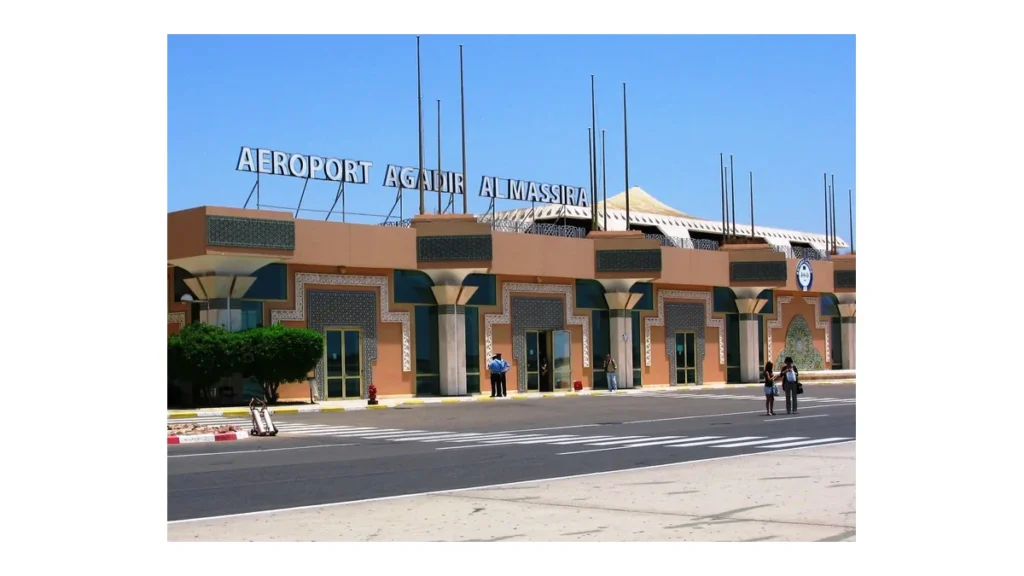
AGA operates a single passenger terminal building, which has been progressively extended and reconfigured to accommodate growing traffic volumes. The terminal houses both international and domestic departure facilities, with airside retail, food and beverage concessions, and standard business-class lounge provision. The airport is served by a single primary runway — designated 10/28 — with a published length sufficient to accommodate narrow-body and medium wide-body commercial aircraft, making it suitable for the Boeing 737 and Airbus A320 family types that dominate its traffic mix, as well as occasional wide-body operations. Cargo facilities exist on site, though AGA functions primarily as a passenger airport; belly-hold freight on scheduled passenger services constitutes the principal cargo channel rather than dedicated freighter operations. In terms of overall scale, industry analysts generally classify AGA as a medium-volume international airport by African standards — significant in regional context, but operating well below the throughput levels of Casablanca or Cairo. Expansion planning, including apron extension and terminal modernisation works, has been referenced in ONDA’s publicly stated infrastructure programmes, though specific budget figures and completion timelines should be verified against current ONDA disclosures.
Visa Regulations
Morocco operates a relatively open visa regime for travellers arriving at AGA from major source markets. Citizens of the United States, the United Kingdom, and all European Union member states are generally permitted to enter Morocco without a prior visa for stays of up to 90 days, subject to holding a valid passport and meeting standard entry conditions. Many other nationalities — including a growing number of African Union member state passport holders — benefit from bilateral visa-free or visa-on-arrival arrangements that Morocco has expanded in recent years as part of its broader African integration strategy. An eVisa system has been under development and rollout for certain nationalities, though travellers should verify current availability before departure. Visa rules are subject to change at short notice and vary significantly by nationality, travel purpose, and length of stay. For a current, nationality-specific lookup, consult the live database at /visa-requirements/.
Recent Developments
The 24-month period leading into 2026 has been characterised by a gradual but sustained recovery and growth phase at AGA following the disruptions of the early 2020s. Several European low-cost carriers have added new routes or increased frequencies to Agadir, responding to strong forward booking data from the UK, French, and German leisure markets. Royal Air Maroc has continued to develop its domestic feed into the airport as part of its wider network rationalisation. Landside infrastructure improvements — including upgraded road access and car park expansion — have been reported in local and regional aviation trade coverage. The airport has also benefited from Morocco’s broader tourism promotion campaigns, which have targeted new source markets in Eastern Europe and the Gulf Cooperation Council region. Regulatory oversight by Morocco’s Direction Générale de l’Aviation Civile (DGAC) has remained consistent with ICAO standards, and no significant safety or operational regulatory actions at AGA have been reported in credible aviation industry sources during this period.
News and Reports
Researchers and journalists tracking operational developments at Agadir–Al Massira Airport should consult several authoritative source categories. The Office National des Aéroports publishes periodic traffic statistics and infrastructure announcements through its official communications channels. Morocco’s Direction Générale de l’Aviation Civile issues regulatory notices, safety oversight updates, and policy documents relevant to all airports operating under Moroccan jurisdiction. At the international level, IATA’s Africa regional reports and ICAO’s Middle East and Africa regional office publications provide comparative context for AGA’s performance within the continental aviation system. Aviation trade titles including ch-aviation, anna.aero, and The Air Current regularly cover North African airport and airline developments with sourced, verifiable reporting. Local Moroccan news outlets covering the Souss-Massa region provide ground-level coverage of airport-related economic and infrastructure stories. Travellers seeking real-time operational information — delays, terminal notices, ground transport — should reference ONDA’s official airport information services directly.