Egyptian Museum (Cairo)
Egyptian Museum (Cairo)
About
The Egyptian Museum in Cairo is the oldest and largest repository of ancient Egyptian antiquities in the world. Sitting at the northern edge of Tahrir Square, it holds more than 100,000 objects spanning roughly 5,000 years of Pharaonic civilisation — from predynastic flint tools to the gilded furniture of New Kingdom royalty. For anyone serious about understanding the ancient world, a visit here is not optional; it is foundational.
The museum’s origins lie in the mid-nineteenth century, when the Egyptian government, under Khedive Abbas I and later Said Pasha, began asserting state control over antiquities that had been flowing freely — and illegally — into European private collections. The French Egyptologist Auguste Mariette established the first formal antiquities service and a precursor collection at Bulaq in 1858. That collection moved to Giza in 1891 before finding its permanent home in the purpose-built Cairo building, which opened to the public in 1902.
Gaston Maspero, another French Egyptologist who served two terms as Director-General of the Antiquities Service, was instrumental in shaping the museum’s early scholarly identity. Egyptian nationals gradually assumed leadership through the twentieth century, a transition that accelerated after the 1952 revolution and the broader project of cultural decolonisation. Today the museum is administered by Egypt’s Ministry of Tourism and Antiquities, and its long-term future is intertwined with the nearby Grand Egyptian Museum at Giza, which has been receiving major collections on a rolling basis.
Country and city context
Egypt sits at the northeastern corner of Africa, bridging the continent with the Levant and the Arabian Peninsula. Cairo, its capital and largest city, is home to more than 20 million people in its greater metropolitan area, making it one of Africa’s most populous urban centres. The city layers millennia of history — Pharaonic, Coptic, Islamic, Ottoman, and colonial — into a dense, loud, and endlessly compelling whole. The Egyptian Museum occupies one of Cairo’s most politically charged public spaces: Tahrir Square, the epicentre of the 2011 uprising, which gives even a routine museum visit an unexpected civic resonance. → Read the Egypt expert briefing
Collection highlights
The museum’s holdings are extraordinary in breadth and depth. Among the most significant pieces and galleries:
- Tutankhamun galleries (upper floor): The burial assemblage of the boy king, discovered by Howard Carter in 1922, including the iconic solid-gold death mask — arguably the most recognised artefact in the history of archaeology.
- Royal Mummy Room: A climate-controlled hall housing the preserved remains of major New Kingdom pharaohs, including Ramesses II and Seti I, displayed with careful attention to dignity.
- Narmer Palette: A ceremonial greywacke palette dating to around 3100 BCE, widely interpreted as one of the earliest historical records of a unified Egyptian state.
- Akhenaten statuary: A striking collection of colossal figures from the reign of the heretic pharaoh, notable for their elongated, stylised forms that broke sharply from classical Egyptian convention.
- Yuya and Thuya collection: Funerary objects from the tomb of Tutankhamun’s great-grandparents, among the best-preserved non-royal burials ever found.
- Predynastic and Early Dynastic galleries: Artefacts tracing the emergence of Egyptian culture before the first dynasty, offering essential context for everything that follows.
Architecture and building
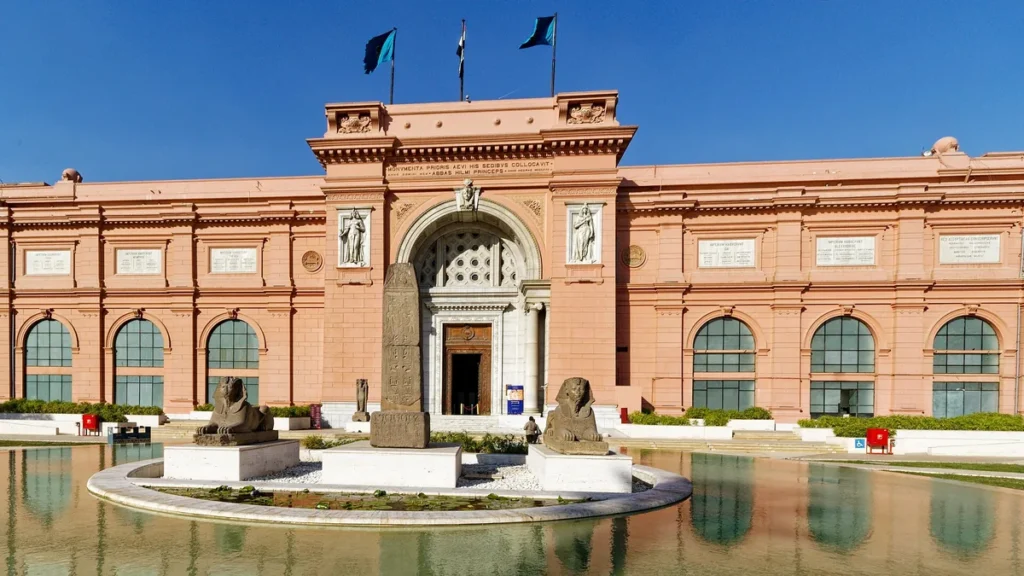
The building was designed by the French architect Marcel Dourgnon, who won an international competition for the commission. It opened in 1902 in a neoclassical style with Egyptianising decorative elements — a common hybrid of the colonial-era taste for antiquity. The salmon-pink facade and the garden courtyard, dotted with ancient statuary, have become as recognisable as the collection itself. The building has seen incremental maintenance over the decades but no comprehensive structural renovation; its ageing infrastructure — limited climate control, crowded storage, uneven lighting — has long been a concern among conservators. The gradual transfer of key collections to the Grand Egyptian Museum at Giza is partly a response to those limitations.
Visiting practical
The Egyptian Museum is located on Tahrir Square in central Cairo, well served by the Cairo Metro (Sadat station). It is generally open daily, including weekends, though hours can vary around public holidays and should be confirmed with official sources before travel. Ticket pricing falls in the moderate band for international visitors — expect to pay meaningfully more than at domestic-rate institutions, with surcharges for the Royal Mummy Room and photography permits. The building’s age means accessibility for visitors with mobility impairments is limited in parts of the upper floor; ground-floor galleries are more navigable. Guided tours, available in multiple languages, are strongly recommended given the density of the collection and the often sparse English-language labelling.
Repatriation and debates
Egypt has been one of the most persistent and high-profile voices in global repatriation debates. The Egyptian government has repeatedly and formally requested the return of the Rosetta Stone from the British Museum and the bust of Nefertiti from the Neues Museum in Berlin, among other objects. Former antiquities minister Zahi Hawass has been the most internationally visible advocate for these claims, framing repatriation not merely as a legal question but as a matter of cultural sovereignty. Neither the British Museum nor the Neues Museum has agreed to permanent return, citing their own legislation and the principle of universal access — arguments Egypt and many source-country scholars reject. The Egyptian Museum in Cairo sits at the centre of this conversation: it is simultaneously a symbol of Egypt’s capacity to house and steward its own heritage, and a reminder of how much of that heritage remains abroad.
Recent developments
The dominant story of the past two years has been the continued, phased opening of the Grand Egyptian Museum (GEM) at Giza, which has drawn international attention and begun receiving artefacts previously held in Cairo. The GEM’s partial opening and ongoing gallery launches have inevitably raised questions about the long-term role of the Tahrir Square building — Egyptian authorities have indicated it will remain open and operational, potentially with a refocused mandate, though firm plans have not been publicly confirmed. Visitor numbers at the Cairo museum have recovered following the disruptions of the pandemic years, supported by Egypt’s broader push to grow tourism revenue. Discussions about improved conservation infrastructure at the Tahrir building have continued without a publicly announced funding commitment as of mid-2025.