Buraq Air
Buraq Air
About
Buraq Air is one of Libya’s longest-operating private carriers and occupies a distinctive, if underappreciated, position in North African aviation — a scheduled airline that has continued to connect a conflict-affected country to regional and international destinations at a time when many competitors have suspended or curtailed operations. Operating under IATA code UZ and ICAO designator BRQ, the airline is headquartered in Tripoli and serves as a commercial lifeline for Libyan travellers navigating a civil aviation environment shaped by years of political instability, infrastructure strain, and competing regulatory authorities.
Buraq Air was founded in 2001, making it one of the earlier private airline ventures to emerge in Libya following a gradual loosening of the state’s grip on commercial aviation. The carrier was established as a privately owned entity, distinguishing it from the state-backed Libyan Airlines, and has maintained that private character through successive periods of political upheaval. Ownership details have not been extensively disclosed in public filings, which is consistent with the broader opacity of Libyan corporate governance, but the airline has consistently presented itself as a commercially driven operator rather than an instrument of government policy.
Over the years, Buraq Air has adapted its network and operational posture to reflect the realities on the ground in Libya. The post-2011 period, following the fall of the Gaddafi government, brought both opportunity and severe disruption to Libyan aviation. Buraq Air navigated that turbulence with varying degrees of success, at times suspending routes and then reinstating them as security conditions permitted. By the mid-2020s, the airline had re-established a functioning scheduled network and was working to consolidate its position as a credible regional carrier.
Bases and Hubs
Tripoli Mitiga International Airport (MJI) / Tripoli International Airport (TIP): Buraq Air’s principal hub and primary base of operations; Tripoli has historically been the airline’s commercial centre of gravity, though the dual-airport situation in the capital — with Mitiga serving as the functional civil aviation hub following damage to the original TIP facility — has added operational complexity in recent years.
Benghazi Benina International Airport (BEN): A secondary focus city serving Libya’s second-largest urban centre and the economic hub of the eastern Cyrenaica region, reflecting the airline’s effort to serve both sides of a politically divided country.
Misrata Airport (MRA): An additional domestic point that has featured in Buraq Air’s network, serving a commercially significant coastal city with growing trade and diaspora travel demand.
Fleet
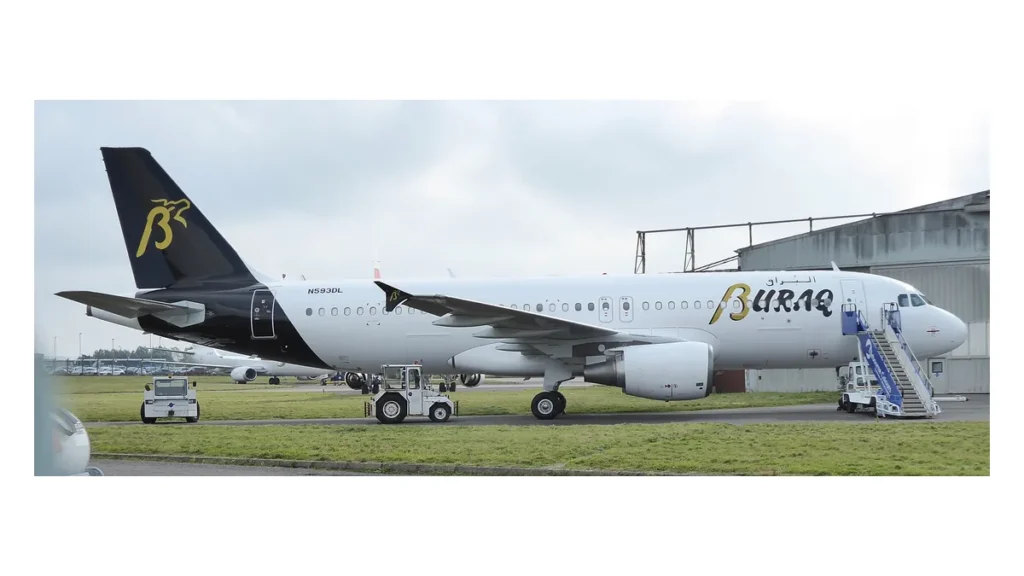
According to publicly disclosed fleet data and aviation registry sources, Buraq Air has historically operated narrowbody jet equipment suited to its regional and medium-haul network. The airline has been associated with Boeing 737 family aircraft — including variants from the Classic and Next Generation series — which form the backbone of operations on both domestic and international routes. Industry observers have also noted the use of Airbus A320 family aircraft within the fleet at various points in the carrier’s history, providing flexibility across different route lengths and passenger volumes. Exact fleet size fluctuates in line with operational demand and aircraft availability in a market where wet-lease and charter arrangements have supplemented owned capacity. No major publicly announced fleet order or renewal programme has been confirmed as of early 2026, though industry estimates suggest the airline continues to evaluate options for modernising its narrowbody equipment in line with regional peers.
Destinations
Buraq Air’s network is primarily regional in character, with a strong emphasis on connecting Libya to neighbouring North African and Middle Eastern markets. Key route categories include domestic services linking Tripoli with Benghazi and other Libyan cities, cross-Mediterranean services to southern European destinations, and routes into the Arab world serving significant Libyan diaspora and business travel flows. Headline international routes have historically included services to Istanbul (IST/SAW), a major transit and trade hub for Libyan passengers; Cairo (CAI), reflecting deep economic and cultural ties between Libya and Egypt; Tunis (TUN); and Amman (AMM). The airline has also operated services to destinations in sub-Saharan Africa on a seasonal or charter basis, though its core scheduled network remains anchored in the North Africa–Middle East–southern Europe triangle. Intercontinental services beyond this zone have not been a consistent feature of the Buraq Air product.
Codeshare and Alliance
Buraq Air is not a member of any of the three major global airline alliances — Star Alliance, SkyTeam, or oneworld — a situation common among smaller regional African and North African carriers. No formal codeshare agreements with major international carriers have been publicly confirmed in recent years, which limits the airline’s connectivity for transfer passengers and its visibility on global distribution systems. The airline’s commercial partnerships have tended to be informal or interline in nature, and any expansion of codeshare arrangements would represent a meaningful step forward in the carrier’s commercial maturity. Investors and partners considering engagement with Buraq Air should note this as both a current limitation and a potential area for development.
Notable Incidents
Africa Research is not able to confirm, with the level of documentary confidence this profile requires, any specific major hull-loss or fatal accident attributable to Buraq Air in its operational history. The airline has operated in an environment — Libyan airspace and airports — that carries elevated operational risk by international standards, and the broader Libyan aviation sector has faced safety oversight challenges documented by the International Civil Aviation Organization (ICAO) and the European Union Air Safety Agency (EASA). Readers requiring a comprehensive safety record assessment are advised to consult the Aviation Safety Network database and ICAO audit disclosures directly. No recent major incident has been prominently reported in credible aviation safety sources as of early 2026.
Financial and Operational Situation
Buraq Air’s financial position is not publicly disclosed in any detail, and no audited accounts are available through standard international commercial databases. Qualitatively, the airline operates in one of Africa’s most challenging commercial aviation environments: a market characterised by currency controls, fuel supply volatility, limited domestic purchasing power, and an aviation regulatory framework that has been fragmented between competing governmental authorities in Tripoli and Benghazi. Industry estimates suggest the airline has remained operationally active and has not entered formal insolvency proceedings, which is itself a meaningful indicator of resilience given the conditions. Profitability, if achieved, is likely to be thin and heavily dependent on route-by-route performance rather than network-wide economies of scale. State support, while not formally confirmed, cannot be ruled out given the strategic importance of maintaining air connectivity in a country with limited surface transport alternatives.
Recent Developments
In the 24 months to early 2026, Buraq Air’s most significant operational context has been the broader effort to stabilise Libyan civil aviation following years of disruption. The airline has worked within the framework of Libya’s Civil Aviation Authority to maintain its air operator certificate and comply with evolving safety directives. Route reinstatements and capacity adjustments have been reported on key corridors including Tripoli–Istanbul and Tripoli–Cairo, reflecting recovering demand from Libyan travellers who had been underserved during peak instability. The question of EASA’s restrictions on Libyan carriers operating into European Union airspace has remained a live regulatory issue, with implications for Buraq Air’s ability to serve southern European markets directly. Any lifting or modification of those restrictions would represent a material commercial development for the airline. Observers should also monitor developments around airport infrastructure investment in Libya, particularly at Mitiga and the long-discussed rehabilitation of Tripoli International, which would directly affect Buraq Air’s hub capacity and operational efficiency.
Related Research
- Libya Expert Briefing — full country profile covering political economy, infrastructure, and investment climate
- African Airlines — the Africa Research pillar covering carriers across the continent
- African Airports — hub and gateway profiles across all African regions
- Country Comparison Tool — benchmark Libya against peer markets across key aviation and economic indicators