Ethiopian Airlines
Ethiopian Airlines
About
Ethiopian Airlines is the largest and most commercially significant carrier on the African continent, operating from its hub at Addis Ababa Bole International Airport (ADD) as a full-service, state-owned enterprise that has come to define what pan-African aviation can look like when managed with long-term strategic intent. Measured by international passengers carried, revenue, and network breadth, it consistently ranks as Africa’s number-one airline and is widely regarded by industry analysts as a benchmark for aviation development across the Global South.
The airline was founded in 1945 with technical assistance from Trans World Airlines (TWA), making it one of the oldest continuously operating carriers on the continent. It is wholly owned by the Ethiopian government and operates under the Ethiopian Airlines Group structure, an umbrella that also encompasses ground-handling, catering, cargo, aviation academy, and maintenance, repair, and overhaul (MRO) subsidiaries. This vertically integrated model has been a deliberate strategic choice, allowing the group to capture value across the aviation chain rather than outsourcing it to foreign providers.
In recent years, the group has pursued an aggressive pan-African investment strategy, taking equity stakes in or providing management support to a number of national carriers across the continent, including Zambia Airways, Malawian Airlines, and ASKY Airlines in Togo. This approach positions Ethiopian Airlines not merely as a carrier but as a continental aviation platform — a role that draws both admiration and scrutiny from regional competitors and policymakers.
Bases and Hubs
Addis Ababa Bole International Airport (ADD) — The airline’s sole primary hub and the nerve centre of its entire global network; ADD functions as a connecting gateway between Africa, Asia, Europe, and the Americas, with Addis Ababa’s geographic position near the Horn of Africa providing competitive transit times on many intercontinental routings.
Lomé–Tokoin International Airport (LFW), Togo — A secondary focus city operated through the airline’s stake in ASKY Airlines, serving as a West African feed point into the broader Ethiopian network.
Lilongwe Kamuzu International Airport (LLW), Malawi — A regional focus point through the Malawian Airlines partnership, supporting intra-African connectivity in southern and central Africa.
Fleet
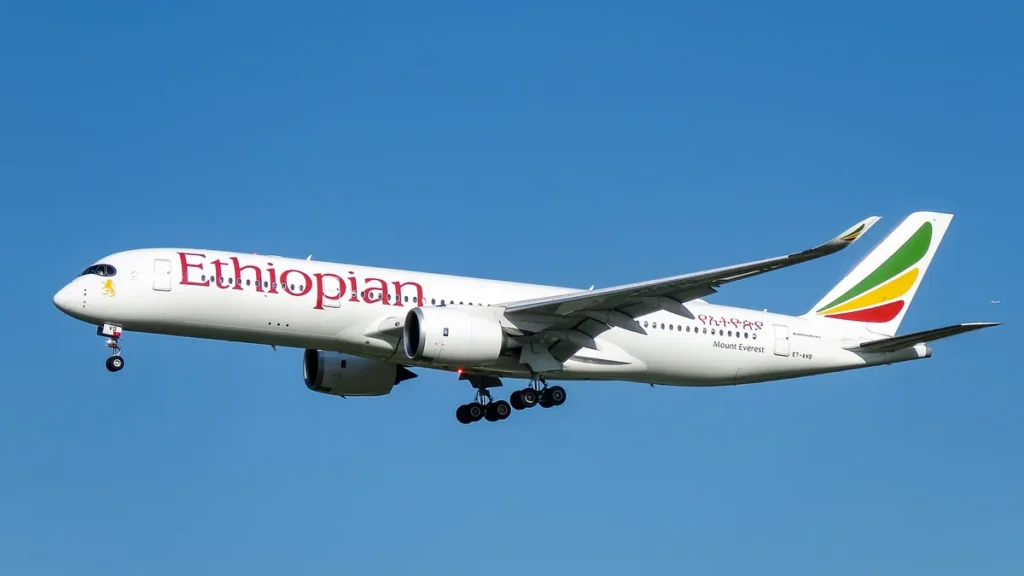
Ethiopian Airlines operates one of the most modern and diverse fleets on the continent. Its long-haul backbone is built around the Boeing 787 Dreamliner family, with both the 787-8 and 787-9 variants in service, complemented by the Boeing 777 in passenger and freighter configurations. According to publicly disclosed fleet data, the airline was among the launch customers for the Boeing 737 MAX, and the type — following the global grounding and subsequent return to service — remains part of its narrowbody and regional strategy. The Airbus A350-900 has also been added to the long-haul fleet, reflecting a deliberate policy of maintaining a mixed-manufacturer portfolio to preserve negotiating leverage and operational resilience.
For regional and thinner African routes, the airline has operated De Havilland Canada Dash 8 turboprops and has used the Boeing 737-800 extensively across the continent. Industry observers note that the group has placed significant forward orders to support its continued growth ambitions, with deliveries of additional widebody and narrowbody aircraft expected through the late 2020s.
Destinations
Ethiopian Airlines operates one of the widest route networks of any carrier based in the developing world. Its intra-African network is particularly extensive, with services to well over fifty African countries — a reach that no other single African carrier matches. Key African routes include Addis Ababa to Nairobi (NBO), Lagos (LOS), Johannesburg (JNB), Cairo (CAI), Accra (ACC), and Dakar (DKR), among many others.
Intercontinentally, the airline serves major hubs across Europe (including London Heathrow, Paris CDG, Frankfurt, and Brussels), Asia (Beijing, Shanghai, Hong Kong, Bangkok, Singapore, and Tokyo), the Middle East (Dubai, Riyadh, and Doha), and North America (Washington Dulles and Toronto). Its South American network, including a service to São Paulo, is notable for an African carrier and reflects the growing trade corridor between Africa and Latin America. The cargo network broadly mirrors the passenger network and is a significant revenue contributor in its own right.
Codeshare and Alliance
Ethiopian Airlines is a full member of the Star Alliance, having joined in 2011 — the first African carrier to do so. Membership provides reciprocal frequent-flyer benefits and interline connectivity with carriers including Lufthansa, United Airlines, Air Canada, Singapore Airlines, and Turkish Airlines, among others. The airline holds codeshare agreements with a broad range of partners beyond the alliance, including several carriers in Asia and the Middle East, which helps feed its hub at ADD from markets where it does not operate its own metal.
Notable Incidents
The most significant incident in the airline’s recent history is the crash of Ethiopian Airlines Flight ET302, a Boeing 737 MAX 8, on 10 March 2019, shortly after departure from Addis Ababa. All 157 people on board lost their lives. The accident, alongside the earlier Lion Air Flight 610 crash, triggered the worldwide grounding of the 737 MAX and led to extensive investigations by Ethiopian, American, and international aviation authorities. The findings centred on the behaviour of Boeing’s Maneuvering Characteristics Augmentation System (MCAS) and have had lasting consequences for Boeing, global aviation regulation, and the airline itself. Ethiopian Airlines has been widely credited by investigators for the professionalism of its crew in the face of a system malfunction that was, by regulatory consensus, not survivable given the information available to the flight deck at the time.
Financial and Operational Situation
Ethiopian Airlines has historically been one of the few African state-owned carriers to operate on a consistently profitable basis, a distinction that sets it apart from many of its peers on the continent. Industry estimates suggest the group returned to strong revenue growth following the disruptions of the COVID-19 pandemic, aided by the recovery of both passenger and cargo demand and by its relatively young, fuel-efficient fleet. The airline benefits from a low-cost base in Ethiopia relative to European or Gulf competitors, though inflationary pressures, foreign-currency constraints — a persistent challenge for Ethiopian businesses given restrictions on hard-currency access — and rising fuel costs have all been cited in analyst commentary as ongoing headwinds.
As a wholly state-owned enterprise, the airline does not publish detailed financial results in the manner of a publicly listed company, which limits independent scrutiny. However, the group’s continued investment in fleet, infrastructure, and pan-African partnerships is broadly interpreted by aviation economists as evidence of underlying financial confidence and government backing.
Recent Developments
In the period leading into 2026, Ethiopian Airlines has continued to expand its intercontinental footprint, with new or resumed routes to destinations in Asia and North America reflecting post-pandemic demand recovery. The airline has progressed discussions around the development of a new, expanded terminal and infrastructure at Addis Ababa Bole International Airport, a project seen as critical to sustaining hub growth as transit passenger volumes increase. Fleet deliveries — including additional Boeing 787 and Airbus A350 aircraft — have been reported in aviation trade media as part of the airline’s long-term fleet plan.
The group’s pan-African investment strategy has remained active, with ongoing involvement in partner carriers across West, Central, and Southern Africa. At the same time, the airline has faced scrutiny over the terms of some of these partnerships from host governments and local aviation stakeholders who question the balance of benefit. Sustainability commitments, including stated ambitions around sustainable aviation fuel (SAF) adoption and carbon-reduction targets, have also featured in the airline’s public communications, in line with broader industry pressure from regulators and institutional investors.