Tassili Airlines
Tassili Airlines
About
Tassili Airlines occupies a distinctive niche in North African aviation: a state-linked Algerian carrier that serves both the country’s vast domestic geography and a select portfolio of international routes, operating in the shadow of national flag carrier Air Algérie while carving out its own identity in the regional market. Named after the Tassili n’Ajjer plateau — one of Algeria’s most iconic Saharan landscapes and a UNESCO World Heritage Site — the airline reflects the country’s dual character as both a Mediterranean nation and a deep Saharan one. For journalists and investors tracking African aviation, Tassili represents an instructive case study in how state-adjacent carriers navigate liberalisation pressures, fuel subsidy regimes, and the slow but accelerating modernisation of African air transport infrastructure.
Tassili Airlines was established in 2000 as a subsidiary of Sonatrach, Algeria’s state-owned hydrocarbons giant and one of Africa’s largest corporations by revenue. Its origins were explicitly operational: the airline was created to transport Sonatrach personnel and contractors to remote oil and gas installations across the Algerian Sahara, a mission that shaped its early network and fleet philosophy. Over time, the carrier expanded beyond its energy-sector mandate to offer scheduled commercial services open to the general public, while retaining its corporate charter business as a core revenue stream.
Ownership has remained anchored within the Sonatrach group, giving the airline a degree of financial insulation uncommon among privately held regional carriers but also exposing it to the governance dynamics and budgetary priorities of its parent. In recent years, Algerian authorities have signalled broader ambitions for the country’s aviation sector, and Tassili has been periodically discussed in that context — though no confirmed privatisation or major structural reorganisation had been publicly announced as of early 2026.
Bases and Hubs
Algiers Houari Boumediene Airport (ALG) — The airline’s principal hub and administrative base, Algeria’s busiest airport and the primary gateway for both domestic connections and international services.
Hassi Messaoud Airport (HME) — A critical operational focus city given its proximity to Algeria’s major oil fields; this route and base reflect the airline’s founding mission serving the energy sector.
Ouargla Airport (OGX) — Another southern hub serving the hydrocarbon-producing interior, reinforcing Tassili’s role as a connector between Algeria’s industrialised south and its northern population centres.
Tamanrasset Aguenar Airport (TMR) — A deep-south focus point serving one of Algeria’s most remote provincial capitals, underlining the airline’s strategic importance to national territorial connectivity.
Fleet
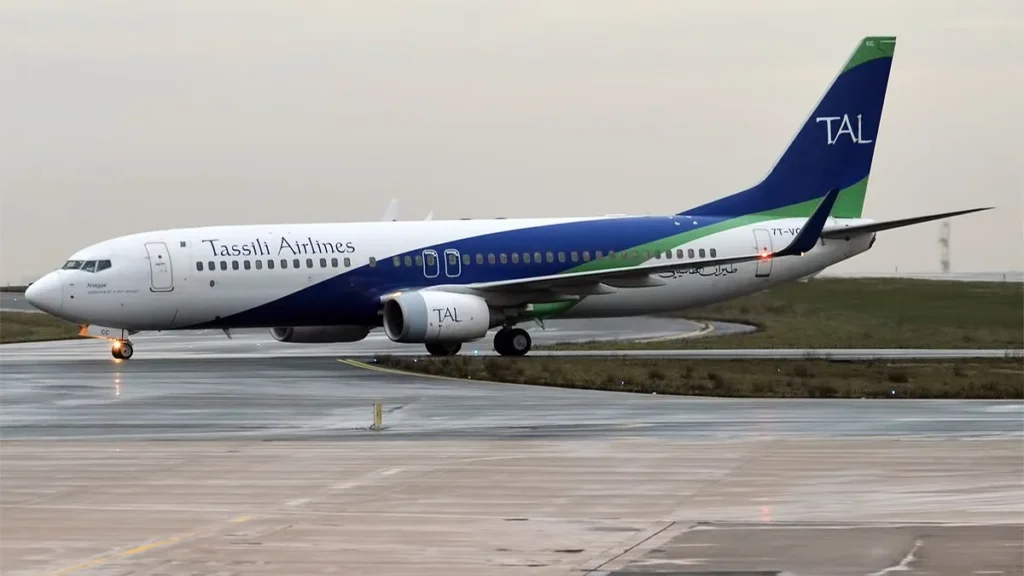
According to publicly disclosed fleet data and industry tracking sources, Tassili Airlines has historically operated a mixed fleet drawing on both Western and, at various points, older Eastern-bloc equipment. In its more recent configuration, the airline has operated Boeing 737 family narrowbodies as a backbone for domestic and short-haul international routes, alongside turboprop aircraft suited to shorter, lower-traffic Saharan sectors where runway infrastructure can be limited. Industry observers have noted that fleet age has been a recurring topic in discussions about the carrier’s modernisation trajectory. As of early 2026, no major confirmed widebody order or significant fleet expansion announcement had entered the public record, though Algerian aviation policy discussions have referenced the need for broader national fleet renewal across the sector.
Destinations
Tassili’s network is predominantly domestic in character, reflecting both its founding mandate and Algeria’s geography — a country larger than Western Europe where surface transport between north and south remains slow and arduous. The airline connects Algiers with a string of southern and interior cities including Hassi Messaoud, Ouargla, Tamanrasset, In Aménas, and Illizi, routes that serve working populations in the energy sector as much as leisure or business travellers. Internationally, the carrier operates a modest portfolio of routes to destinations in the broader Mediterranean and sub-Saharan Africa, with services to select European cities and regional African capitals forming the intercontinental layer of its network. The airline does not operate a hub-and-spoke intercontinental system comparable to Air Algérie; rather, its international routes function as point-to-point extensions of its core domestic offering.
Codeshare and Alliance
Tassili Airlines is not a member of any of the three major global airline alliances — Star Alliance, SkyTeam, or oneworld — and as of early 2026 no accession process had been publicly confirmed. The carrier has maintained interline and commercial arrangements consistent with its role as a regional and domestic operator, but it does not feature prominently in the codeshare ecosystems of major European or Gulf carriers. Industry analysts note that alliance membership or a formal codeshare with a larger network carrier would represent a significant strategic step for the airline, one that would likely require accompanying fleet and service standard upgrades.
Notable Incidents
Tassili Airlines does not have a pattern of major publicly documented safety incidents in its recent operational history. Researchers and journalists requiring a comprehensive safety record should consult the Aviation Safety Network database and Algeria’s civil aviation authority (EGSA) for authoritative historical records. As with any carrier operating in challenging desert environments with variable infrastructure, operational disruptions do occur, but no significant accident or hull loss attributable to Tassili has been prominently recorded in verified public sources in recent years.
Financial and Operational Situation
As a subsidiary of Sonatrach, Tassili Airlines does not publish standalone audited financial results in the public domain, making independent financial analysis difficult. Industry estimates suggest the carrier benefits from the financial backing and procurement leverage of its parent group, which provides a degree of stability unavailable to independent regional carriers of comparable size. However, this structure also means the airline’s investment priorities are subject to Sonatrach’s broader capital allocation decisions, which are in turn sensitive to global hydrocarbon prices. The Algerian dinar’s managed exchange rate and domestic fuel pricing policies further complicate direct cost comparisons with regional peers. Qualitatively, the airline is understood to operate as a strategically important rather than purely profit-maximising entity, with its social and logistical role in connecting remote communities and energy installations factored into its operational mandate.
Recent Developments
In the 24 months leading into 2026, Tassili Airlines has operated within a broader Algerian aviation context marked by the government’s stated ambition to increase air connectivity and attract foreign investment into infrastructure. Algeria’s civil aviation authority has been active in updating regulatory frameworks in line with ICAO standards, a process that affects all carriers operating in the country. Tassili has continued to serve its core southern domestic network, and industry observers have noted ongoing discussions about fleet renewal options as older narrowbody aircraft approach the end of their economic service lives. The airline’s parent company, Sonatrach, has itself been subject to significant restructuring conversations at the national level, which carry downstream implications for Tassili’s strategic direction. Travellers and investors should monitor announcements from Algeria’s Ministry of Transport and Sonatrach’s corporate communications for confirmed developments.