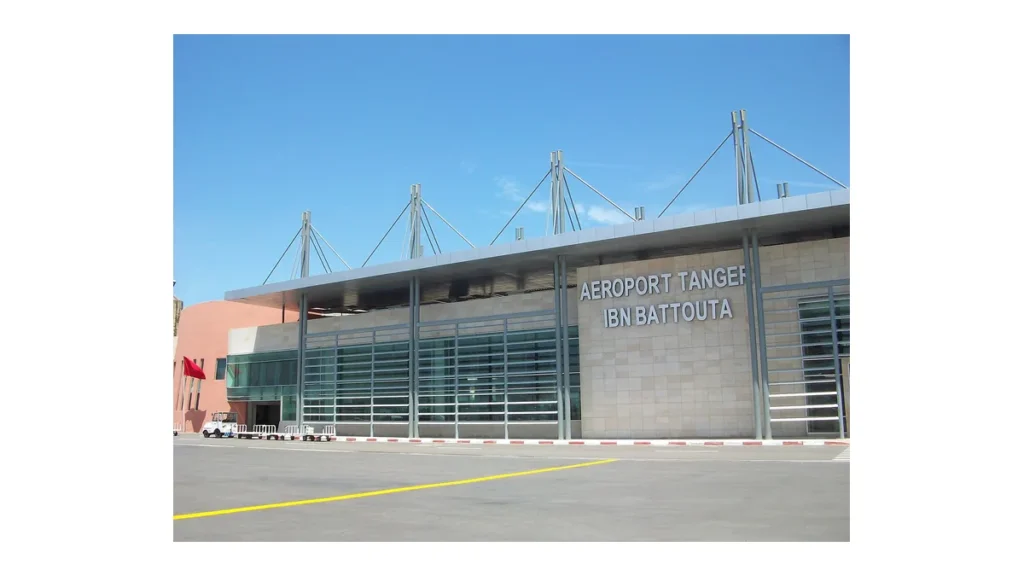
Tangier–Ibn Battouta Airport
Tangier–Ibn Battouta Airport
About
Tangier–Ibn Battouta Airport (IATA: TNG / ICAO: GMTT) serves the northern Moroccan city of Tangier, one of Africa’s most strategically positioned urban centres, sitting at the confluence of the Atlantic Ocean and the Mediterranean Sea, barely 14 kilometres from the European coastline across the Strait of Gibraltar. Named in honour of the celebrated 14th-century Tangerine explorer Ibn Battouta — whose journeys across Africa, Asia, and Europe remain among the most extensive in pre-modern history — the airport functions as a meaningful secondary international gateway for Morocco and a growing node in the broader North African aviation network. For travellers, journalists, and aviation analysts tracking the continent’s infrastructure evolution, TNG offers a compelling case study in how a mid-sized regional airport can leverage geography, tourism growth, and national investment to punch above its weight class.
The airport’s origins trace to the mid-twentieth century, when Tangier’s status as an international zone gave the city an outsized cosmopolitan character and a corresponding need for air connectivity. Commercial operations developed steadily through the post-independence decades, and the facility was progressively upgraded as Tangier transitioned from a faded diplomatic curiosity into a serious industrial and logistics hub, anchored by the Tanger Med port complex — one of Africa’s largest container ports — and the Renault manufacturing plant that opened in the early 2010s. Ownership and operational oversight sit with the Office National des Aéroports (ONDA), Morocco’s national airports authority, which manages the country’s entire civil aviation infrastructure under the supervision of the Ministry of Transport and Logistics.
Significant terminal expansion and airside works were carried out in the years surrounding Morocco’s broader infrastructure push ahead of its co-hosting ambitions for international sporting events. These investments improved passenger processing capacity, modernised baggage handling systems, and enhanced the overall passenger experience at a facility that had previously struggled to absorb peak-season demand from European leisure and diaspora traffic. As of 2026, TNG is classified as a medium-capacity international airport, with ongoing works reflecting ONDA’s stated commitment to aligning Moroccan airport infrastructure with projected growth in both tourism arrivals and cargo throughput.
Country
Morocco is a constitutional monarchy located in the far northwest of the African continent, bordered by Algeria to the east, Mauritania to the south, and the Atlantic and Mediterranean coastlines to the west and north respectively. Its capital is Rabat, though Casablanca functions as the dominant economic and commercial centre. With a population estimated at over 37 million people, Morocco occupies a pivotal regional position as a bridge between sub-Saharan Africa, the Arab world, and Europe — a geographic and cultural duality that shapes its trade relationships, diaspora patterns, and aviation demand in equal measure. The country has pursued an active open-skies policy with the European Union since the mid-2000s, a framework that has materially shaped the route networks of airports including TNG.
→ Read the Morocco expert briefing
Airlines based here
Royal Air Maroc, Morocco’s flag carrier and the dominant force in the country’s aviation market, operates scheduled services through Tangier–Ibn Battouta Airport, though its primary hub is Mohammed V International Airport in Casablanca. At TNG, Royal Air Maroc functions as a significant visiting carrier rather than a true base operator, providing domestic connectivity to Casablanca and select international routes. The low-cost carrier Ryanair has historically maintained one of the strongest operational footprints at TNG among visiting carriers, deploying the airport as a focus city for routes connecting Tangier to multiple European destinations, particularly in Spain, the United Kingdom, Belgium, and Italy — markets with large Moroccan diaspora communities. easyJet and Transavia France have also operated seasonal and year-round services from TNG, reflecting the airport’s importance to the European leisure and visiting-friends-and-relatives (VFR) segment. Iberia Express and Vueling have provided connectivity to Spanish cities given the geographic proximity of Tangier to the Iberian Peninsula. No carrier currently designates TNG as a primary hub in the full network sense, but Ryanair’s volume of rotations makes it the de facto anchor operator for European traffic.
Flights and destinations
The route network at Tangier–Ibn Battouta Airport is weighted heavily toward intra-European and Europe–North Africa corridors, consistent with the airport’s geographic position and the composition of its passenger base. Within Morocco, Casablanca (Mohammed V) provides the principal domestic connection, effectively linking TNG into Royal Air Maroc’s wider African and intercontinental network through a spoke arrangement. Internationally, European destinations that have featured in the airport’s scheduled network include Madrid, Barcelona, Paris (both Charles de Gaulle and Orly), London Stansted, Brussels Charleroi, Milan Bergamo, and Düsseldorf Weeze — many of these served by low-cost carriers targeting diaspora and leisure travellers. Seasonal charter operations expand the European footprint further during summer months. Intercontinental connectivity from TNG itself remains limited; travellers requiring transatlantic or long-haul services typically connect through Casablanca. Within Africa, direct regional connectivity beyond Morocco is sparse at TNG, though industry analysts note that the airport’s catchment area — which extends into northern Morocco’s growing industrial workforce — represents latent demand that could support additional intra-African routes as the continent’s air connectivity agenda advances.
Facilities and capacity
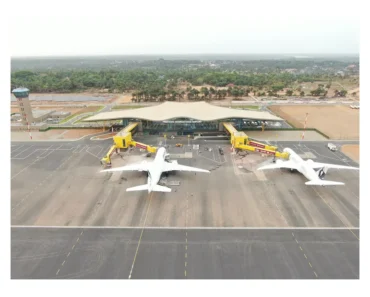
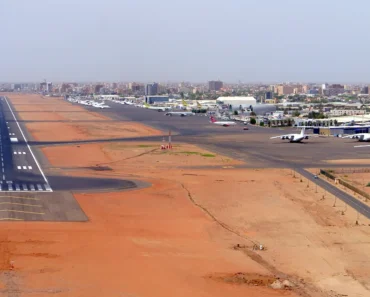
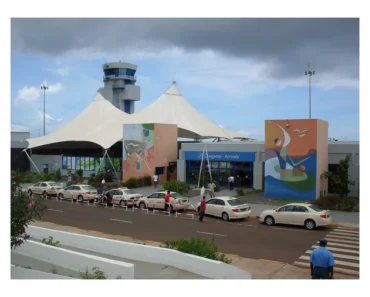
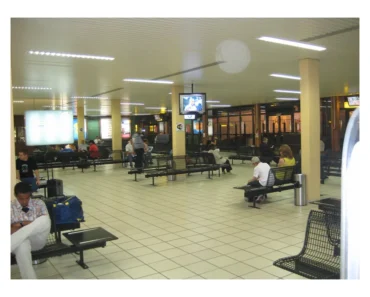
Tangier–Ibn Battouta Airport operates from a single passenger terminal building that has been subject to phased expansion and refurbishment works managed by ONDA. The terminal accommodates both Schengen-adjacent international departures and domestic processing, with separate zones for arriving and departing passengers. The airfield is served by two runways — the primary instrument runway oriented to accommodate the prevailing wind patterns of the northern Moroccan coastal environment — capable of handling narrow-body jet operations that constitute the bulk of TNG’s traffic. Wide-body operations are technically feasible but infrequent given the current route mix. Cargo facilities exist on site, serving light freight and mail operations, though TNG is not positioned as a primary cargo hub; the Tanger Med free zone’s logistics needs are served through a combination of road transport to Casablanca and dedicated freight arrangements. According to publicly disclosed traffic data reviewed by industry observers, TNG handles several million passengers annually, placing it firmly in the medium-hub category within the African context — larger than many regional airports on the continent but significantly smaller than Casablanca’s Mohammed V or Cairo International. Planned capacity enhancements, as referenced in ONDA’s publicly communicated infrastructure roadmap, are intended to accommodate projected growth in both scheduled and charter traffic through the latter part of the 2020s.
Visa regulations
Travellers arriving at Tangier–Ibn Battouta Airport are subject to Morocco’s national visa regime, which is administered by the Ministry of Foreign Affairs and managed at the border by the Direction Générale de la Sûreté Nationale (DGSN). Morocco operates a relatively open visa policy for many major source markets: citizens of the United States, the United Kingdom, and European Union member states are generally permitted to enter Morocco visa-free for stays of up to 90 days, presenting a valid passport at the immigration counter. Many other nationalities — including a growing number of African Union member-state passport holders — benefit from bilateral visa-free or visa-on-arrival arrangements that Morocco has expanded in recent years as part of its South-South cooperation agenda. An eVisa system has been under various stages of development and rollout; travellers should verify current availability for their nationality before travel. It is important to note that visa regulations are subject to change without advance notice, and the information above reflects general policy as understood in early 2026. For a current, nationality-specific lookup, consult the live visa tool at this site.
→ Check live visa requirements for Morocco
Recent developments
In the 24 months leading into 2026, Tangier–Ibn Battouta Airport has seen a number of operationally significant developments consistent with broader trends in Moroccan aviation. Route network activity has reflected the post-pandemic recovery and consolidation phase across North African aviation, with low-cost carriers adjusting frequencies and, in some cases, adding new European city pairs to capture rebounding diaspora and leisure demand. ONDA has continued to advance terminal and airside improvement works at TNG as part of its national airports investment programme, with particular attention to passenger flow management and digital processing infrastructure. Morocco’s successful co-hosting preparations for major international sporting events have accelerated infrastructure investment across the country’s airport network, and TNG has been identified in industry commentary as a secondary relief airport for northern Morocco’s anticipated visitor influx. Regulatory alignment with ICAO standards and IATA operational safety frameworks has remained an ongoing priority for Moroccan civil aviation authorities, with the Moroccan civil aviation authority — Direction Générale de l’Aviation Civile (DGAC Maroc) — publishing updated compliance documentation in line with international audit cycles. New airline interest in TNG has been reported in trade press, though confirmed schedule additions should be verified against current airline booking systems.
News and reports
Researchers and journalists tracking developments at Tangier–Ibn Battouta Airport should consult a layered set of primary and secondary sources. The Office National des Aéroports (ONDA) publishes official press releases, traffic statistics, and infrastructure announcements through its institutional communications channels — ONDA’s official website is the authoritative source for Moroccan airport operational data. The Direction Générale de l’Aviation Civile (DGAC Maroc), operating under the Ministry of Transport and Logistics, issues regulatory notices, safety oversight reports, and air transport policy documents relevant to all Moroccan airports including TNG. At the continental level, IATA’s Africa regional office produces periodic market analysis and connectivity reports that contextualise TNG’s performance within the broader African aviation landscape; these are accessible through IATA’s publications portal. The ICAO Middle East and Africa regional offices publish safety and infrastructure audit summaries that include Moroccan airspace. For real-time route and schedule intelligence, aviation data platforms such as OAG and Cirium are the industry standard, though access typically requires subscription. Moroccan business press outlets and international aviation trade publications including ch-aviation and The Air Current periodically cover significant developments at TNG and the wider Moroccan market.