Air Cairo
Air Cairo
About
Air Cairo occupies a distinctive niche in North African aviation: a scheduled carrier rooted in Egypt’s tourism and leisure economy, operating under IATA code SM and ICAO code MSC, and positioned as a lower-cost complement to the country’s flag carrier on routes where price sensitivity and seat capacity matter most. While it does not command the continental footprint of Ethiopian Airlines or EgyptAir, Air Cairo has carved out a durable role connecting Egyptian gateways to European leisure markets and select regional destinations, making it a carrier worth watching for anyone tracking the evolution of African aviation beyond the headline names.
Air Cairo was established in 2003 as a joint venture with significant EgyptAir involvement, reflecting Cairo’s broader strategy of segmenting its aviation market between a full-service flag carrier and a more commercially agile leisure-oriented operation. The airline is majority-owned by EgyptAir Holding Company, placing it firmly within Egypt’s state-linked aviation ecosystem, though it operates with a degree of commercial independence in route planning and pricing.
Over the years, Air Cairo has evolved from a predominantly charter-focused operation into a scheduled carrier, a transition that reflects wider trends across the African and Mediterranean aviation landscape. In recent corporate terms, the airline has continued to align its strategy with Egypt’s ambitions to grow inbound tourism, particularly following the recovery of the Egyptian travel sector after the disruptions of the early 2020s. No major ownership restructuring has been publicly announced as of early 2026, though EgyptAir Holding’s broader modernisation agenda is understood to encompass its subsidiary carriers.
Bases and Hubs
Cairo International Airport (CAI) — Air Cairo’s principal hub and primary base of operations, serving as the airline’s administrative and operational centre and the departure point for the majority of its scheduled network.
Sharm el-Sheikh International Airport (SSH) — A critical focus city for the airline given the resort destination’s heavy reliance on leisure traffic from Europe, and one of the busiest points in Air Cairo’s operational schedule during peak tourism seasons.
Hurghada International Airport (HRG) — A second major Red Sea resort gateway that anchors Air Cairo’s leisure-market proposition, particularly for travellers originating in Central and Eastern Europe.
Luxor International Airport (LXR) — Serves as a secondary focus city connecting Egypt’s Upper Nile cultural tourism corridor to international markets, with Air Cairo providing seasonal and scheduled services.
Fleet
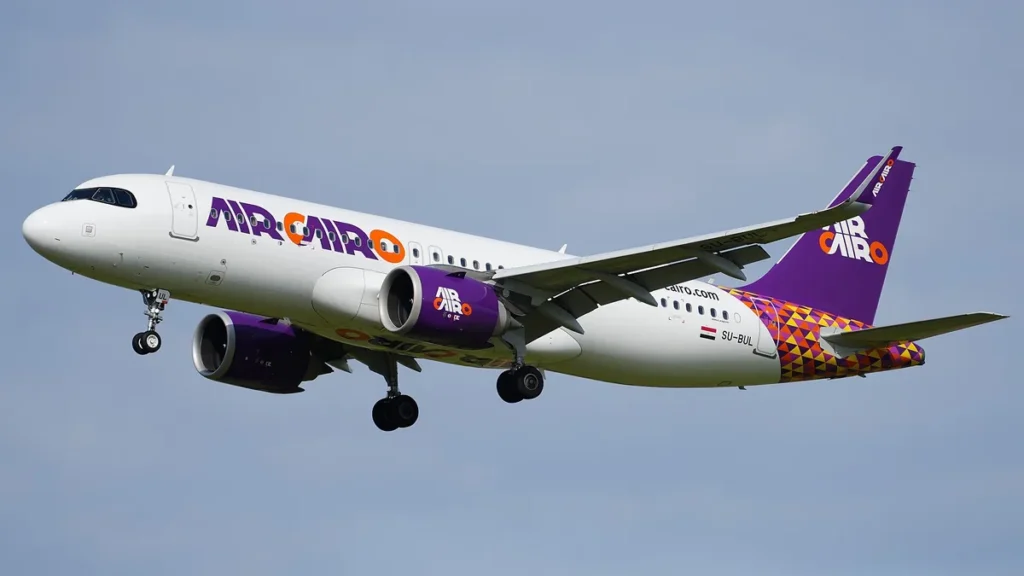
Air Cairo operates a narrowbody fleet centred on the Airbus A320 family, which provides the range, fuel efficiency, and cabin flexibility suited to its mix of short-to-medium-haul leisure and scheduled routes. According to publicly disclosed fleet data and industry tracking sources, the airline’s operational aircraft are predominantly A320-series jets, with the type’s commonality offering maintenance and crew scheduling advantages within the broader EgyptAir group ecosystem. Industry estimates suggest the fleet has remained relatively modest in size compared to larger African carriers, consistent with Air Cairo’s focused network strategy. No major widebody acquisition programme has been publicly confirmed as of early 2026, though the airline’s parent group has signalled interest in fleet modernisation across its subsidiaries in line with Egypt’s civil aviation development targets.
Destinations
Air Cairo’s network is shaped primarily by the demand corridors between Egypt’s leisure gateways and European source markets, with secondary coverage of regional Middle Eastern and Arab world destinations. The airline’s European routes form the commercial backbone of its schedule, with services to cities including Rome, Milan, Moscow, Warsaw, Prague, and a range of other Central, Eastern, and Southern European points that generate strong inbound tourism flows to the Red Sea and Nile Valley. Within the Arab region, Air Cairo serves select Gulf and Levant destinations, complementing EgyptAir’s fuller regional network rather than competing directly with it. Intra-African connectivity beyond North Africa remains limited, reflecting the airline’s leisure-market orientation rather than a pan-African network ambition. Seasonal frequency adjustments are a defining feature of the operation, with capacity ramping significantly during European winter sun and summer holiday periods.
Codeshare and Alliance
Air Cairo is not a member of any of the three major global airline alliances — Star Alliance, SkyTeam, or oneworld — and operates as an independent scheduled carrier in alliance terms. Its most significant commercial relationship is with its parent, EgyptAir, which is itself a Star Alliance member; this group relationship provides indirect connectivity benefits and some degree of interline cooperation, though Air Cairo does not carry Star Alliance branding or benefits in its own right. Formal codeshare arrangements with third-party carriers have not been widely publicised, and the airline’s commercial model has historically prioritised direct sales and tour-operator partnerships over interline network building. Investors and analysts tracking the carrier should note that any future alliance affiliation or expanded codeshare strategy would represent a meaningful strategic shift.
Notable Incidents
Air Cairo does not have major incidents prominently documented on its public safety record in recent years. No significant hull losses or fatal accidents attributable to the carrier appear in widely referenced aviation safety databases for the period covering its scheduled operations. As with any assessment of airline safety, readers are encouraged to consult authoritative sources such as the Aviation Safety Network and the Egyptian Civil Aviation Authority for the most current and complete regulatory record.
Financial and Operational Situation
As a subsidiary of the state-linked EgyptAir Holding Company, Air Cairo does not publish standalone audited financial results in the public domain, making precise profitability assessments difficult for external observers. Qualitatively, the airline’s financial health is understood to be closely tied to the performance of Egypt’s inbound tourism sector, which has shown meaningful recovery momentum since the mid-2020s following years of volatility driven by geopolitical uncertainty and the global pandemic. The Egyptian pound’s depreciation cycle has created a complex operating environment, compressing purchasing power for Egyptian outbound travellers while potentially improving price competitiveness for inbound leisure routes priced in foreign currencies. Industry observers note that state ownership provides a degree of financial insulation but also introduces constraints on the pace of commercial decision-making and fleet investment. Operational efficiency improvements tied to the broader EgyptAir group modernisation agenda are reported to be ongoing.
Recent Developments
In the 24 months leading into early 2026, Air Cairo’s most consequential developments have centred on network recovery and selective expansion into European leisure markets where demand for Egyptian resort destinations has rebounded strongly. The airline has been reported to be evaluating fleet renewal options consistent with the Airbus A320neo family, which would align it with wider industry trends toward more fuel-efficient narrowbody operations and reduce per-seat operating costs on its core routes. Egypt’s broader aviation regulatory environment has seen increased attention from the Egyptian Civil Aviation Authority as the government pursues its tourism growth targets, creating both opportunity and compliance obligations for carriers like Air Cairo. Partnership discussions with European tour operators have reportedly intensified as the leisure travel market restructures post-pandemic, with Air Cairo positioned as a capacity provider of choice for certain Red Sea itineraries. Observers will be watching whether the airline moves to formalise any expanded codeshare or interline arrangements that would broaden its commercial reach beyond its current direct-sales model.