Trans Air Congo
Trans Air Congo
About
Trans Air Congo is the Republic of the Congo’s principal scheduled carrier, operating out of Maya-Maya Airport in Brazzaville (BZV) and serving as one of the few commercially active airlines registered in a country whose aviation sector remains underdeveloped relative to the broader Central African region. Carrying the IATA designator Q8 and ICAO code TSG, the airline occupies a niche but strategically important position in a market where demand for reliable air connectivity — both domestically and across the Congo Basin — consistently outpaces supply.
Trans Air Congo was established in the 1990s, emerging during a period of gradual economic liberalisation in the Republic of the Congo following years of political instability. The airline was founded with a mandate to serve domestic routes that surface transport — hampered by the country’s dense equatorial forest and limited road infrastructure — cannot reliably cover. Ownership has historically reflected a mixed public-private structure, though the precise composition of its shareholding has not been consistently disclosed in public filings. Industry observers note that the airline has operated with varying degrees of government support over the decades, a pattern common among smaller Central African carriers.
In recent years, Trans Air Congo has undergone quiet but notable corporate repositioning, seeking to stabilise operations and expand its regional footprint beyond the domestic market. The airline has faced the structural pressures familiar to small African carriers: currency volatility, high fuel costs denominated in hard currency, thin load factors on secondary routes, and the challenge of maintaining airworthiness standards that satisfy both the Congolese civil aviation authority and the requirements of international partners.
Bases and Hubs
Brazzaville – Maya-Maya Airport (BZV): The airline’s principal hub and administrative base, BZV serves as the gateway to the Republic of the Congo’s capital and the primary origin point for both domestic and regional services.
Pointe-Noire Airport (PNR): The country’s second city and its commercial and oil-industry hub, Pointe-Noire functions as a key focus city for Trans Air Congo, anchoring the airline’s most commercially significant domestic trunk route.
Fleet
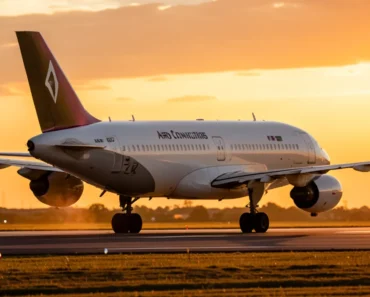
According to publicly disclosed fleet data and industry tracking sources, Trans Air Congo has historically operated a modest fleet of narrowbody and turboprop aircraft suited to the short-sector, lower-frequency operations that characterise its network. Aircraft types associated with the carrier have included Boeing 737 series variants, which provide the capacity and range needed for regional African routes, alongside smaller turboprop equipment used on thinner domestic sectors where jet economics are difficult to justify. Industry estimates suggest the operational fleet remains compact — as is typical for carriers of this scale in the Central African market. No major publicly announced fleet order or wide-body acquisition has been confirmed as of early 2026, though the airline has signalled interest in fleet modernisation to meet evolving ICAO emissions and noise standards.
Destinations
Trans Air Congo’s network is primarily shaped around domestic connectivity within the Republic of the Congo, with Brazzaville and Pointe-Noire forming the backbone of its schedule. Beyond the domestic market, the airline operates regional services to select Central and West African destinations, reflecting both commercial demand and bilateral air services agreements. Key regional routes have historically included services to Kinshasa (FIH) — just across the Congo River, making it one of the world’s shortest international routes by distance — as well as connections into other francophone Central African capitals. The airline does not currently operate intercontinental services; its network is best understood as a regional feeder and domestic lifeline carrier rather than a long-haul operator.
Codeshare and Alliance
Trans Air Congo is not a member of any of the three major global airline alliances — Star Alliance, SkyTeam, or oneworld. The airline has not publicly disclosed active codeshare agreements with major international carriers as of early 2026. This is consistent with its operational profile as a domestic and sub-regional carrier; formal interline and codeshare arrangements, where they exist, are likely to be bilateral and commercially modest in scope. Travellers connecting onward from Brazzaville to intercontinental services typically do so through carriers operating at BZV independently, including Air France and other regional operators serving the route.
Notable Incidents
Trans Air Congo does not have a prominent recent safety incident on its publicly available record that can be cited with confidence and full attribution. Researchers and journalists requiring a comprehensive safety history should consult the Aviation Safety Network (ASN) database and the Bureau d’Enquêtes et d’Analyses (BEA) records, as well as the Congolese civil aviation authority’s published findings, rather than relying on secondary sources. As with all carriers operating in the Central African environment, adherence to ICAO safety oversight standards and the outcomes of USOAP audits of the national civil aviation authority are relevant contextual factors for any safety assessment.
Financial and Operational Situation
Trans Air Congo’s financial profile is not publicly disclosed in detail, and no audited accounts are available in the open domain as of early 2026. Qualitatively, the airline operates in one of the more challenging commercial environments in sub-Saharan Africa: the Republic of the Congo’s economy is heavily dependent on oil revenues, which creates both opportunity (business travel demand from the energy sector, particularly on the BZV–PNR corridor) and vulnerability (currency and fiscal instability when commodity prices fall). Industry observers characterise the airline as a carrier that has historically relied on a combination of commercial revenue and implicit state support to sustain operations. Profitability, in the conventional sense, is difficult to assess without disclosed financials, but the airline’s continued operation across multiple decades is itself an indicator of structural resilience, however fragile.
Recent Developments
In the 24 months to early 2026, Trans Air Congo has continued to navigate the post-pandemic normalisation of African aviation demand, which has seen passenger volumes recover unevenly across the continent. The airline has maintained its core domestic schedule and has explored opportunities to deepen regional connectivity as Central African governments push for improved intra-regional air links under the Single African Air Transport Market (SAATM) framework. Regulatory engagement with the Congolese civil aviation authority has remained an ongoing operational consideration, particularly as ICAO’s Africa-Indian Ocean (AFI) regional office has intensified oversight of smaller national carriers. No major new route launches or confirmed fleet orders have been publicly announced in this period, though the airline’s management has indicated awareness of the need to modernise operations to remain competitive as larger regional carriers extend their networks into Brazzaville.