Air Tanzania
Air Tanzania
About
Air Tanzania Company Limited (IATA: TC / ICAO: ATC) is Tanzania’s national flag carrier and the country’s primary instrument of scheduled commercial aviation. Operating from its principal hub at Julius Nyerere International Airport in Dar es Salaam (DAR), the airline connects one of East Africa’s largest economies to regional neighbours and an expanding roster of intercontinental destinations. In a continent where flag carriers have historically struggled with financial sustainability, Air Tanzania occupies a strategically significant position: a state-backed airline in a country whose tourism sector — anchored by Kilimanjaro, the Serengeti, and Zanzibar — generates consistent long-haul demand that the carrier is increasingly positioned to capture.
Air Tanzania traces its origins to 1977, when it was established following the dissolution of East African Airways, the tripartite carrier shared by Tanzania, Kenya, and Uganda. For much of its early history the airline operated as a modest domestic and regional carrier, hampered by ageing equipment, thin capitalisation, and the structural challenges common to state-owned enterprises across the continent. A period of partial privatisation in the early 2000s — involving a partnership with South African Airways Technical — yielded limited results, and the airline was effectively renationalised and restructured in the years that followed.
The most consequential turning point came in the mid-2010s under the administration of the late President John Magufuli, when the Tanzanian government committed substantial public capital to a fleet renewal programme and a strategic repositioning of the airline as a genuine intercontinental carrier. That ambition has continued under subsequent leadership, with the Tanzanian government retaining full ownership of the airline and treating it as a matter of national economic policy rather than purely a commercial enterprise.
Bases and Hubs
Julius Nyerere International Airport, Dar es Salaam (DAR) — The airline’s primary hub and operational centre, handling the majority of Air Tanzania’s international and domestic departures and serving as the main maintenance base.
Kilimanjaro International Airport (JRO) — A secondary focus city serving the northern tourism circuit, with connections to Arusha and acting as a gateway for safari and Kilimanjaro-bound travellers.
Abeid Amani Karume International Airport, Zanzibar (ZNZ) — A key domestic and regional node, reflecting the island’s outsized importance to Tanzania’s inbound tourism economy and its growing appeal to international leisure carriers.
Fleet
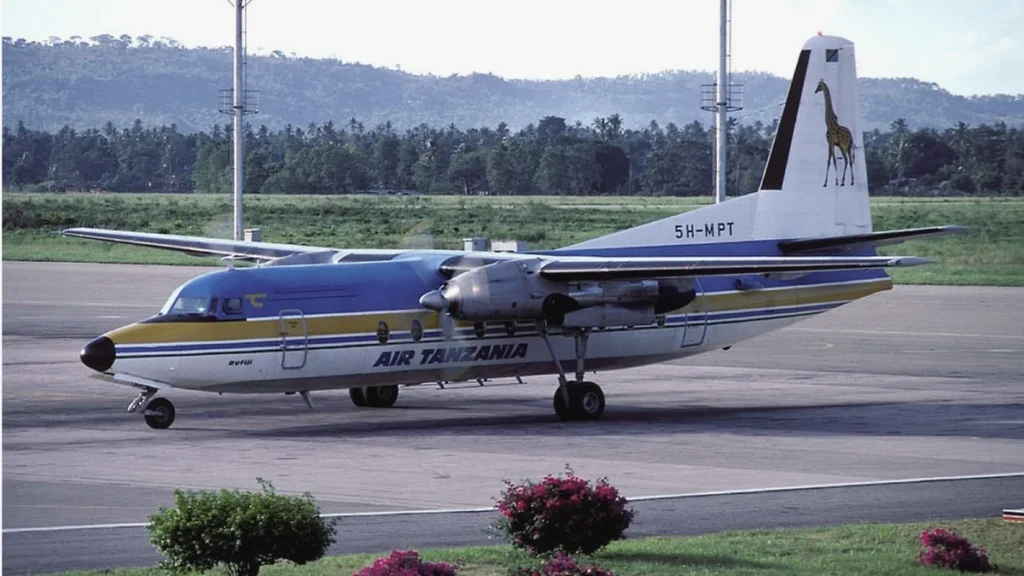
Air Tanzania operates a mixed fleet that reflects its dual mandate of serving thin domestic routes and competing on long-haul intercontinental corridors. According to publicly disclosed fleet data, the airline’s widebody intercontinental capability is provided by Boeing 787 Dreamliner aircraft, which were central to the government’s fleet renewal push and enabled the airline’s expansion beyond Africa for the first time in its modern history. Narrowbody and medium-range operations are supported by Boeing 737 series aircraft, which handle the bulk of regional African and domestic flying. For thinner domestic routes — including connections to smaller Tanzanian airstrips — the airline has operated turboprop equipment suited to shorter runways and lower passenger volumes. Industry observers have noted that fleet standardisation and maintenance capacity remain ongoing operational considerations for the carrier as it seeks to improve reliability metrics.
Destinations
Air Tanzania’s network spans three broad tiers. Domestically, the airline serves a range of Tanzanian cities and island destinations, providing connectivity that is often the only viable alternative to road travel in a geographically large country. Regionally, the carrier links Dar es Salaam to key East and Central African hubs including Nairobi (NBO), Entebbe (EBB), Lusaka (LUN), and Harare (HRE), competing with carriers such as Kenya Airways and Ethiopian Airlines on some of the continent’s busiest corridors. At the intercontinental level — the most strategically ambitious tier — Air Tanzania has operated services to destinations including Mumbai (BOM) in South Asia and Guangzhou (CAN) in China, routes that reflect both Tanzania’s trade relationships and the government’s foreign policy priorities. The airline has also operated or explored services to European markets, where demand from the Tanzanian diaspora and inbound tourism provides a commercial rationale. The network’s shape is deliberately outward-looking, though load factor performance on longer routes remains a subject of industry scrutiny.
Codeshare and Alliance
Air Tanzania is not a member of any of the three major global airline alliances — Star Alliance, SkyTeam, or oneworld. The airline has pursued bilateral codeshare and interline arrangements as its primary mechanism for extending network reach and feeding traffic onto its longer routes. Partnership discussions with regional carriers have been reported periodically, and the airline’s intercontinental ambitions make alliance affiliation or deeper bilateral agreements a logical strategic consideration for the medium term. Travellers and travel agents should verify current interline ticketing arrangements directly with the airline or through GDS platforms, as the commercial partnership landscape has evolved alongside the carrier’s network expansion.
Notable Incidents
Air Tanzania does not have major hull-loss or fatal accident events prominently documented in its recent operational history under its current restructured form. The airline’s safety oversight falls under the Tanzania Civil Aviation Authority (TCAA). As with any assessment of airline safety, readers are directed to the Aviation Safety Network database and ICAO audit disclosures for the most current and authoritative information. No specific incidents are cited here in the absence of independently verified, publicly documented records.
Financial and Operational Situation
Air Tanzania operates as a wholly state-owned enterprise, and its financial position is closely tied to the Tanzanian government’s willingness to provide capital support. Industry estimates suggest the airline has not consistently achieved commercial profitability, a pattern common among African flag carriers that are expected to serve developmental and connectivity objectives alongside commercial ones. The government’s substantial investment in new Boeing 787 aircraft represented a significant balance-sheet commitment, and the airline’s ability to generate sufficient revenue on its long-haul routes to service those obligations is a key variable watched by aviation analysts. Operationally, the carrier has made measurable progress in schedule reliability and network breadth compared to its pre-renewal era, though it continues to face competitive pressure from better-capitalised regional peers such as Ethiopian Airlines and Kenya Airways. Transparency around financial reporting remains limited relative to publicly listed carriers, making independent assessment of profitability trends difficult.
Recent Developments
In the 24 months leading into 2026, Air Tanzania has continued to consolidate the network expansion that defined its previous strategic phase. The airline has pursued additional regional African routes as part of a broader effort to build a viable feeder network for its widebody intercontinental services, recognising that long-haul profitability depends heavily on connecting traffic. Discussions around potential new European destinations have been reported in Tanzanian aviation and business media, reflecting sustained government interest in direct links to source markets for tourism. Fleet utilisation and on-time performance have been areas of management focus following earlier operational disruptions. The airline has also engaged with digital distribution modernisation, improving its presence on global booking platforms. Regulatory engagement with the TCAA and alignment with IATA standards have continued as the carrier seeks to strengthen its international commercial credibility. Investors and partners considering engagement with the airline are advised to monitor official Tanzanian government communications and IATA membership status updates for the most current operational picture.