Royal Museum of Benin (Edo Museum of West African Art)
Royal Museum of Benin (Edo Museum of West African Art)
About
The Edo Museum of West African Art — formally known as the Royal Museum of Benin — is one of the most anticipated cultural institutions on the African continent. Still in development as of 2025, it is being built in Benin City, Nigeria, as the designated future home of the Benin Bronzes: thousands of brass plaques, ivory carvings, and royal regalia looted by British forces during the Punitive Expedition of 1897. When it opens, it will represent not only a landmark in African museology but a significant moment in the long global reckoning over colonial-era cultural property.
The museum’s origins lie in a convergence of advocacy, diplomacy, and institutional pressure that gathered pace through the 2010s and accelerated sharply after 2020. The Benin Dialogue Group — a consortium involving the Benin Royal Court, the Edo State Government, and major European holding institutions including the British Museum, the Humboldt Forum, and several Dutch and German museums — provided the framework within which the new institution was conceived. The goal was to create a world-class facility in Benin City capable of receiving, housing, and interpreting returned objects on Nigerian soil.
The project is overseen by the Legacy Restoration Trust, a Nigerian body established to manage the museum’s development and governance. No single founding director has been publicly confirmed as of early 2025, though the Trust works in close coordination with the Oba of Benin’s palace and the Edo State Government. The museum is designed to function as both a royal cultural institution and a public research centre, serving scholars, diaspora communities, and international visitors alike.
Country and city context
Nigeria is Africa’s most populous nation and its largest economy by GDP, a country of extraordinary cultural plurality with more than 250 ethnic groups and a creative and intellectual tradition that spans millennia. Benin City, capital of Edo State in the south-south region, was the seat of the Benin Kingdom — one of the most sophisticated pre-colonial states in West Africa, renowned for its court art, its administrative complexity, and its centuries-long engagement with European traders. Today the city is a busy commercial and educational hub of roughly 1.5 million people, with a strong sense of historical identity rooted in the legacy of the Oba and the royal court. For any visitor with an interest in African history, art, or politics, it is an essential destination. → Read the Nigeria expert briefing
Collection highlights
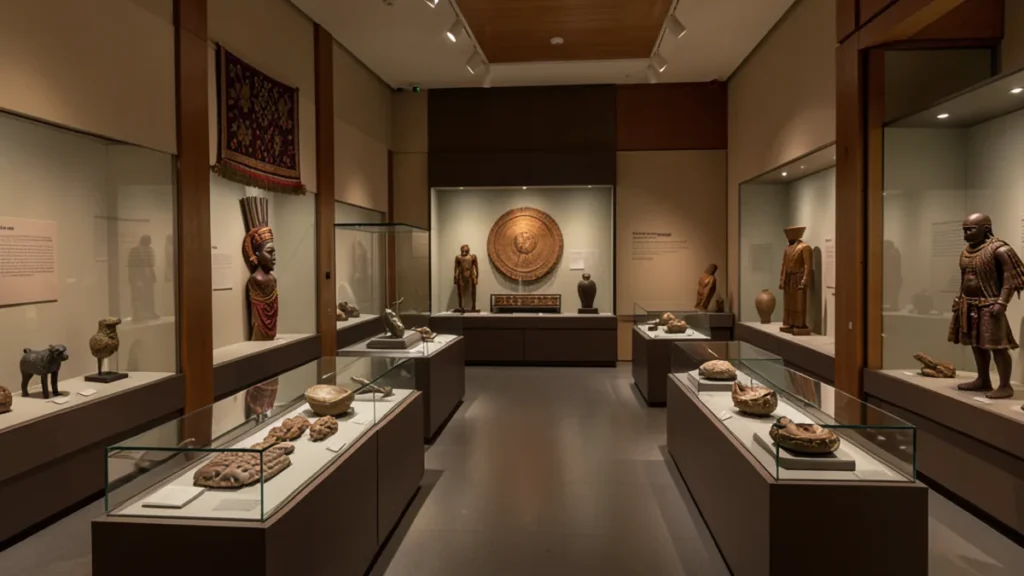
The museum’s permanent collection will be built around objects returned from European institutions, supplemented by works already held in Nigeria. While the full display programme has not been finalised, the following categories of object are central to the museum’s identity and mission:
- Benin brass plaques: Rectangular cast-brass panels that once lined the pillars of the Oba’s palace, depicting court ceremonies, warriors, and Portuguese traders — among the most technically accomplished works of African metalwork.
- Queen Idia ivory mask: A carved ivory pendant mask associated with the mother of Oba Esigie, now an icon of African art and the emblem of Nigeria’s FESTAC festival — versions are held in London and New York; repatriation of such pieces remains a live discussion.
- Royal brass heads: Cast memorial heads placed on ancestral altars of deceased Obas, combining spiritual function with extraordinary sculptural refinement.
- Ivory leopards: Paired ceremonial figures that symbolise royal power, originally displayed in the Oba’s throne room.
- Benin bronzes from German collections: Objects transferred from institutions including the Ethnologisches Museum Berlin and museums in Stuttgart and Dresden form part of the first wave of confirmed returns.
- Court narrative reliefs: Large plaques recording historical events and diplomatic encounters, functioning as a visual archive of the kingdom’s political history.
Architecture and building
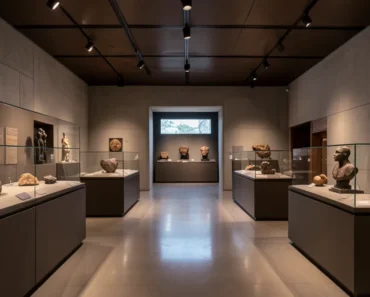
The museum building is designed by Sir David Adjaye, the Ghanaian-British architect responsible for the Smithsonian National Museum of African American History and Culture in Washington D.C. Adjaye’s design for the Edo Museum of West African Art draws on the geometry and spatial logic of traditional Benin court architecture, incorporating open courtyards and layered facades intended to evoke the compound structures of the royal palace. The building is sited in Benin City on land adjacent to the historic palace precinct. Construction was underway as of 2024, with an opening date not yet officially confirmed at the time of writing. The project has been described as one of the most significant new museum commissions in Africa in a generation.
Visiting practical
The Edo Museum of West African Art is not yet open to the public as of early 2025. When it does open, it will be located in central Benin City, Edo State, Nigeria, within reach of the Oba’s Palace and the existing Benin City National Museum on Ring Road. Visitors planning ahead should note that Benin City is served by Benin Airport (BNI), with connections to Lagos and Abuja. Ticket pricing has not been announced; entry fees at comparable new African institutions typically fall in a low-to-mid band, with concessions for students and local residents. Accessibility provisions are expected to meet international standards given the building’s contemporary design brief. Travellers are advised to check the Legacy Restoration Trust’s official communications for opening announcements.
Repatriation and debates
The Edo Museum of West African Art exists, in the most direct sense, because of the repatriation debate — and it sits at the centre of it. The Benin Bronzes were taken during a punitive military expedition in 1897 and dispersed across European and American collections over the following century. Calls for their return, led by the Benin Royal Court and Nigerian cultural advocates, intensified from the 1970s onward. The debate sharpened considerably after 2018, when the Sarr-Savoy report commissioned by the French government recommended broad restitution of African cultural heritage. Germany moved decisively: in 2022, the German government transferred legal ownership of more than 1,100 Benin objects to Nigeria, with physical returns beginning that year. Other institutions, including the Horniman Museum in London, followed. The British Museum, which holds the largest single collection of Benin material outside Nigeria, has not transferred ownership, citing the constraints of the British Museum Act 1963 — a legal and political impasse that remains unresolved. The question of whether objects returned to Nigeria are the property of the federal government, Edo State, or the Oba’s palace has also generated internal debate, reflecting the complexity of post-colonial cultural governance. The new museum is intended to provide a resolution framework, but the conversations it has sparked are far from over.
Recent developments
Between 2023 and 2025, the museum project maintained significant momentum. Physical returns of Benin objects from German federal and state institutions continued, with objects entering temporary storage in Nigeria ahead of the museum’s completion. The Legacy Restoration Trust engaged in ongoing negotiations with additional European holding institutions. In 2024, discussions between the Nigerian government and the British Museum over long-term loan arrangements — a proposed alternative to outright return — attracted considerable press attention and criticism from repatriation advocates who argued that loans do not constitute genuine restitution. Construction on the Adjaye-designed building progressed through 2024, with updated renderings released publicly. The museum’s development has also prompted renewed investment in Benin City’s broader cultural infrastructure, including conservation work at the Oba’s Palace complex.