Zeitz MOCAA
Zeitz MOCAA
About
Zeitz MOCAA — the Zeitz Museum of Contemporary Art Africa — opened in Cape Town in September 2017 and immediately established itself as the largest museum dedicated to contemporary art from Africa and its diaspora anywhere in the world. Its arrival marked a significant shift in the global art conversation: for the first time, a major institutional space of this scale was built specifically to collect, preserve, and exhibit work made by African artists on their own terms, rather than as a footnote to Western collections.
The museum was founded through a partnership between Jochen Zeitz, the German businessman and former CEO of Puma, and the V&A Waterfront, the mixed-use development company that manages Cape Town’s historic harbour precinct. Zeitz donated a substantial portion of his personal collection — assembled over roughly two decades and widely regarded as one of the most significant private holdings of contemporary African art — as the founding gift. The museum operates as a non-profit public institution, a point its founders have emphasised in response to questions about the relationship between private wealth and public cultural infrastructure.
Mark Coetzee served as the museum’s founding Executive Director and Chief Curator, playing a central role in shaping its programmatic identity and acquisition strategy. Leadership has evolved since the opening years, with the institution working to broaden its curatorial voice and deepen engagement with artists and communities across the continent and its diaspora.
Country and city context
South Africa occupies a singular position on the continent — a country of extraordinary cultural complexity, deep economic inequality, and a post-apartheid democratic project that remains very much in progress. Cape Town, its legislative capital and most-visited city, sits at the southwestern tip of the continent beneath the flat-topped profile of Table Mountain. The city is a major hub for tourism, finance, and the creative industries, but it also carries some of the starkest spatial and economic divisions inherited from apartheid-era planning. The V&A Waterfront, where Zeitz MOCAA is located, sits within one of the city’s most internationally connected and commercially developed zones, a fact that shapes both the museum’s accessibility and the critiques directed at it. → Read the South Africa expert briefing
Collection highlights
The permanent collection spans painting, sculpture, photography, video, and installation, with particular depth in work produced from the 1990s onward. Among the areas and works that have drawn consistent critical attention:
- Works by El Anatsui, the Ghanaian sculptor known for large-scale tapestries assembled from bottle caps and metal fragments — pieces that address consumption, trade, and African material history simultaneously.
- Photography and video work engaging directly with post-apartheid South African identity, including pieces that sit in dialogue with the country’s Truth and Reconciliation process.
- A dedicated Centre for the Moving Image, housing film and video works from across the continent that are rarely given institutional space at this scale.
- Rotating gallery presentations drawn from the Zeitz collection that place artists from North Africa, West Africa, East Africa, and the diaspora in conversation with one another, resisting the tendency to treat “African art” as a monolithic category.
- Works by Wangechi Mutu, the Kenyan-American artist whose collage and sculpture practice interrogates the female body, colonialism, and mythology.
Visitors should note that, as with many contemporary art museums, specific works rotate and not all pieces are on permanent display. Checking the museum’s current exhibition schedule before visiting is advisable.
Architecture and building
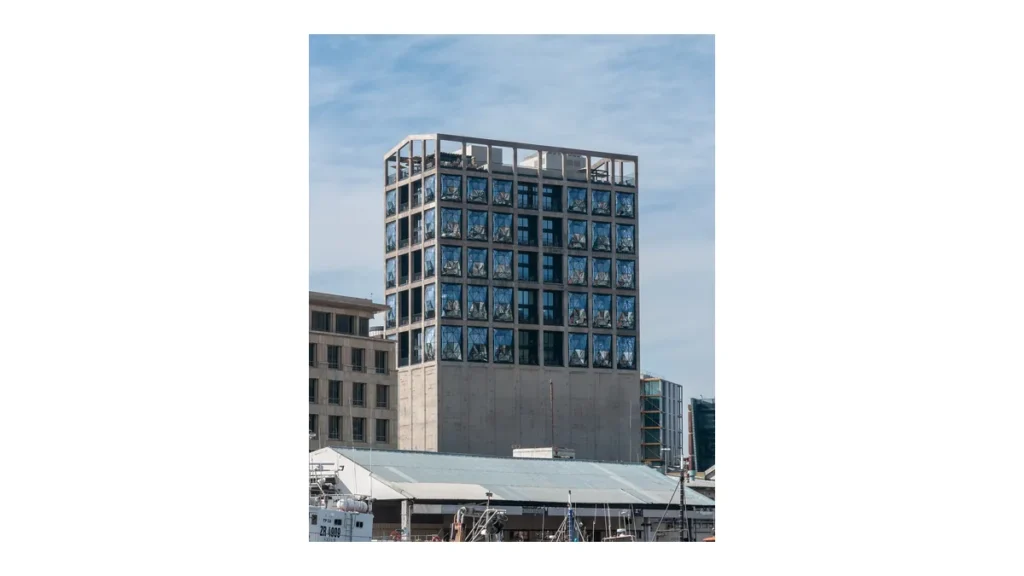
The building is one of the most discussed adaptive reuse projects in recent African architectural history. The structure is a former grain silo complex built in the 1920s on the Cape Town waterfront — a brutalist industrial form consisting of 42 cylindrical concrete tubes that once stored grain for export. The conversion was designed by the London-based firm Heatherwick Studio, led by Thomas Heatherwick. The central design move involved carving a cathedral-like atrium through the cores of the cylinders, creating a dramatic interior volume of curved concrete that floods with natural light. The museum opened in this form in September 2017. The building contains approximately 6,000 square metres of gallery space across nine floors, along with a rooftop sculpture garden with views across the harbour and toward Table Mountain.
Visiting practical
Zeitz MOCAA is located within the Silo District of the V&A Waterfront in central Cape Town, easily reachable by taxi, ride-share, or the MyCiTi bus network. The museum is generally open most days of the week, with reduced hours on certain public holidays; visitors should confirm current opening times directly with the museum before travel, as hours have varied since the post-pandemic reopening period. Ticket prices fall in the mid-range band for Cape Town cultural attractions — broadly comparable to major city museums internationally, with concession rates typically available for students and children. The building has lift access to all gallery floors and is considered broadly accessible for visitors with mobility requirements, though the curved interior architecture means some spaces have unusual floor surfaces. Guided tours are available and recommended for first-time visitors navigating the non-linear layout.
Repatriation and debates
Zeitz MOCAA’s position in repatriation debates is distinct from that of ethnographic museums holding colonial-era objects. Its collection is composed of contemporary work acquired through the art market and direct relationships with living artists, rather than objects removed from communities during the colonial period. This means the institution does not face the same category of repatriation claims directed at, for example, European natural history or ethnographic museums holding Benin Bronzes or ancestral remains. However, the museum is not without controversy. Critics — including African artists, curators, and cultural commentators — have raised substantive questions about who controls the narrative of African contemporary art when that narrative is anchored in a private collection assembled by a European collector, housed in a commercially developed waterfront precinct, and priced in ways that limit access for many South Africans. These are not repatriation debates in the strict legal sense, but they are genuine questions about cultural ownership, representation, and whose vision of African art gets institutionalised. The museum has acknowledged some of these tensions publicly and has made efforts to diversify its curatorial leadership and community programming, though debate continues.
Recent developments
In the period from 2023 to 2025, Zeitz MOCAA has continued to expand its exhibition programme with a focus on artists from across the continent who have historically received less institutional attention than those based in South Africa or represented by major international galleries. The museum has hosted several large-scale solo and thematic exhibitions during this period, including presentations engaging with ecology, the body, and African futures as curatorial themes. Leadership and governance conversations have continued, reflecting broader sector-wide discussions about the role of founding donors in shaping institutional direction over the long term. The museum has also worked to develop its education and public programming offer, with an emphasis on reaching younger audiences and school groups from communities across Cape Town, including those outside the immediate Waterfront area.